Cicero Epoxy Flooring has spent more than 20 years on epoxy flooring in Wood Dale and across the western suburbs, and the work here includes a floor most customers never see. Under a raised access floor, the concrete slab is still a floor that needs care, even when nobody walks on it. We treat it as a surface with a job to do.
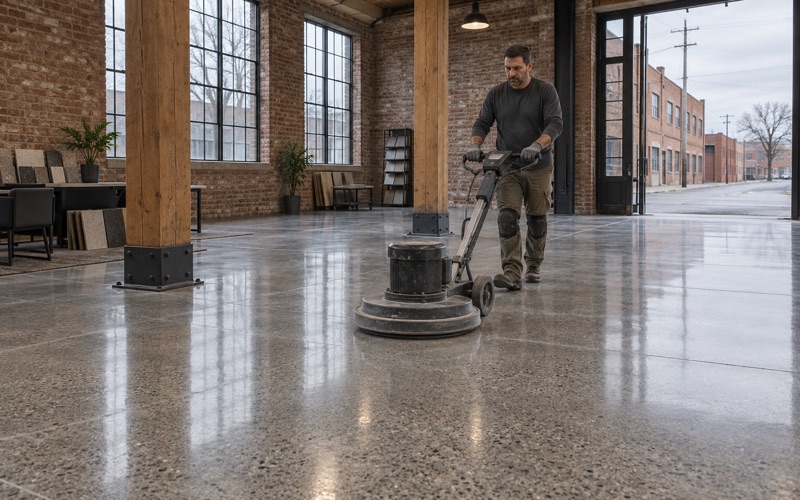
That job is to stay clean and intact while air moves across it. We open the concrete mechanically with a diamond grinder or shot blaster, never an acid etch, so a sealer or thin coating bonds to sound material instead of a weak skin. That bond is what keeps the surface from shedding into the air later.
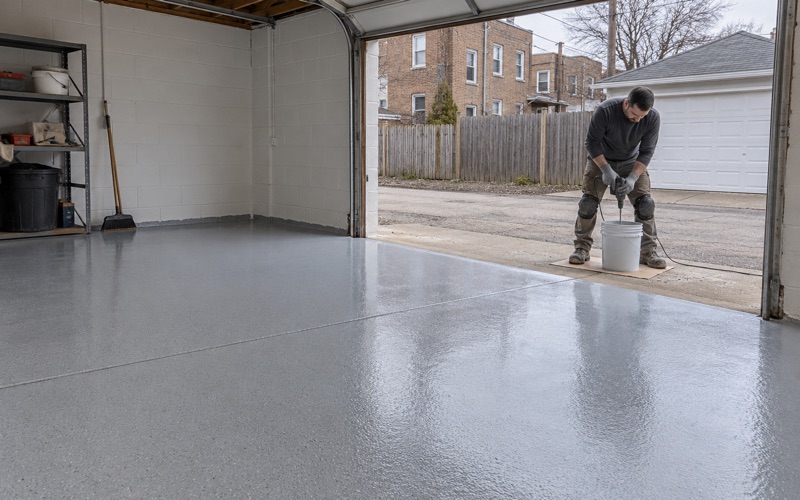
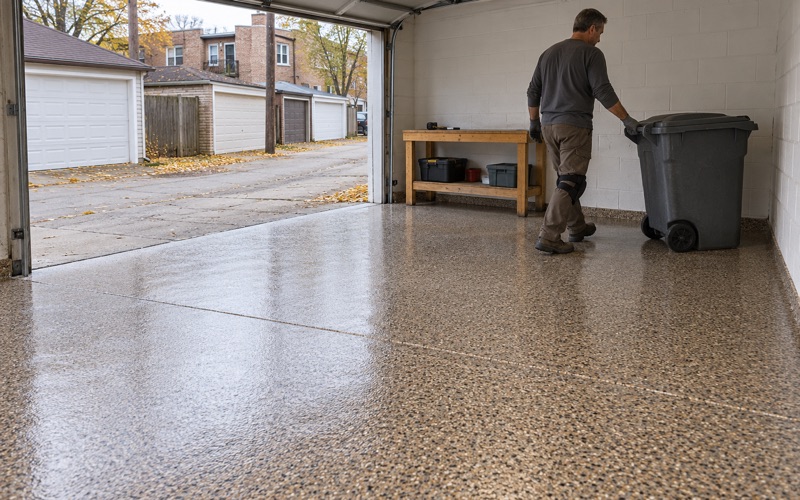
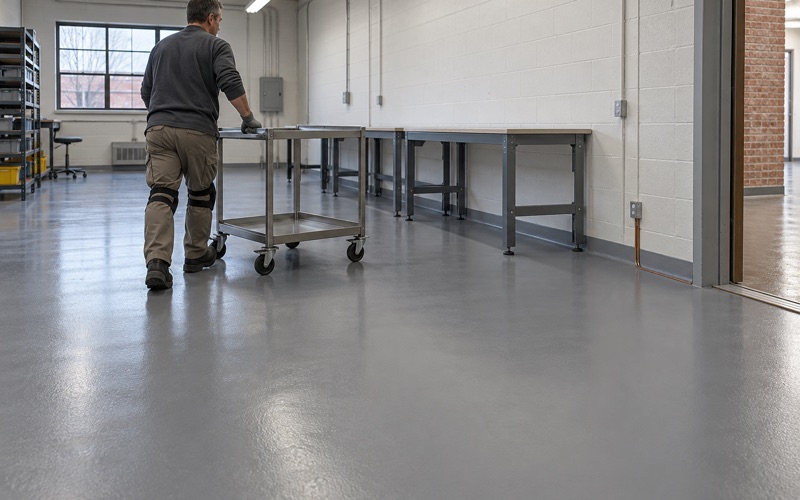
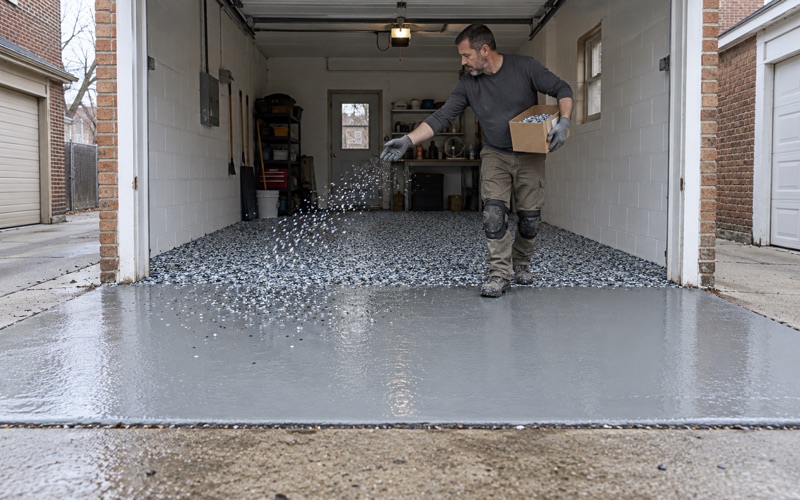
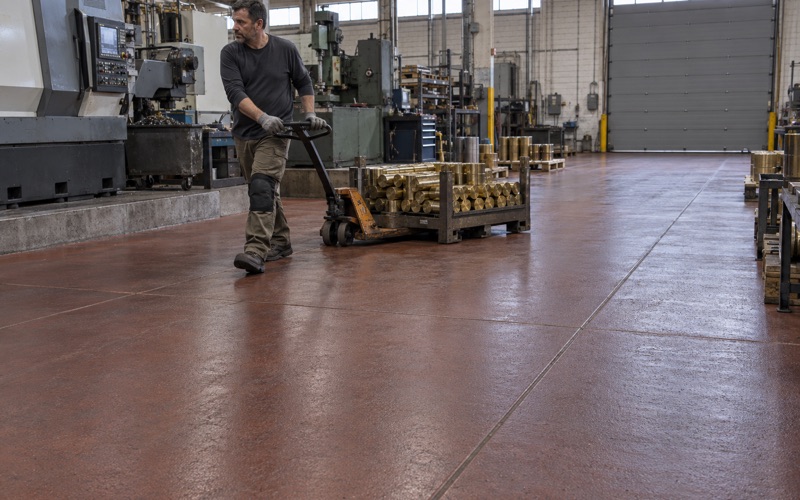
Wood Dale is not only server rooms. We also coat garage slabs in older homes and floors in the city’s machine shops and assembly plants, and the same habits carry across all of them: mechanical prep, a measured moisture result and a proposal written in enough detail to check.
111,000 Square Feet of Raised Floor
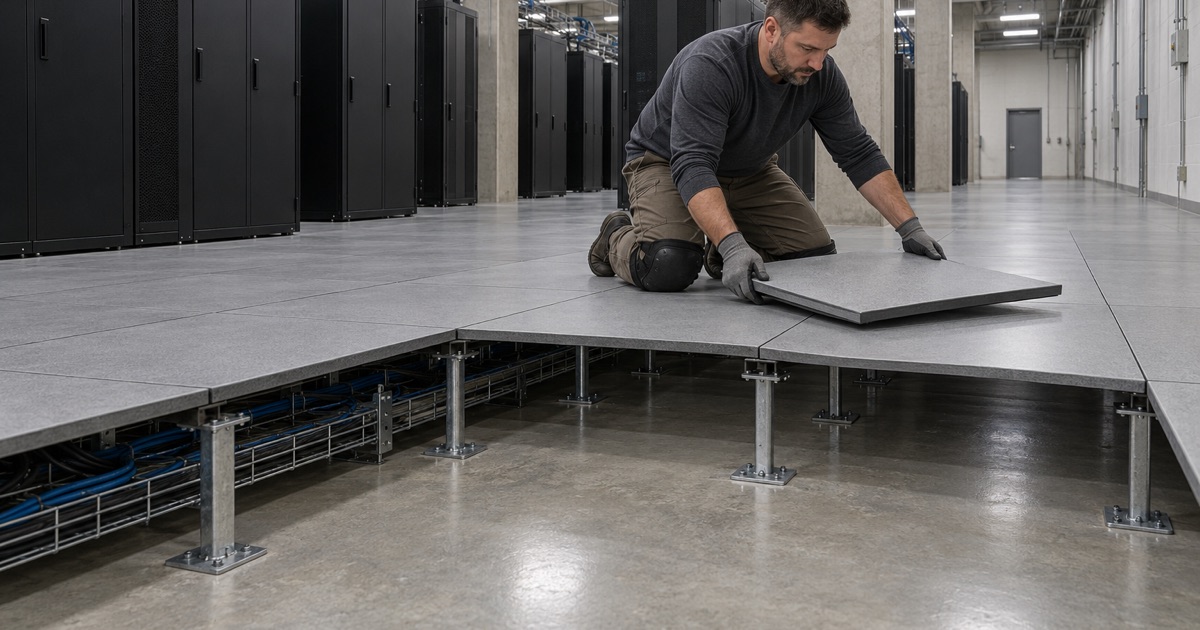
Wood Dale sits in Addison Township, DuPage County, about 17 miles west of downtown Chicago and two miles from O’Hare, and it holds data center space. The clearest record is Element Critical’s January 7, 2019 acquisition of two enterprise data centers in the city.
That matters here for one reason: every square foot of raised floor sits on a slab. We do not install access floors. Our work is the concrete beneath them, which is easy to forget once the tiles are down.
What the 2019 Announcement Described
The announcement covered 195,000 square feet across the two buildings, with 111,000 square feet of raised floor and up to 15 megawatts of available power. It also described $40 million to develop and enhance the Wood Dale facilities.
Those are 2019 figures, and we do not claim they describe the floors as they stand today. What they show is scale: a large share of that space was built on access floor, which means a large area of structural concrete sitting under it.
CH1 on Edgewood Avenue
CH1 is at 711 N Edgewood Avenue and is described as a 115,000-square-foot retrofit facility, and CH2 is at 341-361 Haynes Drive. A retrofit matters to a floor contractor, because in a converted building the slab under the access floor is often older than the room above it.
Older concrete can carry old adhesive, patching compound, paint or oil, and each changes what will bond. We map cracks, spalls and old coating first and say plainly when a section needs repair before anything is applied to it.
A New Campus Going Up
CyrusOne celebrated the topping out of its Wood Dale data center on May 13, 2025: two buildings totaling more than 500,000 square feet, an initial 18 megawatts of IT capacity, and a design aimed at LEED certification. We have not checked whether its halls use raised floors.
Element Critical and CyrusOne are reference points for this page, not customers of ours. They show what kind of building Wood Dale holds, and the slab questions below apply to any computer room or telecom space in the city that sits on pedestals.
Looking for epoxy-flooring closer to Midlothian? See Epoxy-Flooring in Midlothian.
The Floor Under the Floor, and Why It Gets Sealed
In a typical raised-floor room, the structural slab is the bottom of an underfloor air plenum. Cooling units push conditioned air into the space between the slab and the floor tiles, and perforated tiles let it up where the equipment needs it. The concrete is not a walking surface there; it is one wall of a duct.
Concrete Dust in the Air Stream
Bare concrete dusts. Foot traffic during construction, abrasion and the slow breakdown of a weak surface layer all release fine particles, and in a plenum those particles ride the same air that cools the equipment. Sealing or coating the slab is the general practice for stopping that at the source.
We do not tell anyone a code demands it, and we have not read one that requires a sealed plenum slab. A facility’s own engineers and specifications decide what goes down. Our part is making sure whatever is chosen bonds to the concrete and stays put.
Choosing a Sealer or a Thin Coat
A plenum slab does not need the build of a forklift aisle. Options range from a lithium silicate densifier that hardens the surface to a thin 100% solids epoxy sealer that closes it, and the choice turns on the slab’s condition, its moisture and what the facility’s specification calls for.
Low odor matters in an occupied building, and so does color. A light gray or white coat makes dropped hardware and early dusting easy to spot when a tile is lifted for inspection.
Moisture Comes Before the Coating
A coating on a slab with vapor coming through it can blister and let go, and under an access floor a failure is hard to see and harder to reach. We test before pricing, using ASTM F2170 in-situ relative humidity probes or ASTM F1869 calcium chloride tests depending on the slab.
Where readings run high, a moisture-mitigation primer goes into the scope. A slab poured without an under-slab vapor retarder is the usual suspect, though only a test settles it. Moisture is also the first exclusion we name when we walk through what a coating warranty does not cover, before the job is sold.
Coating Around Pedestals, Cable and Live Equipment
The hard part of a plenum slab is not the chemistry. It is that the slab is crowded with pedestals, cable trays, power whips and sometimes running equipment, and the space above it may never go dark. We plan the work around all of that before any machine comes off the truck.
Preparing the Slab Without Making Dust
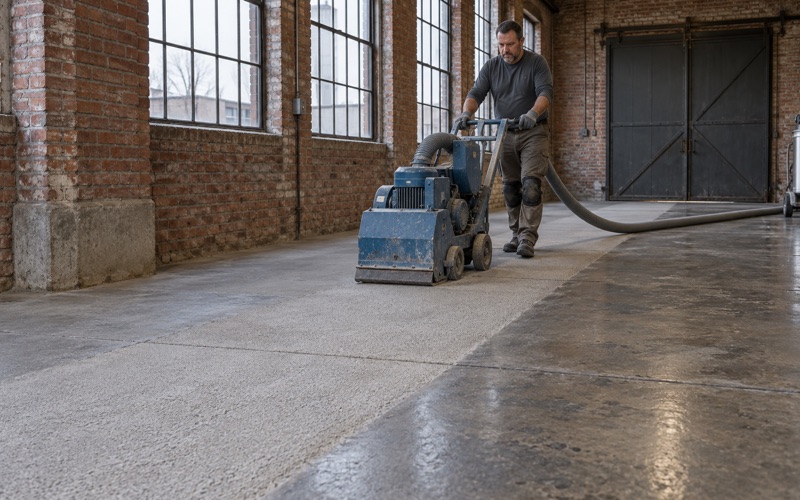
Surface prep is where dust is made, so it is where control matters most. We grind with a diamond grinder tied to a vacuum at the machine, so dust is captured as it is made rather than swept up afterward, and we aim for a light ICRI concrete surface profile suited to a thin film.
Shot blasting is fast on open floor but needs room the space under an access floor rarely gives. Around pedestal bases and in tight corners, hand tools and edge grinders do the work, and the profile there is checked as carefully as in the open.
Working Pedestal by Pedestal
Coating has to wrap the base of each pedestal without gluing adjustment hardware or bridging gaps that should stay open. Where tiles are lifted for access, we work in sections, coat, let that area reach its cure, and move on, so only a small part of the floor is open at once.
Cure is set by slab temperature and the dew point spread at the surface, not by the calendar. Conditioned rooms are usually steady, which helps, but we still read the slab before each coat instead of assuming.
Cable Trays and What Sits on the Slab
Cable trays, conduit and supports often run low under the floor or sit directly on the concrete. We do not move or disconnect anyone’s cabling; the facility’s own staff or its electrical contractor handles that, and we mask, protect and coat around what stays in place.
Anything left on the slab, from abandoned wire to old firestop debris, gets flagged rather than coated over. A sealed floor with trash sealed into it still sheds, and it hides the condition of the concrete underneath.
Protecting Live Equipment
Racks, power distribution and cooling units near the work area stay protected and stay running. We seal off the open section with plastic sheeting where the facility allows it, keep grinders on vacuum the whole time, and stop work if the facility’s monitoring shows anything it does not like.
Nothing is rinsed. Water has no place under an access floor, so cleanup is vacuum and tack cloth, and the last pass before coating is a wipe-down checked by hand.
Work Inside a Building That Stays Live
A data hall, like a production line, usually cannot stop for a floor. We phase factory, warehouse and shop floors around shifts with overnight and weekend windows, and a live computer room gets the same kind of plan, written with the people who run it.
Odor, Air Handling and Access
Because the plenum feeds the room, anything applied under the floor can reach the air above it. We select products with that in mind, agree with the facility when cooling units near the work area can be adjusted, and keep containers and mixing outside the protected space.
Data center access is usually controlled, and we work inside whatever rules a site sets: escorted entry, logged tools, fixed hours. A schedule that ignores them does not hold up.
What Gets Checked at Handover
Before tiles go back down, we walk the finished slab with the facility’s representative and look at coverage around every pedestal base, at edges and at any patched area. Thin spots are touched up while access is still open, because lifting tiles again later costs everyone time.
That detail is what makes a handover check possible. Our proposal names the product line, the number of coats and the finished thickness, so the floor can be measured against the quote rather than against anyone’s memory.
Registration Before the Permit
The City of Wood Dale requires every contractor to register with the Community Development Department before a permit issues, with a certificate of insurance carrying $2,000,000 in public liability coverage and naming the city as certificate holder. Illinois has no state flooring license, so we check each town’s registration and insurance rules before booking.
Whether a given floor job needs a permit is the city’s call, and we ask rather than guess. Community Development can be reached at 630-766-5133.
Garages and Homes in Wood Dale
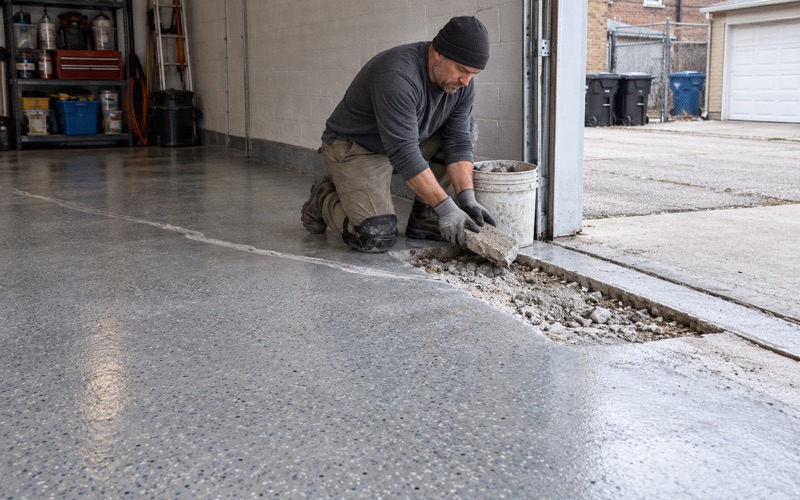
Away from the data halls, most of the city’s homes are owner-occupied, 77.0 percent of occupied units. In garages we check for paint, patching compound and old coatings first, then choose a system that stands up to the rock salt and brine tires carry in.
Home jobs over the state threshold get a written contract and the Home Repair: Know Your Consumer Rights pamphlet before grinding begins. Homeowners doing their own non-licensed work on their own property do not need to register with the city.
- 20+ Years on Concrete
- Moisture Tested Before Pricing
- Written Coat-by-Coat Proposals