Cicero Epoxy Flooring brings 20+ years to epoxy-flooring in Western Springs, and the newest garages we coat here start with a question most homeowners do not expect: where will the car charge? A detached garage built in the village today arrives with a charging location already decided, and that fixed point should set the order of the work on the floor.
Our approach is simple to describe and easy to get wrong. The coating goes down before any charger, conduit or bollard is fastened at floor level, and it turns up into a cove where the electrical raceway meets the wall. Cutting a fresh floor around equipment that is already mounted leaves cut edges that are harder to seal, so we plan the sequence with your electrician from the start.
We do not do electrical work, and we say so up front. What we bring is the floor: a slab opened with a diamond grinder or shot blaster rather than acid, a moisture test written into the scope before the price is final, and a proposal that names the product line, the coat count and the finished thickness you can check us against.
A New Western Springs Garage Comes Wired for a Charger

Western Springs is a village in Cook County and a suburb of Chicago, and its Community Development department publishes its own permit guides for homeowners. The detached garage guide is the one that matters for a floor, because it carries a line most people skim past: an EV-capable parking space has to be roughed in.
What the village’s detached-garage guide asks for
The Village of Western Springs Detached Garage Accessory Structure Permitting Guide calls for construction to the 2018 IRC and the 2017 NEC as amended by the village. Every contractor on the job must be registered, the permit fee is 1.75 percent of the proposed cost of work, and a refundable site performance bond is posted alongside it.
Within that guide, the EV-capable space is listed with an example of a 40-amp minimum NEMA plug. The inspection schedule includes a Garage Slab Pre-pour check, so the slab itself has been inspected by the village before a coating contractor ever arrives. Questions about the permit itself go to Community Development at 708-246-1800.
What EV-capable means under state law
The guide points to the Electric Vehicle Charging Act, 765 ILCS 1085. Under that statute, an EV-capable space has electrical panel capacity and a continuous raceway or cable assembly for a 208-volt or 240-volt circuit of 40 amperes or more. The raceway runs from a suitable panelboard to an outlet or enclosure located within 3 feet of the parking space.
The act requires at least one such space for each new detached single-family residence with dedicated parking. It applies to new construction, not to garages already standing in the village. A capable space is also not a charger: it is the wiring path and the capacity, waiting for equipment to be added later.
Why a charging location matters before coating
Because the raceway has to end within 3 feet of the stall, the charging point is settled long before the floor is coated. That gives us something older garages never offered: a known spot where conduit, an enclosure and possibly a protective bollard will meet the floor and the wall.
Looking for epoxy-flooring closer to Franklin Park? See Epoxy-Flooring Services in Franklin Park.
Coat First, Mount the Charger Second
The order of trades is where a new garage floor in Western Springs is won or lost. Our preference is plain: the coating goes down on bare concrete, cures, and only then does anything get bolted through it at floor level.
Sequencing the floor with the electrician
We ask for the electrician’s plan before we schedule, so we know where the raceway rises, where the enclosure will sit and whether a bollard or wheel stop is coming. Ideally the rough-in is complete and the wall end of the conduit is capped, with nothing yet mounted on the slab, when our crew arrives to grind.
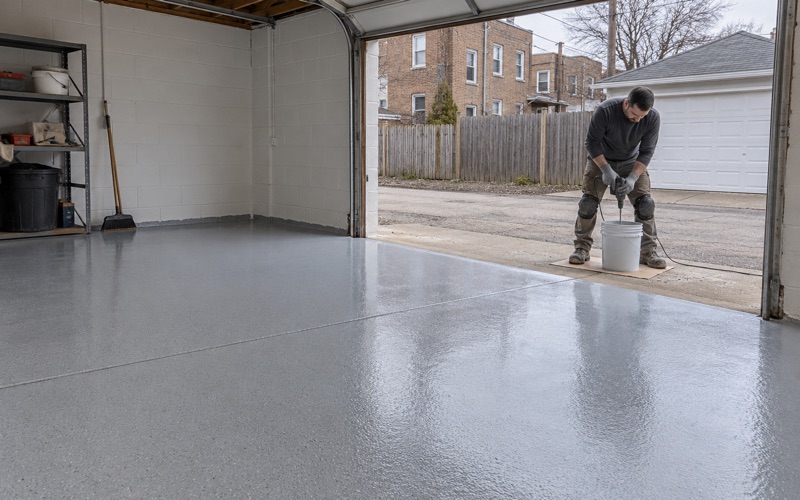
Then the floor goes in as one continuous system: ground to a profile, primed, built to the thickness named in the proposal and topcoated. Once it has cured, the electrician mounts the charger and any floor-level hardware on a finished surface, and anchors are set through a coating that was never cut around an obstacle.
Why fitting around equipment is the wrong order
When a charger or bollard base is already on the floor, a grinder cannot reach the concrete beneath or tight against it. The coating then stops at a hand-trimmed edge around each fixture, which is exactly where water, grit and cleaning chemicals have a place to start working under the film.
Having equipment taken down and remounted for us also means a second electrical visit you would rather not pay for. Neither the statute nor the village guide says anything about floors, so this is not a rule we are quoting, only the sequence that keeps the finished floor whole.
Moisture and cure timing in a brand-new slab
A new garage slab still holds water from the pour, so the moisture test written into our scope matters here as much as anywhere. We use the ASTM F1869 calcium chloride test or ASTM F2170 in-situ relative humidity probes, and the result decides whether the slab is ready or needs more time.
Cure times on our side follow slab temperature and dew point rather than the calendar. If the garage is unheated and the slab is cold, we tell you to wait, which also gives the electrician a clean window to finish the rough-in before we start.
The Wall Line and the Charging Stall
Where the floor meets the wall beside the stall is the detail that separates a planned EV garage floor from an improvised one. It is also where conduit, the enclosure and any wall protection all land within a few feet of each other.
Turning the coating up into a cove base
We carry the coating a few inches up the wall as an integral cove, so the joint between slab and wall is sealed rather than left as an open seam. Along the charging wall the cove goes in before anything is surface-mounted, and the electrician then fastens conduit straps and the enclosure to a finished, sealed surface.
Where conduit has to pass down to floor level, we leave the cove continuous and let the electrician route above it or seal the penetration once the coating has cured. The goal is a single unbroken line from the stall to the wall, with no raw concrete exposed at the base.
Bollards, wheel stops and anchors
A bollard or wheel stop is often added to protect the enclosure, and it is anchored into the slab. If one is planned, we coat the full stall first and mark the anchor locations so they are drilled through a cured, bonded system instead of a floor cut back around a post.
Choosing a system for the stall
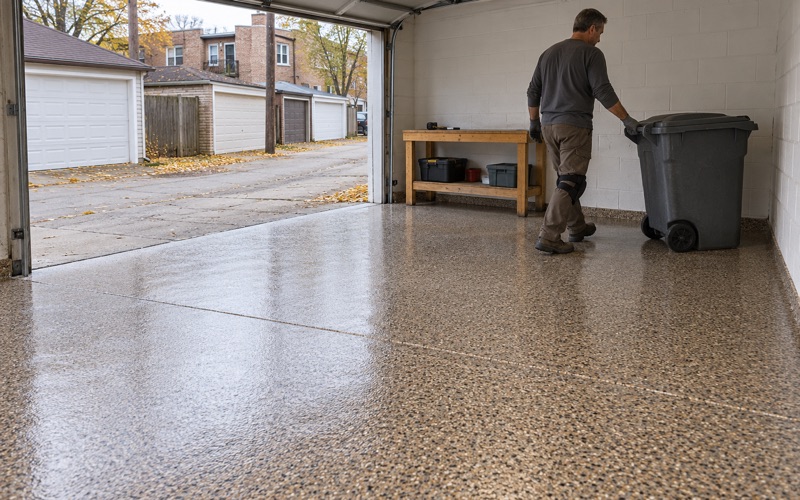
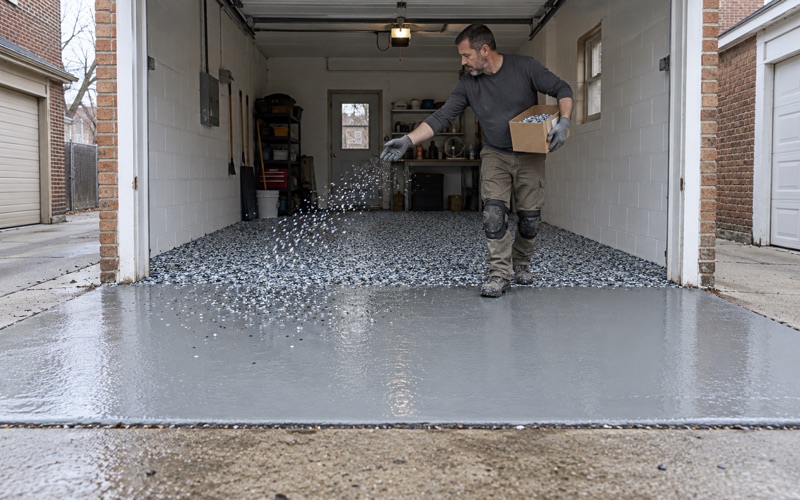
For the charging stall we usually build a 100% solids epoxy base with a vinyl flake or quartz aggregate broadcast, finished with a polyaspartic topcoat. The broadcast gives texture underfoot where you step out while handling a charging cable, and the topcoat is what resists hot tire pickup.
Grinding dust is collected by vacuum at the machine rather than swept or rinsed, which matters in a new garage where the electrical box and raceway end are already in place. We profile the slab to an ICRI concrete surface profile suited to the system before the first coat.
Hours in One Spot, and Garages Already Coated
A charging car is a parked car that stays put for hours, often overnight, in the same tire footprint. That pattern, rather than anything about the vehicle itself, is what we plan the stall’s finish around.
What a fixed tire footprint asks of the floor
Tires that stop in the same spot every day bring in whatever they picked up on the street and leave it there to sit. A topcoat chosen for hot tire pickup resistance, plus a broadcast texture that hides wear patterns, keeps those tire footprints from becoming the first part of the floor to look tired.
Our proposal states the finished thickness for the stall, so you can see that the area taking the most repeated wear was not built thinner than the rest. Keeping the floor swept of grit under those wheels does more for its appearance than any cleaner.
Adding a charger to a floor that is already coated
Some garages in the village were coated before anyone planned for a charger, and an owner may decide to add one later. If that is your garage, have the electrician wall-mount the enclosure and run conduit on the wall above the cove line wherever possible, so the coated floor is not cut at all.
When a bollard or floor anchor is unavoidable, we can come back afterward to seal the penetrations and patch the surrounding finish with the same product line. Where an older coating is failing anyway, we map it along with any cracks first and tell you honestly whether the stall should be recoated now, before the hardware goes in.
Booking the work in Western Springs
Illinois has no state flooring license, so before we book a job we check the village’s own contractor registration, bond and insurance requirements. On a home job above the state threshold, you receive a written contract and the Illinois Home Repair: Know Your Consumer Rights pamphlet before any grinding starts.
We explain what the coating warranty excludes before the job is sold, and moisture is the first exclusion we name. Then we set the start date around your electrician’s rough-in, so the floor and the charger each go in at the right point in the build.
- 20+ Years on Concrete
- Moisture Tested Before Pricing
- Written Coat-by-Coat Proposals