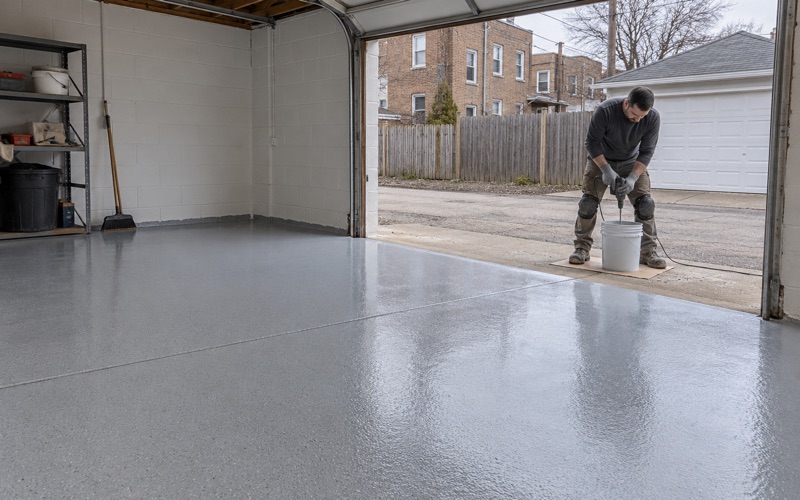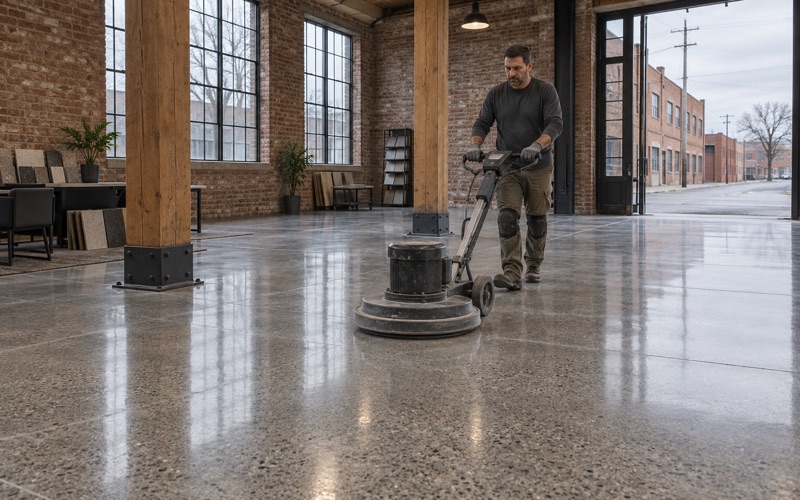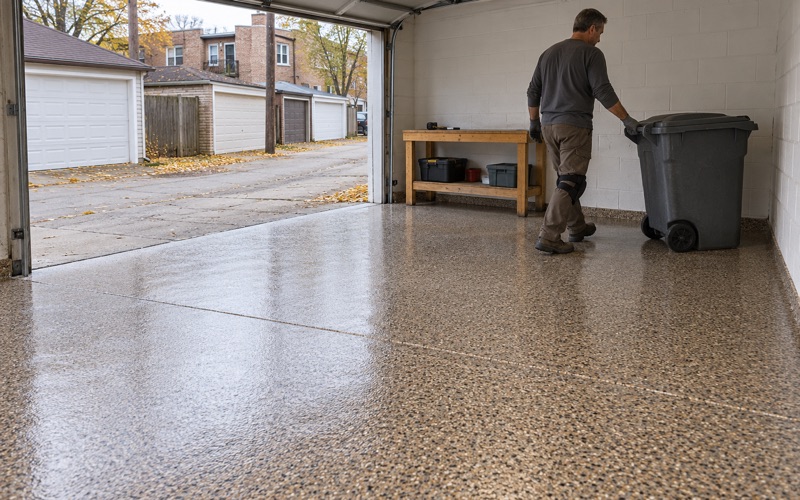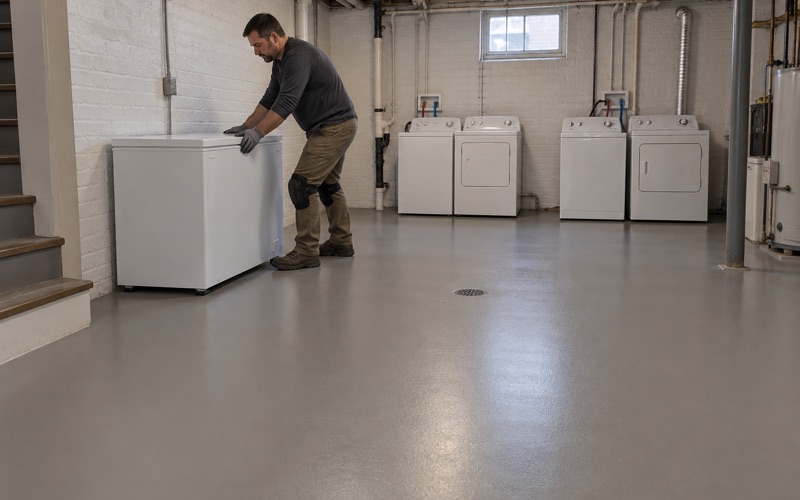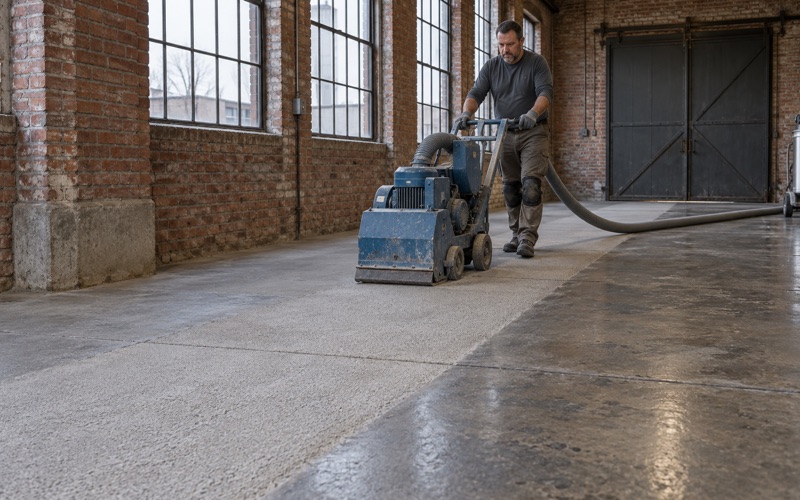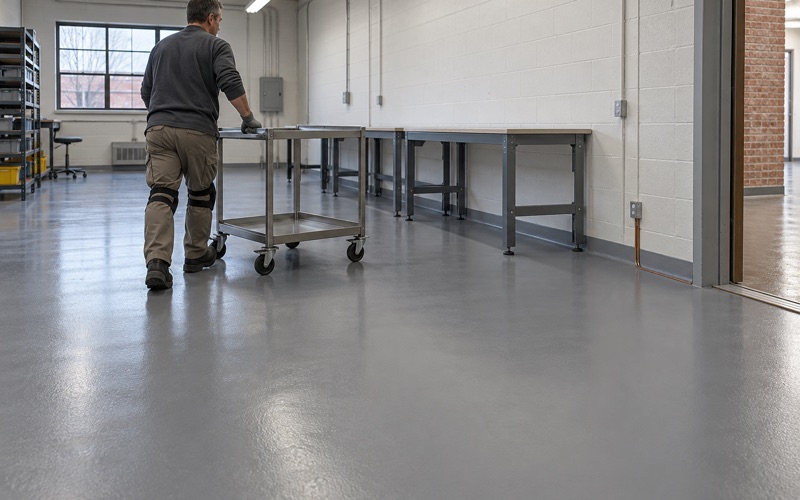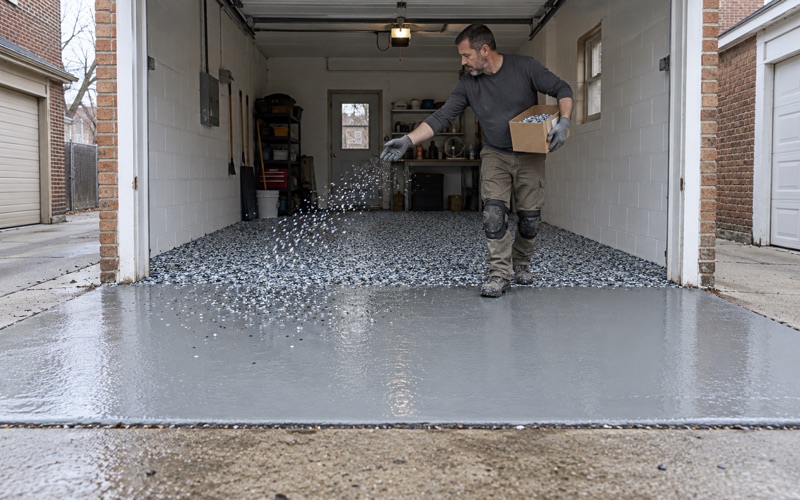
Cicero Epoxy Flooring brings more than 20 years of work to epoxy-flooring in Westchester, and some of the floors we plan here belong to buildings that cannot simply close for a week. Our method does not change with the building: a diamond grinder or shot blaster opens every slab, because an acid etch leaves a coating too little to hold on to.
Before a price is final, a moisture test goes into the scope, and the written proposal names the product line, the number of coats and the finished thickness. That gives an owner or a facility manager a document to check the finished floor against, rather than a promise to remember. Moisture is also the first exclusion we name when we explain what a coating warranty does not cover.
This page is about one kind of floor in particular: an outpatient dialysis clinic, where a treatment floor and a water-treatment room share one roof and one tight schedule. Homeowners will find the same grinding, testing and written scope behind a garage or basement job, but the clinic shows most clearly why planning the window matters as much as choosing the coating.
A Dialysis Center on Wolf Road
Fresenius Kidney Care Westchester operates at 2400 Wolf Road, Suite 101A, an address the US Census geocoder places inside the village, in Proviso Township in Cook County. The center lists in-center hemodialysis as its service. We have not worked on that floor and have not seen its layout; we describe it because a clinic of its kind shows what a dialysis floor asks of a coating.
Westchester is a western suburb of Chicago with 16,892 residents at the 2020 census, and the village describes itself as primarily residential. In a town shaped that way, a medical clinic on Wolf Road is one of the clearer examples of a floor that has to keep working around the people who depend on it.
Two Floors Under One Roof
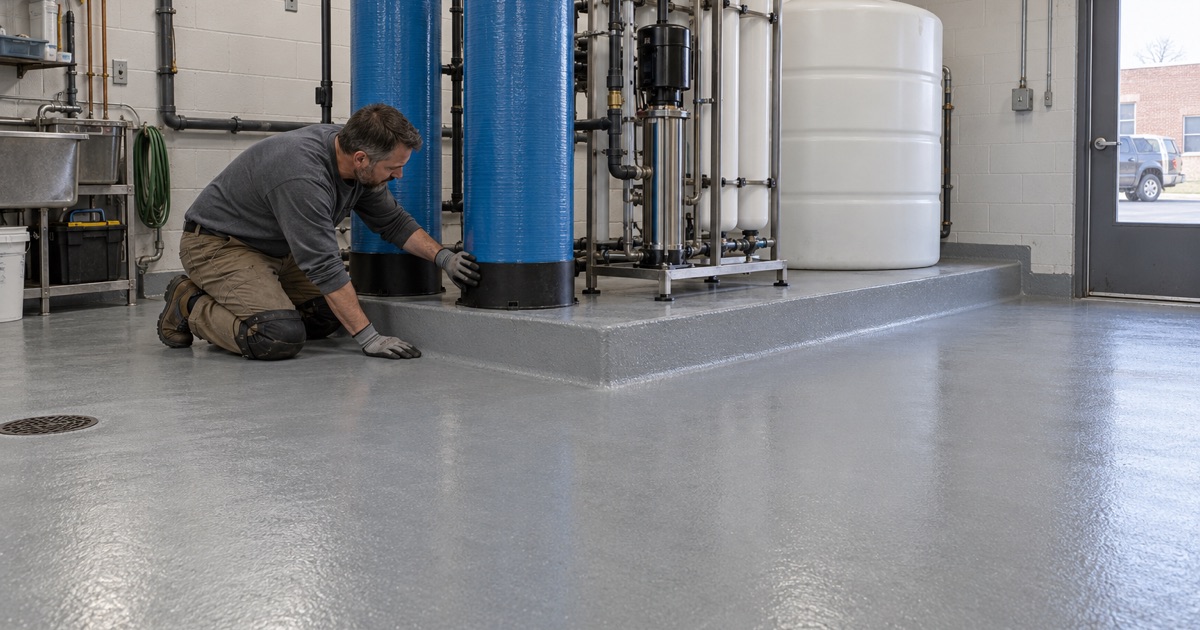
A dialysis clinic is really two floors with different jobs. The treatment floor is where patients sit for hours, staff move carts and machines between them, and the surface is wiped down and mopped between patient shifts. The water-treatment room is a working equipment space, with filtration and reverse-osmosis units, storage tanks and floor drains that keep the slab wet and carry heavy point loads.
Treating both rooms with one system is the easy proposal and usually the wrong one. We scope them separately, with their own moisture readings, their own surface profile and their own build, and the written proposal lists each room’s product line, coat count and finished thickness on its own line. That way neither room inherits a compromise built for the other.
Starting From the Slab That Is There
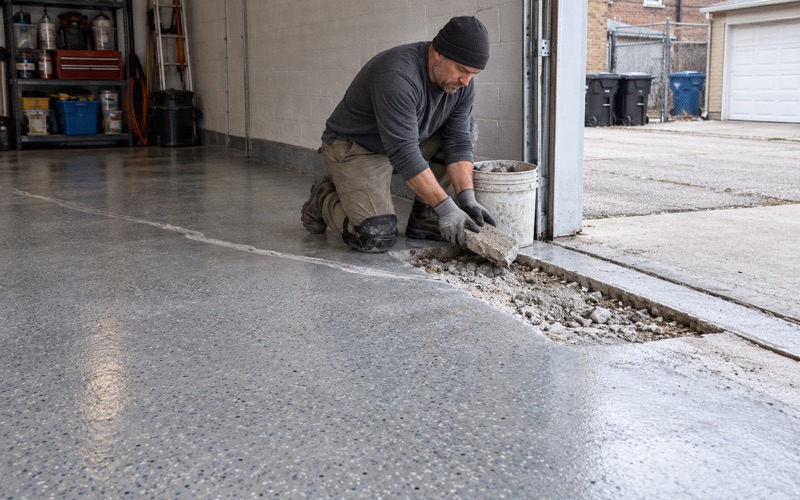
Outpatient clinics are often fitted into existing commercial space, so the slab underneath may carry old tile adhesive, patching compound or a previous coating. We map cracks, spalls and leftover material before choosing a system, then grind or shot blast to an ICRI concrete surface profile the primer can key into. A slab that needs repair is repaired first, or we tell the owner it should not be coated yet.
Grinding dust is collected at the machine by vacuum rather than rinsed toward a floor drain, which matters more in a building where the drains serve clinical equipment. The work zone is sealed off from occupied suites, and the cleanup is finished before the space is handed back.
Looking for epoxy-flooring closer to Justice? See Epoxy-Flooring Services in Justice.
Spills at the Chair and Water Under the Equipment
Saline and Dialysate on the Treatment Floor
On the treatment floor, saline, dialysate and blood spills happen beside the chairs, and the floor is cleaned between patient shifts rather than at the end of a quiet day. That pattern rewards a seamless, nonporous surface with as few joints as possible for liquid to settle into, and a finish texture chosen so wet mopping stays practical.
We usually look at a 100% solids epoxy base with a polyaspartic or polyurea topcoat for a floor like this, and we weigh slip resistance against cleanability with the owner rather than for them. We do not sell any coating as a health measure; what we offer is a surface that holds up to the cleaning the clinic already does.
Tanks, Reverse Osmosis and Floor Drains
The water-treatment room is a different problem. Reverse-osmosis equipment, filtration housings and tanks sit in one place for years, so the slab beneath them takes concentrated point loads, and water at the drains and around fittings can keep parts of the floor wet for long stretches. A coating there has to tolerate standing water and resist being crushed under feet and skids.
That room is also where we are most careful about drains. The floor has to keep falling to every drain after coating, with no lip at the grate where water can pond, and we say plainly that a coating does not stop water coming up a floor drain. If backflow is a question, the drain gets looked at first.
Moisture Before Anything Else
A slab that stays damp from above may also be wet from below, and the two are easy to confuse. We test before pricing, using ASTM F2170 in-situ relative humidity probes or ASTM F1869 calcium chloride testing where they suit the slab, and a moisture-mitigation primer goes into the build only when the numbers call for it.
Moisture is also why we test the water-treatment room separately from the treatment floor. Readings near a drain or beside an equipment pad can differ from those across the open floor, and a single average would hide the spot most likely to fail.
Six Days From 5:00 a.m.: Planning Around Sunday
Fresenius Kidney Care Westchester runs Monday through Saturday from 5:00 a.m. to 5:00 p.m. and is closed on Sunday, so a clinic on that schedule has one full day with nobody in the chairs. Sunday is the natural window for floor work, and the whole plan is built backward from the first Monday shift.
What Fits in One Closed Day
One day is enough for some jobs and not for others. A repair of a defined area, a recoat over a sound, well-bonded system, or one small room can often be planned to grind, coat and reach a walkable state between Saturday evening and Monday at 5:00 a.m. A full treatment floor usually cannot, and we would rather phase it over several Sundays than rush a cure.
Phasing is the same habit we bring to factory and warehouse floors that cannot stop a line: overnight and weekend windows, work zones closed off in sequence, and each section returned to service before the next opens. The difference here is that the schedule belongs to patients, so the Monday deadline does not move.
Cure Set by the Slab, Not the Clock
Cure times come from slab temperature and the dew point spread at the slab surface, not from the calendar or the hour Monday’s first patient arrives. A coating applied too close to the dew point can develop amine blush or lose adhesion, so we read the room’s conditions ahead of time and choose a product and schedule that will be ready in time.
If the readings say the floor will not be ready by 5:00 a.m., we say so before the weekend, not on Sunday night. Fast-curing polyaspartic topcoats widen the window on some jobs, but they do not excuse skipping the test, and a floor that opens tacky creates a worse problem than a postponed one.
What the Federal Rules Say, and What They Leave to the Owner
Federal conditions for coverage for dialysis facilities include 42 CFR 494.60, the section on the physical environment. It requires the building to be “constructed and maintained to ensure the safety of the patients, the staff, and the public,” and it requires a maintenance program for all equipment, including “the water treatment system.”
Space That Prevents Cross-Contamination
The same section says the space for treating each patient must be sufficient to “prevent cross-contamination” and to accommodate emergency equipment and staff. It names no floor material, and CMS does not approve floor coatings for this purpose. Choosing a surface that supports those requirements, and keeping it maintained, is left to the facility and the people it hires.
In practice, that means our proposal reads as a specification the clinic’s own team can review: substrate preparation, the measured moisture result, each layer’s product and thickness, and how the floor meets drains and doorways. What we do not do is describe the floor as satisfying the regulation; that judgment belongs to the operator.
Local Authorities and Contractor Checks
The Village of Westchester’s Community Development and Building Department is the building authority here, and we ask it whether a given coating job needs a permit rather than assume either way. Illinois has no state flooring license, so the village’s own registration, bond and insurance rules are checked before a job is booked.
For a clinic, the operator may also need to involve the Westchester Fire Department or the Cook County Department of Public Health, and we schedule around whatever they require. Products are picked inside the Illinois VOC limits for floor and industrial coatings, which bind whoever applies them, and that matters more in a building people return to on Monday.
The Same Method for a Westchester Home
Westchester is largely owner-occupied, at 90.8 percent of occupied units, so the person who books a garage or basement floor is usually the one who will live with it. Those jobs get the same grinding, testing and written scope as a clinic, and home jobs over the state threshold come with a written contract and the Home Repair: Know Your Consumer Rights pamphlet before grinding starts.
A floor coating is never sold as radon reduction here, because in Illinois that is licensed mitigation work under IEMA. Every garage proposal also states what the warranty excludes, in writing, before the work is sold. If a slab is too damaged or too wet to coat well, the proposal says that instead.
- 20+ Years on Concrete
- Moisture Tested Before Pricing
- Written Coat-by-Coat Proposals