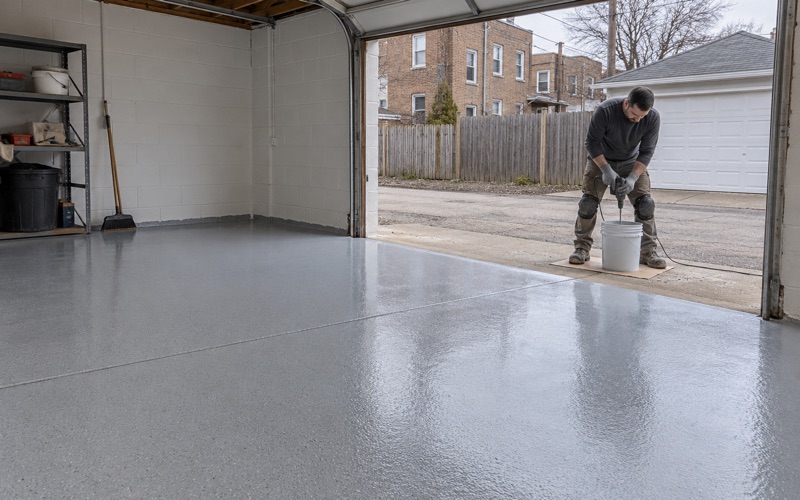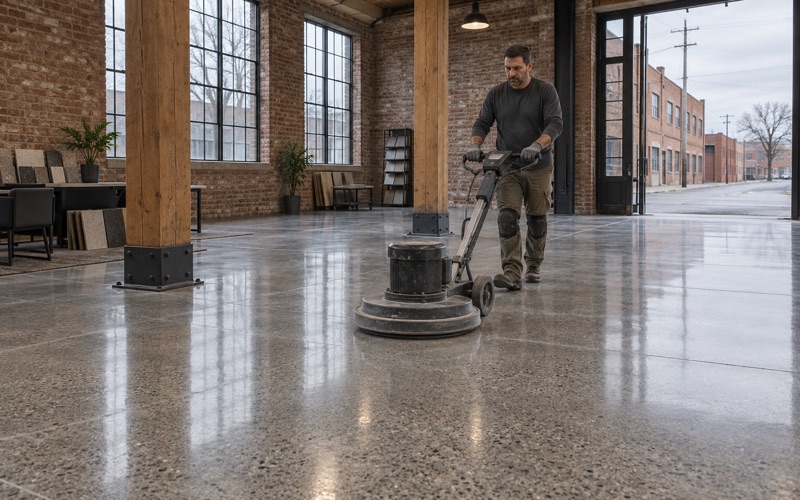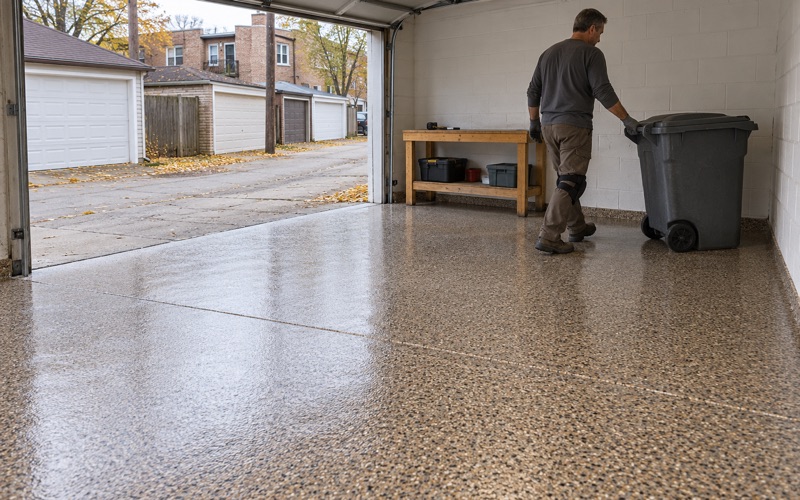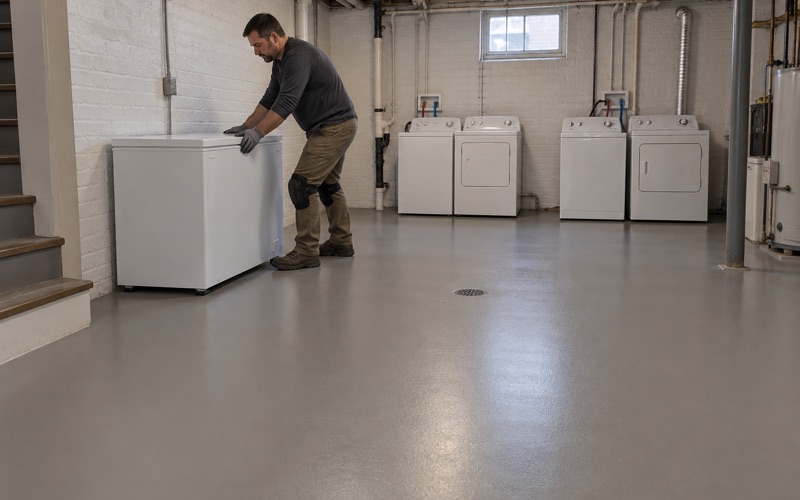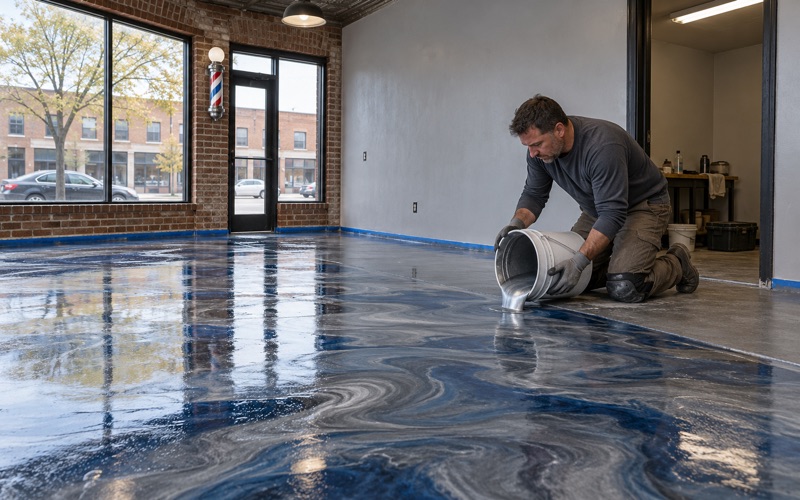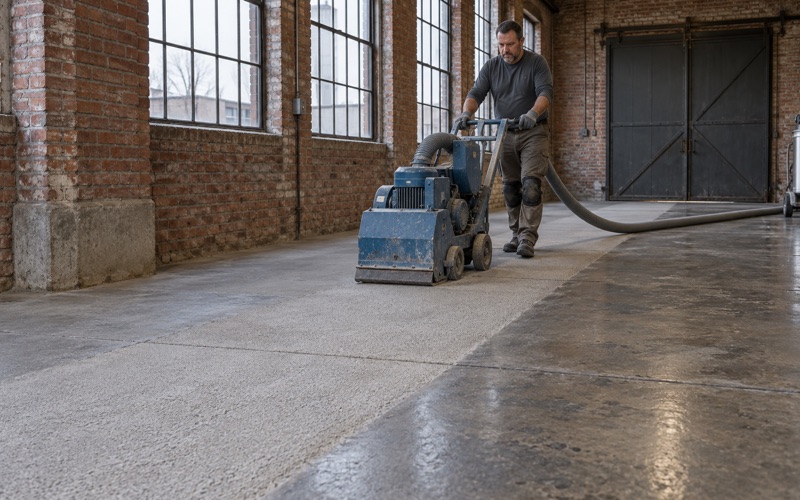
Cicero Epoxy Flooring has spent more than 20 years on epoxy flooring in Schiller Park and the rest of our service area, and the work always starts at the slab rather than the color chart. We open every floor with a diamond grinder or a shot blaster, because an acid etch leaves a coating with too little to grip.
Before a price is final, a moisture test goes into the written scope, whether the slab sits under a garage, a basement or a production room. The proposal names the product line, the number of coats and the finished thickness, so anyone can hold the installed floor up against the quote and check it.
This page is about one kind of floor in particular: the assembly floor where small parts get handled all day. On that floor the coating is not mainly fighting impact or chemicals. Its job is to make a dropped part easy to see and easy to sweep up, and that changes the color, the finish and the repair work we recommend.
A Connector Maker on Winona Avenue and Why Dropped Pins Matter
What Gets Built at 9509 Winona Avenue
Amerline Enterprises, at 9509 Winona Avenue, manufactures circular connectors and accessories, including AEC, NATO and ordnance connectors described as interchangeable with military-style connectors. The company says its products are tested for impact, shock and vibration. It also offers custom design, engineering and overmolding services, and a directory listing gives 1980 as its founding year.
We name Amerline here as a local example of the kind of work this page is about, not as a customer. We have not seen its floor, its process or its quality system, and nothing on this page describes them. What the address does show is that small-part connector assembly happens inside Schiller Park, in Leyden Township, Cook County.
A Dropped Part Has to Be Found
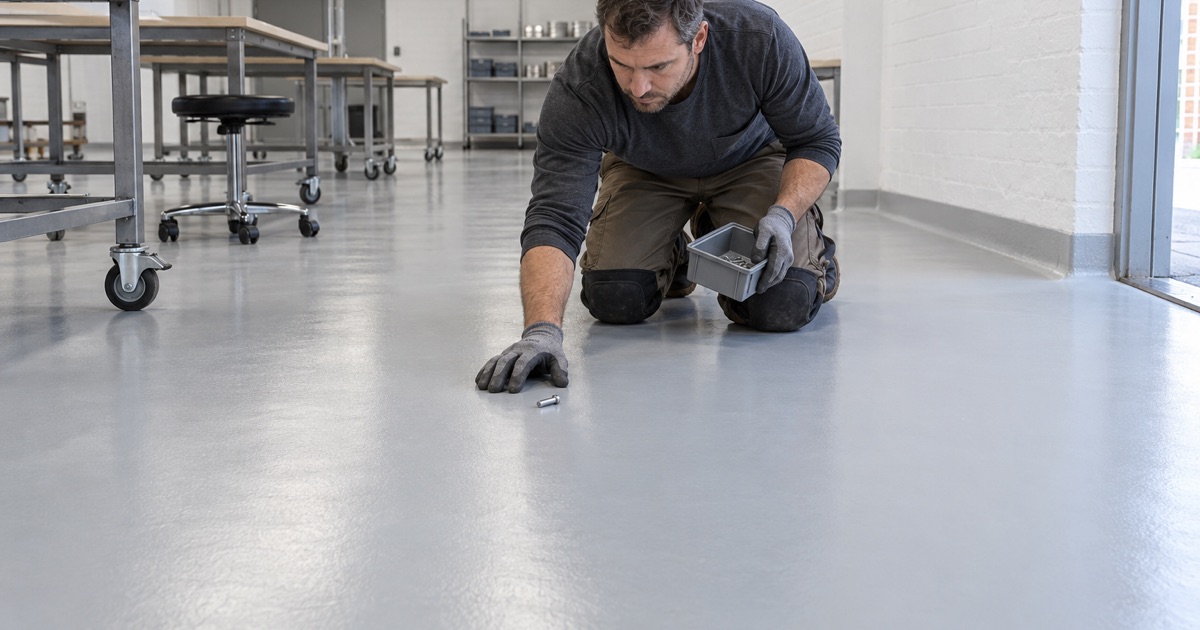
Connector work involves contacts, pins and seals small enough to vanish against a busy background. In defense-supply manufacturing generally, a part that hits the floor is treated as foreign-object debris, and it has to be found and accounted for rather than left for the night crew. The floor either helps that search or slows it down.
A worn gray slab with stains, saw cuts and patched cracks gives a metal pin a hundred places to blend in. A tool crib can replace a lost contact, but it cannot explain where the first one went, and on many assembly lines that question matters as much as the part. That is the floor problem we solve here.
Why Impact and Chemicals Come Second
Most industrial floor conversations start with forklifts, pallet jacks and spills. In light assembly the loads are usually carts and rolling chairs, and the chemicals are mostly cleaners, so a thick trowel-down system can be more floor than the room needs. We still check the wheel loads and solvents in use before we pick a system.
Some electronics and connector rooms also ask about static-dissipative or ESD flooring. That is a separate system with a specified resistance range, and we build to the range the buyer’s own specification calls for rather than guessing at one. If no specification exists, we say so and recommend settling it before the slab is ground.
Looking for epoxy-flooring closer to Chicago Ridge? See Chicago Ridge Epoxy-Flooring.
A Light, Seamless Floor Shows What Fell
Choosing a Light Color
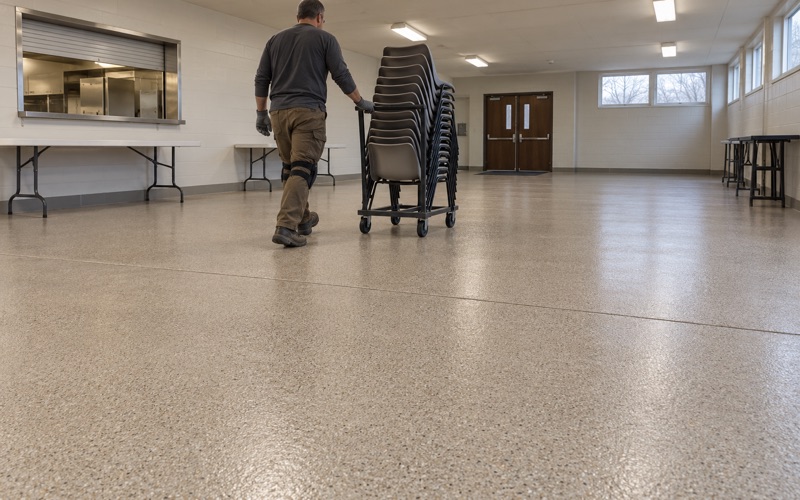
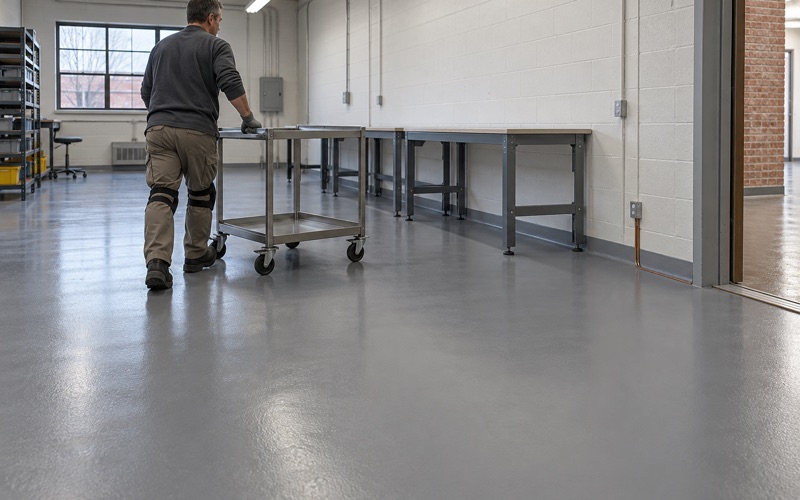
A pale field color gives a dark seal or a plated pin a background to stand out against. Light gray, white and pale tan are the usual choices, and we put sample chips down under the room’s own lighting before anyone commits. No standard we have read requires a particular floor color for this, so the choice belongs to the people working on that floor.
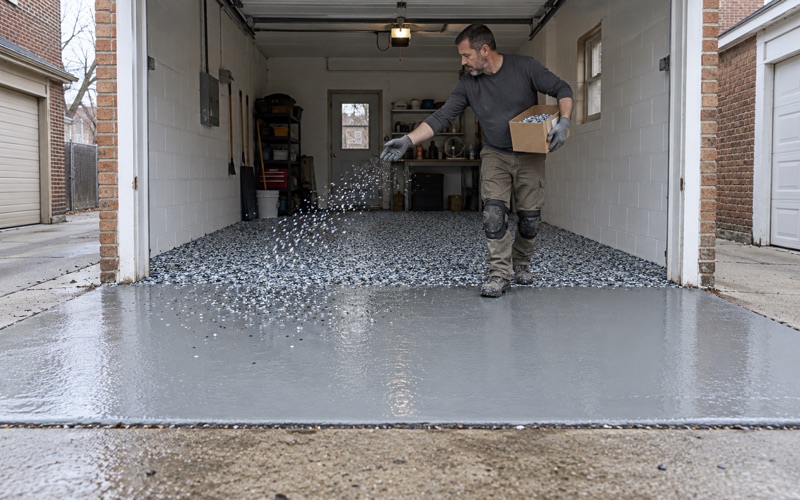
We usually steer assembly rooms away from heavy vinyl flake broadcast. A full flake floor is excellent at hiding dirt, which is exactly the wrong quality when the goal is to find a small part. A solid color, or a very light quartz aggregate broadcast where traction is needed, keeps the surface readable at a glance.
Seamless Means No Edges to Catch On
Tile, sheet goods and old coatings that have lifted at the edges all create seams, and seams collect small parts. A poured 100% solids epoxy cures as one continuous film from wall to wall. Where the wall meets the floor, an integral cove base can carry the coating up a few inches so nothing rolls under a baseboard.
The finish matters too. A high-gloss topcoat looks clean but can throw glare under bright task lighting, which hides small objects in the reflection. We often suggest a satin polyaspartic or urethane topcoat over the epoxy body coat, and we show the sheen on a sample under the same lights before the room is scheduled.
Keeping It Easy to Sweep
A floor that makes parts visible still has to give them up when someone sweeps. Heavy texture grips small contacts the same way it grips grit, so we keep the profile of the finished surface as smooth as the room’s safety needs allow. Where wet cleaning happens near a bench, a fine aggregate in that zone only is usually the better compromise.
Sweepable also means the coating has to survive daily dust mopping without wearing through in the traffic lanes. A worn lane turns back into bare concrete, and bare concrete is where dust and small parts settle again. We plan the topcoat schedule around the busiest aisles so the readable surface lasts as long as the rest of the floor.
Closing Cracks and Joints Where Parts Hide
Mapping the Slab Before We Price It
Every crack, spall, saw cut and patch of old coating gets marked on a plan of the room before a number goes on the proposal. On an assembly floor that map doubles as a list of every place a pin could disappear. If the slab is too far gone for a coating to be honest about, we tell you it needs repair or replacement first.
We also look for what is already on the concrete: paint, patching compound, old adhesive from a tile floor that came up years ago. Each of those changes how the slab has to be ground and which primer will bond, and finding them before the price is set keeps a change order off the job.
Filling Cracks So Nothing Drops Into Them
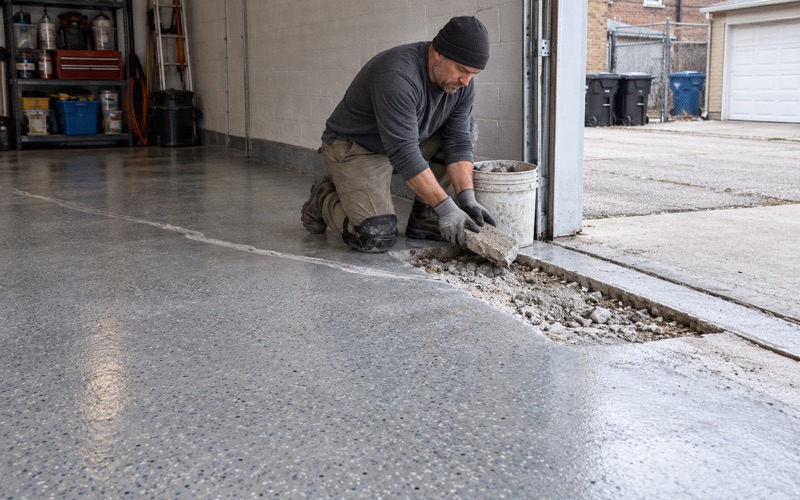
A static crack is routed open, cleaned and filled with a rigid epoxy or polyurea filler, then ground flush so the coating passes over it without a dip. A crack that is still moving gets a different treatment, because a rigid fill over a working crack will simply reopen. We tell you which kind each one is and what that means for the finished floor.
Spalled edges and pitted areas are rebuilt with an epoxy mortar before the body coat goes down. A coating alone telegraphs every low spot underneath it, and a low spot is where a dropped seal ends up resting out of sight. Getting the surface flat first is slower, but it is the part of the job that serves the assembly room most.
Control Joints Are Honest Seams
Saw-cut control joints exist so the slab can crack where it is told to. Filling them with a semi-rigid polyurea joint filler, shaved flush, closes the gap without fighting the slab’s movement. Coating straight over a moving joint looks seamless for a season and then splits along a straight line, which is worse than a joint that was handled properly.
Joint filler is maintenance, not a one-time fix. We point out every joint on the plan, explain how often filler typically needs topping up in a working room, and leave the product name in the paperwork so your own maintenance staff can match it later. A joint kept full stays a line on the floor instead of a slot that swallows parts.
Assembly Benches, Overmolding and the Aisle Between
Zoning the Floor by Task
An assembly building is rarely one floor with one job. The bench area wants the lightest, smoothest surface; an overmolding or molding area may see hot purged material and more cleaning; the aisle between carries carts all shift. We can change color, texture or topcoat by zone within a single installation so each area gets what it needs.
Painted aisle lines and a contrasting band around each bench help as well. A line tells people where carts belong, and a band gives the search for a dropped part a place to start. Both go in under the topcoat so foot traffic and carts do not wear them off within a few months.
Working Around Production
A line that cannot stop does not have to. We phase the floor in sections around shifts, with overnight and weekend windows, and grind with dust collection at the machine so fine concrete dust does not settle onto benches or open parts bins. Cure times are set by slab temperature and dew point, so the schedule reflects the room rather than the calendar.
Moisture is checked before the schedule is fixed, with ASTM F2170 in-situ relative humidity probes or ASTM F1869 calcium chloride testing depending on the slab. A high reading calls for a moisture-mitigation primer, and moisture is the first exclusion we explain in any coating warranty before the job is sold. Testing first adds time; skipping it can cost the floor.
Licensing and Paperwork in Schiller Park
Illinois has no state license for coatings work, so the rules that matter are local. The Village of Schiller Park requires contractors to be licensed with the village before construction starts, registering through the Community Core app with cost, scope of work, insurance, surety bond and workers’ compensation as applicable. The license year runs May 1 to April 30.
We confirm that registration is current before a Schiller Park job is booked. Permits and inspections are handled through the village’s Community Development Department, which has a Building Official, a Permit Coordinator and Inspectors, and we check with that office whether a given floor project needs a permit rather than assuming it does not.
- 20+ Years on Concrete
- Moisture Tested Before Pricing
- Written Coat-by-Coat Proposals