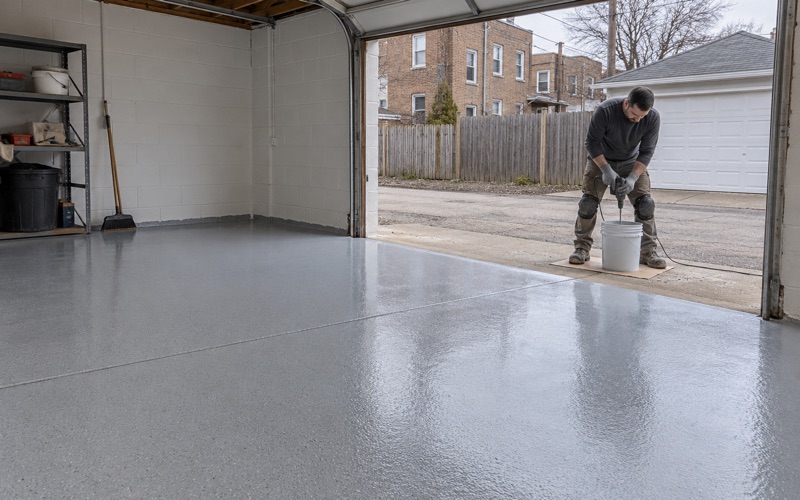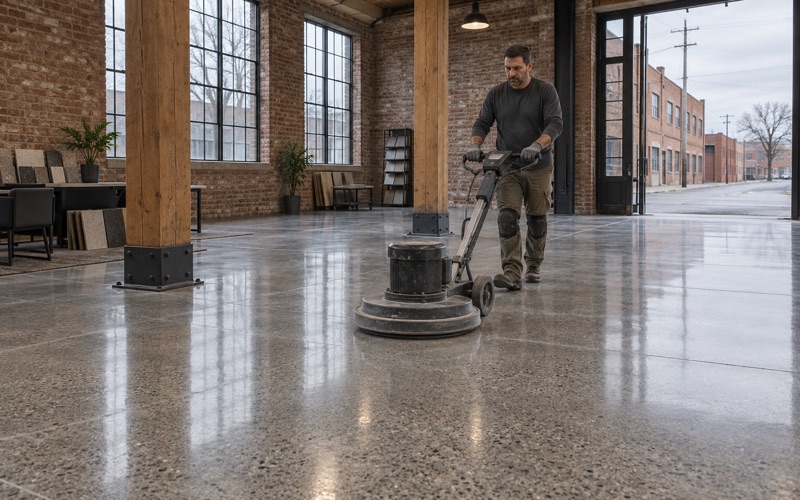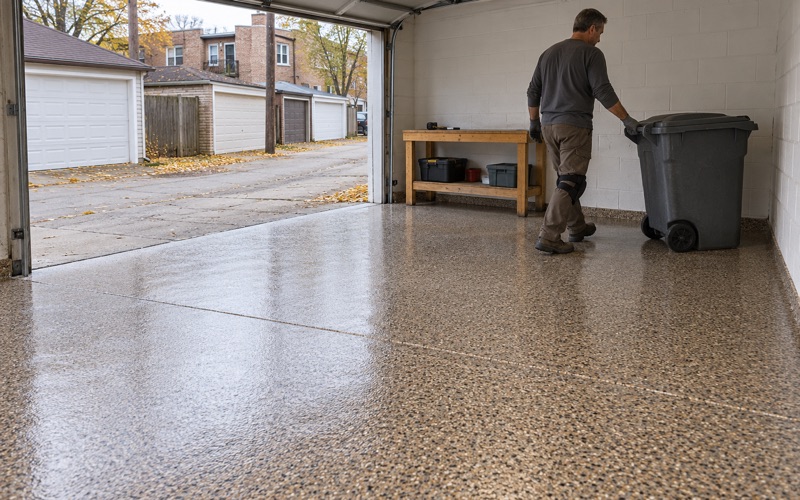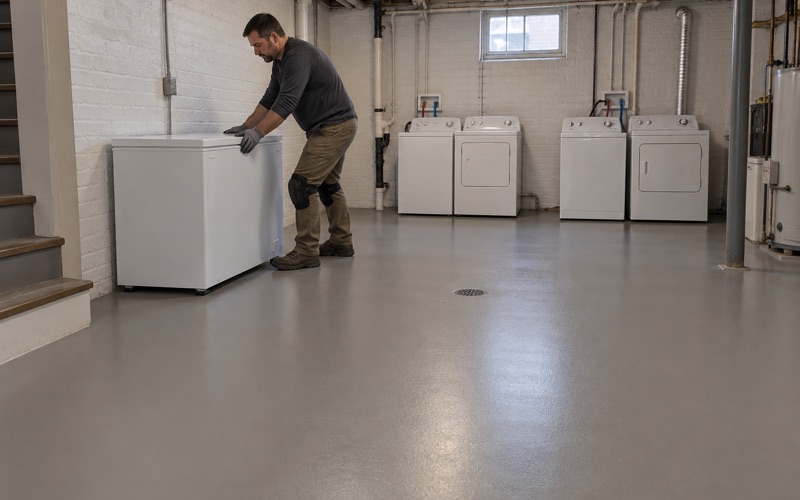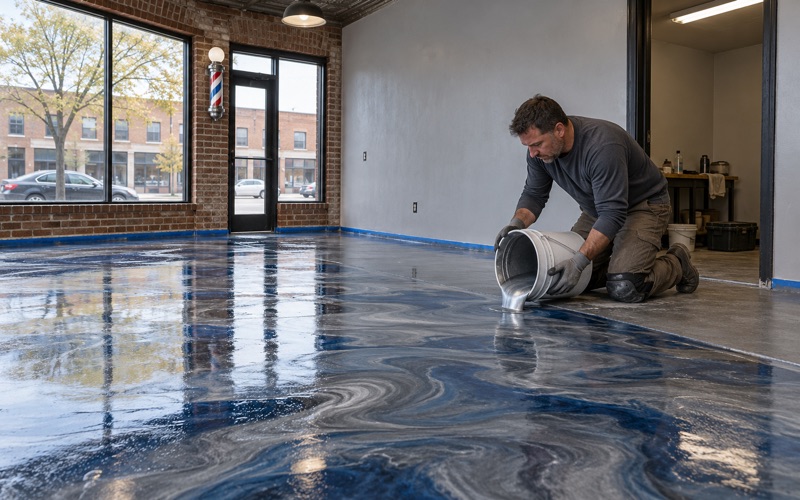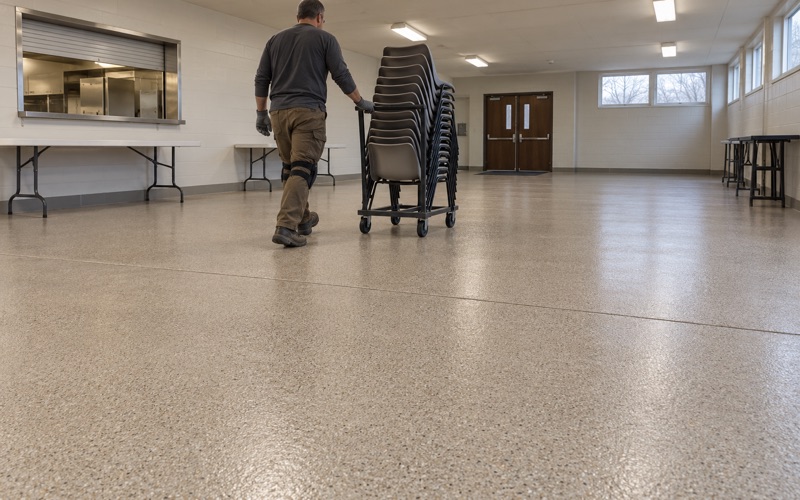
Cicero Epoxy Flooring handles epoxy-flooring in Riverdale with more than 20 years in the trade, and the timing that matters most here is simple: a house that has just changed hands and that nobody lives in yet. An empty basement and an empty garage are the easiest floors we will ever coat, with no shelving to move and no car to park somewhere else.
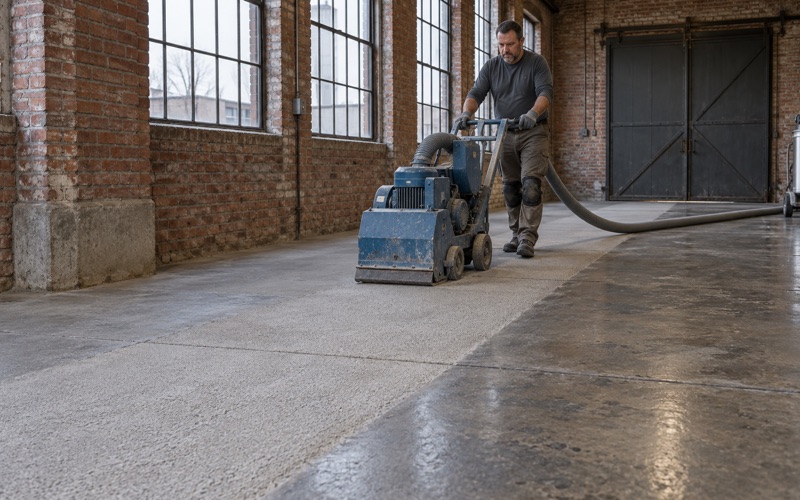
We open every slab mechanically, with a diamond grinder or a shot blaster, because an acid etch leaves a coating too little to grip. Before a price is final, a moisture test goes into the written scope, and the proposal names the product line, the number of coats and the finished thickness so you can hold the floor up against the quote.
This page explains how the village’s point-of-sale process shapes that window, what the inspection does and does not cover, and where a coating fits for a new owner. It also covers the houses that come back after sitting empty, and the water questions a Riverdale basement has to answer before any system goes down.
Every Riverdale Sale Starts With a Village Inspection
Riverdale Municipal Code 15.54 requires a Certificate of Compliance inspection for every proposed change in ownership, and the village asks for the application at least two weeks before closing. The inspection covers both the interior and the exterior. The fee is $220 for a single-family or two-unit building, includes one re-inspection, and the certificate is valid for six months.
The inspectors work for Riverdale Inspectional Services on West 138th Street, and the village notes that they are firefighter and emergency medical personnel. The list they work from leans heavily toward keeping people safe inside the house rather than toward how it looks.
What the Inspection List Covers
The village’s list runs from house numbers, gutters, roofs, paint and tuckpointing to smoke and carbon monoxide alarms, GFCI protection, locks, windows, plumbing and 100-amp electrical service. Basement windows are on it, and so are basement sleeping rooms, which need an egress opening of 5.7 square feet with a sill no higher than 44 inches.
What the list does not name is a floor finish. Nothing in the inspection calls for an epoxy floor, so a coating in this window is the owner’s choice, made for how the house will be lived in rather than to satisfy the village. We say that on the first call, because a buyer under a deadline should spend it on violations first.
Permits and the No-Permit List
The village publishes a list of minor work that may be done without a permit. It includes installing floor covering such as carpeting, floor panels or floor tiles, and basic concrete repair limited to filling cracks and broken corners. A resinous coating is not named on that list, and the village tells owners to check with Inspectional Services about anything else.
So we make that call before the job is booked, and we check Riverdale’s contractor registration, bond and insurance terms at the same time, since Illinois issues no state flooring license. Under the closing affidavit, no work may be done without the proper permits, which is one more reason to settle the question early.
Looking for epoxy-flooring closer to Forest Park? See Epoxy-Flooring in Forest Park.
Sixty Days, an Escrow and an Empty House
When violations remain at closing, the village can issue a conditional certificate if the new owner takes on the repairs. The buyer signs a 60-day closing affidavit and posts an escrow deposit at a flat rate of 3 percent of the purchase price, which is there to guarantee the violations are corrected within those 60 days.
The affidavit is plain about occupancy: nobody, the buyer included, may live in the house until every violation has been corrected and re-inspected. The escrow can be forfeited if violations are not promptly addressed. That leaves a newly bought house empty, on a clock, with its basement and garage wide open.
Where a Floor Fits in the Window
We are not the people who clear violations, and we do not promise that a floor job will help release an escrow or meet the deadline. What we can do is schedule around the violation work, so the electrician, the plumber and the window installer finish in the basement before we grind, and our coating cures before the boxes arrive.
That order matters on a concrete floor. Trades dragging ladders and conduit across a fresh coating will mark it, and a slab that still has open plumbing work may get cut or patched again. We would rather wait a week for the plumber to finish than coat a basement twice.
Cure Time Inside the Deadline
Sixty days sounds generous until the season is wrong. We set cure times by slab temperature and the dew point spread at the slab surface, not by the calendar, and an unheated garage in January is told to wait. A basement is usually easier, since the furnace can hold the room steady once the utilities are on.
In a closing that lands in winter, that can mean coating the basement inside the 60 days and leaving the garage for spring. Polyaspartic topcoats shorten the return-to-service time on a garage, but they still need a dry slab above the dew point, and amine blush on a cold epoxy coat is a defect we will not leave in place.
Older and Vacant Houses Coming Back to Life
Riverdale’s housing is old. In the Census Bureau’s American Community Survey estimate, 74.0 percent of the village’s units were built before 1970, and the 1950s alone account for 34.7 percent, more than any other decade. The same estimate counts about a quarter of units as unoccupied, and some of the houses that change hands come out of that pool.
With that many 1950s houses, a slab from that era is a likely starting point, and it may have been painted more than once and patched in places. Older basement floors get checked for paint, patching compound and old adhesive before we pick a system, because a new coating bonds only as well as whatever is under it.
Vacant Property Registration
Section 15.100 of the village code requires the owner of any building that has become vacant to file a registration statement within 30 days. The owner certifies the property is vacant, secure, posted and insured, with minimum liability insurance of $1,000,000 for a single-family house, and the registration renews by October 1 while the building stays empty.
A house that sat under that registration may reach us with a closed-up basement and a slab that has had no heat or air movement for a long stretch. We run the moisture test after the house has been heated and ventilated for a while, because a reading taken in a cold, shut house says little about the floor a family will live over.
Bank-Owned, Tax-Sale and Rehab Purchases
The village’s packet lists bank-owned and tax-sale purchases among the sale types the Certificate of Compliance covers. A buyer who plans to rehab a house and sell it later must have every violation corrected and re-inspected before reselling, and pay for a new inspection when that sale comes.
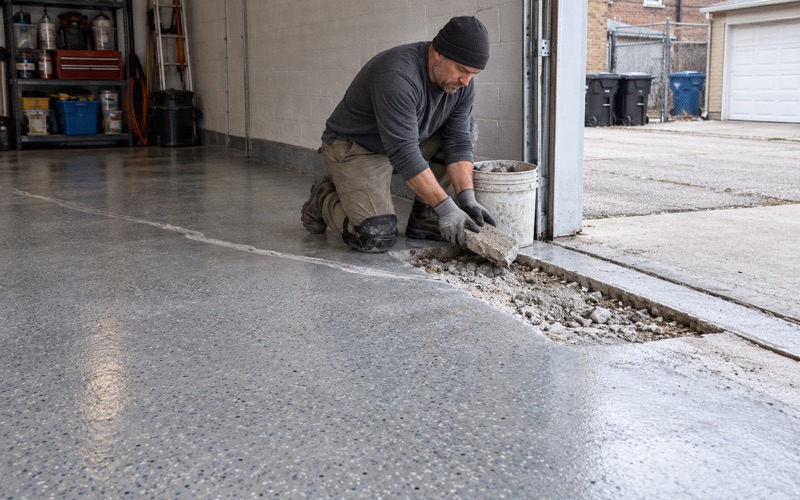
For a rehab, we map the cracks, spalls and old coating first and say so when a floor needs repair or replacement rather than a coating. A finished garage floor is easy to show a later buyer, but only if the slab under it was sound enough to hold one.
The Garage Floor
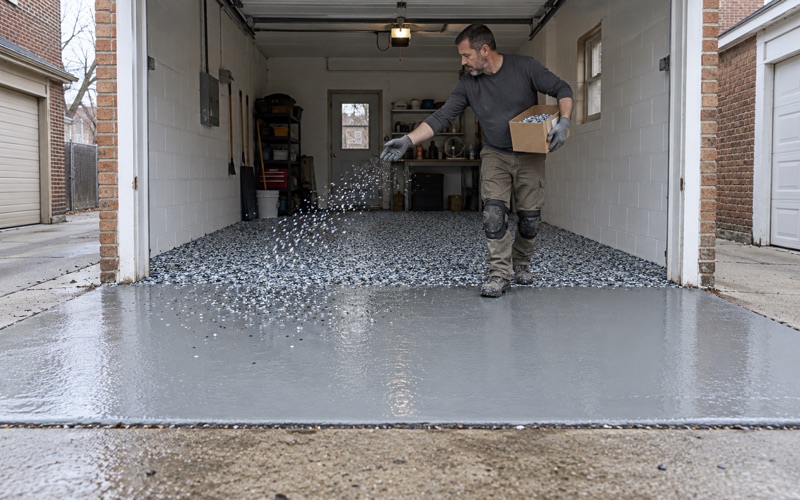
Riverdale garages see the brine and rock salt that ride in on tires all winter. We choose garage systems that stand up to calcium chloride and road salt, usually a 100% solids epoxy base with a vinyl flake broadcast and a polyaspartic topcoat that resists hot tire pickup.
Seepage, Backups and the Northeast Side
The village describes its own water problems plainly. Its hazard-mitigation annex names flooding in areas north of 138th Street and east of School Street, seepage and sewage in basements, and sewage backups in homes on the northeast side. Riverdale sits along the Little Calumet River, and regional stormwater there is managed by the Metropolitan Water Reclamation District of Greater Chicago.
The northeast sewer separation, funded with a $7.4 million Cook County grant secured in 2016, is recorded in the 2024 annex as completed and as having reduced flooding. Reduced is not the same as gone, and a basement that has taken water before still gets the questions first.
Drain and Backflow First
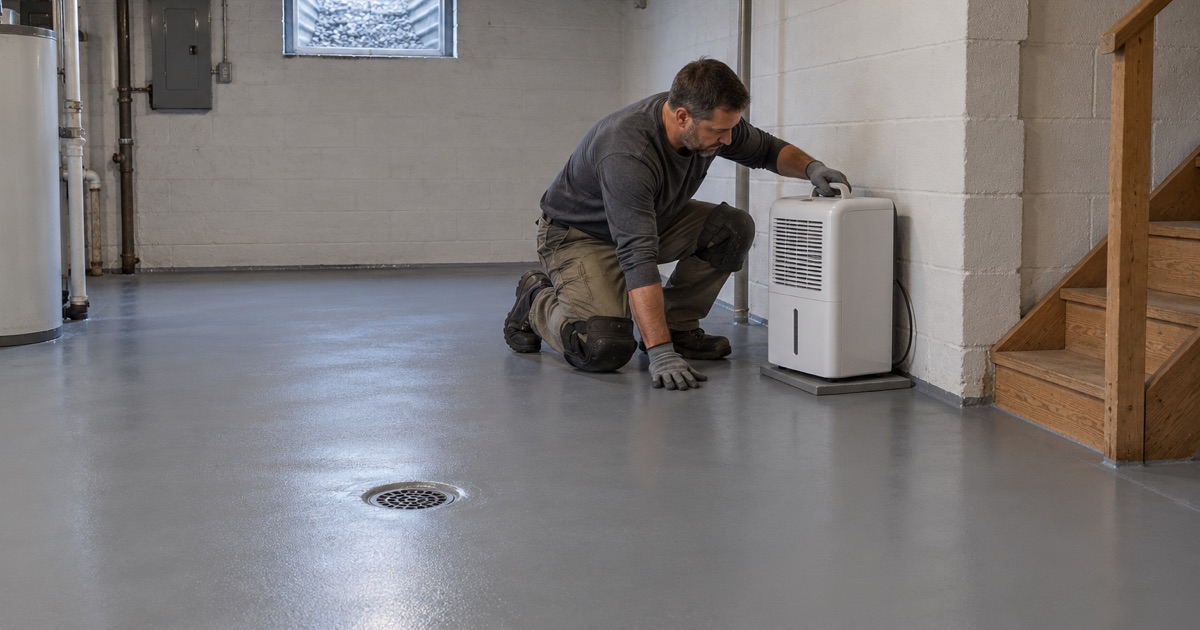
A coating will not stop water coming up a floor drain, and we say so before anything else. If a basement has a history of backups, the drain and backflow question goes to a plumber first, and the floor is coated after the source is dealt with, not instead of dealing with it.
Plumbing already sits on the point-of-sale inspection list, so a buyer may be working with a plumber during the 60 days anyway. That is a sensible time to ask about the drain, before the basement is finished and before anything is stored on the floor.
Testing for Moisture Under the Slab
Seepage is a slab problem as much as a drain problem. We start with an ASTM D4263 plastic sheet test as a quick read, then use ASTM F2170 in-situ relative humidity probes or ASTM F1869 calcium chloride testing when the result decides which system goes down. Efflorescence on the wall base or slab is a sign we note on the map.
When the numbers run high, a moisture-mitigation primer under the coating can be the right answer, and sometimes the honest answer is that the slab should not be coated yet. Moisture is the first exclusion we name in any coating warranty, and we explain the rest of the exclusions before the job is sold.
How the Work Is Run
In an empty house we still keep grinding dust out of the plumbing, vacuuming it at the machine rather than rinsing it toward a floor drain. Products are chosen inside the Illinois VOC limits for floor coatings, and we never sell a basement coating as radon reduction, since that is licensed mitigation work in Illinois. Home jobs over the state threshold also get a written contract and the Illinois consumer-rights pamphlet before any grinding starts.
- 20+ Years on Concrete
- Moisture Tested Before Pricing
- Written Coat-by-Coat Proposals