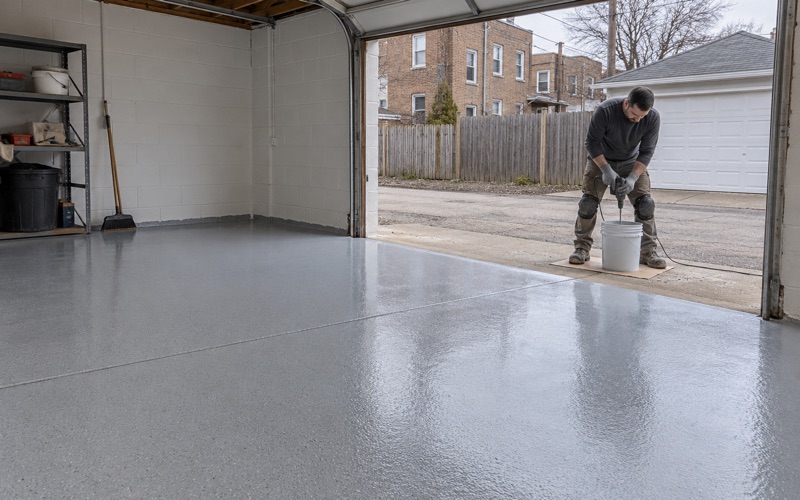
Cicero Epoxy Flooring has spent more than 20 years on epoxy-flooring in River Grove and the surrounding Cook County suburbs, and the floors we think hardest about are the ones animals live on. A coating under paws, crates and a mop bucket fails at its edges first, so our work starts at the joints and seams rather than the middle of the slab.
That approach suits a veterinary clinic, a grooming room, a pet-supply back room or a house with two large dogs and a mudroom door. We open each slab with a diamond grinder or a shot blaster, never an acid etch, because a coating that is only resting on the surface lets liquid creep beneath it. Before the price is settled, a moisture test is written into the scope.
Our written proposal names the product line, the number of coats and the finished thickness, so an owner or practice manager can hold the finished floor against the quote. We are also plain about limits: no resin locks out odor for good, shrugs off every claw, or kills germs by itself, and a sound floor still depends on how it is cleaned.
An Animal Hospital on Grand Avenue Since 1972
Elmwood Grove Animal Hospital at 8330 Grand
River Grove is a village in Leyden Township, Cook County, and a full-service animal hospital sits at 8330 Grand Avenue. Elmwood Grove Animal Hospital has operated there since 1972 and lists surgery, dental care, imaging, electrocardiography, echocardiography and an in-house pharmacy among its services. We have not worked on its floors, but a practice of that scope shows the full range of what a clinical floor takes.
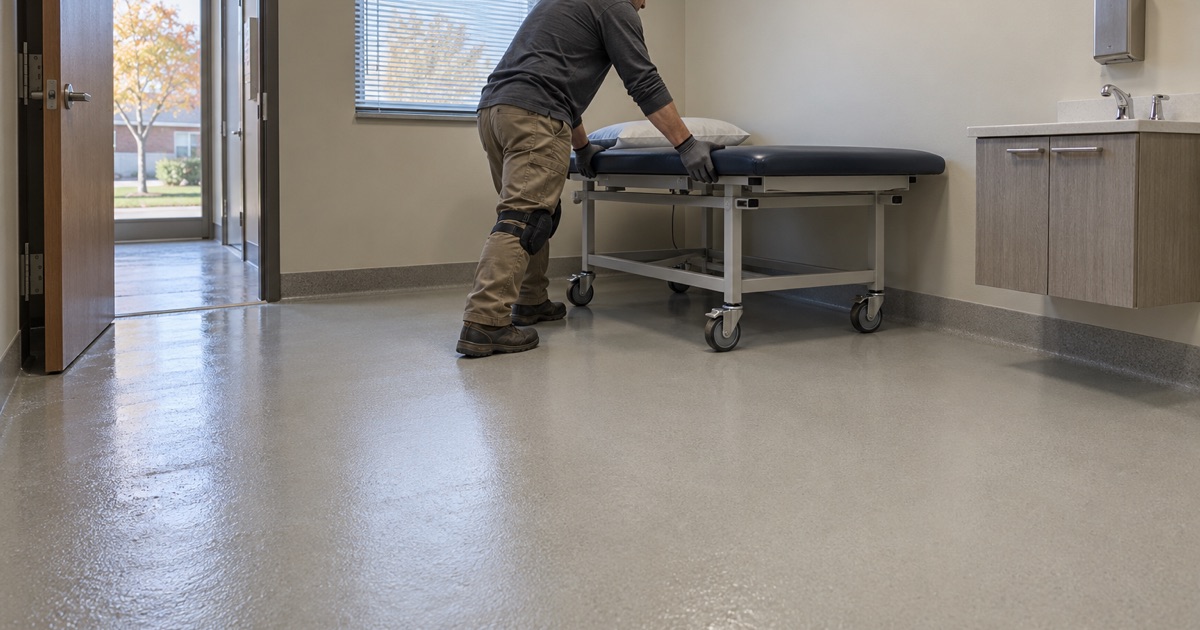
Exam rooms, treatment areas, surgery and holding spaces each ask something slightly different of a floor. Exam rooms see nervous animals and quick cleanups, treatment areas see wheeled carts and dropped instruments, and holding rooms see the longest contact with urine. A floor plan for a practice of this kind is really four floor plans that have to meet cleanly at the doorways.
Other Rooms That Animals Use
A veterinary practice is the clearest case, but grooming rooms, pet-supply stockrooms and boarding businesses face the same three problems: liquid at the seams, claws on the topcoat and a mop that never rests. The system we propose for each depends on how wet the room gets and how many animals cross it in a day, not on a single pet-floor package.
Where a room is hosed rather than mopped, the floor needs a slope to a drain and a cove all around, and we check the existing pitch before promising either. A flat slab can be built up with urethane cement to move water, but that is a larger job and is priced as one.
Who Signs Off on Clinical Floor Work
Any remodeling in River Grove valued over $100 requires a building permit, and concrete work is named in that rule. Permits run through the Village of River Grove Building Department at 2621 N Thatcher Avenue, which also registers contractors on a calendar-year license with a $10,000 trade-specific bond and a certificate of liability insurance naming the village.
Illinois has no state flooring license, so we confirm that registration, bond and insurance before a job is booked rather than after. Fire-code questions on a commercial space go to the River Grove Fire Department, and every product we propose sits inside the Illinois VOC limits for floor and industrial coatings, which bind the applicator.
Looking for epoxy-flooring closer to Westchester? See Epoxy-Flooring in Westchester.
Urine, Seams and the Edges That Decide the Floor
Why Open Joints Fail First
Animal urine is a thin, salty liquid, and it travels. On a floor with open seams, sawcut control joints or a gap where a sheet floor meets the wall, it wicks into the opening, reaches bare concrete and stays there. Mopping cleans the surface above it, which is why a room can look spotless and still smell by afternoon.
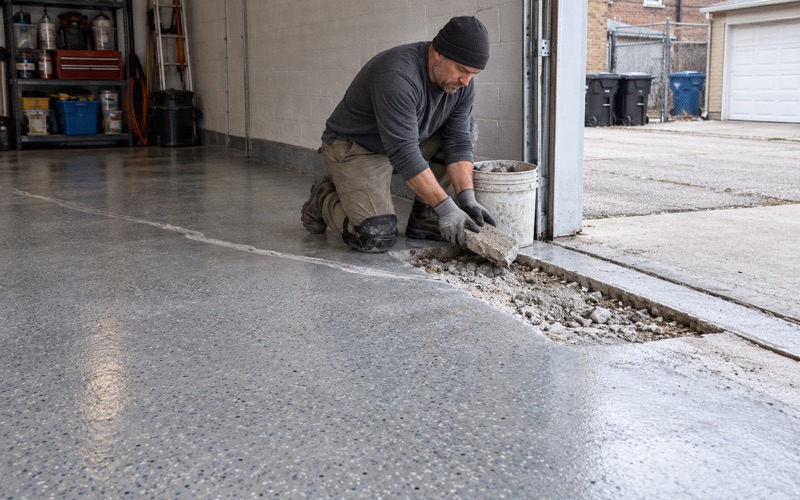
A seamless resin floor removes most of those openings, but only if the joints are dealt with on purpose. We map every crack, spall and joint before pricing, fill the ones that can be filled, and tell the owner plainly when a slab is too broken to coat well. Old coating that has lifted at an edge is ground out completely rather than feathered over.
Coving the Wall Line
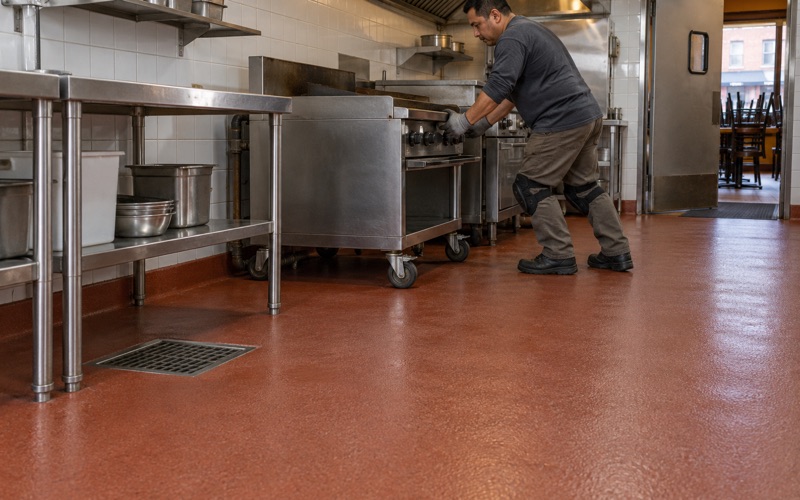
The joint between floor and wall is where clinical floors most often let liquid through. A coved base carries the resin a few inches up the wall in one continuous piece, so there is no corner for urine or mop water to sit in. The FDA Food Code addresses coved floor and wall junctures for food establishments, and that same detail suits a room that is mopped all day.
Cove work is slower than flat work and it shows on the quote as its own line. Where a cove meets a doorway, a drain or a cabinet base, we detail the termination so the edge is sealed rather than simply stopped, because an open termination is just another seam.
Moisture Under the Coating
A slab that pushes vapor upward will lift a coating from below, and a lifted edge is a new seam. We test before we price, using ASTM F2170 in-situ relative humidity probes or ASTM F1869 calcium chloride testing depending on the slab, and a high reading means a moisture-mitigation primer goes into the system.
Moisture is also the first warranty exclusion we name, before anything is signed. A coating warranty that does not cover vapor failure is common across the industry, and an owner should hear that from us at the proposal stage rather than discover it after a corner starts to bubble.
Claws, Wheels and a Mop After Every Patient
Scratches From Claws and Crates
Dog claws dig at a floor most where animals turn, brace or scramble, which means exam room doorways, scale platforms and the stretch in front of a reception desk. A soft topcoat shows those marks quickly. We favor a harder wear layer, often a polyaspartic or urethane topcoat over 100% solids epoxy, and a quartz aggregate broadcast where traction matters more than a smooth sheen.
Harder does not mean untouchable. Any resin floor will collect fine scuffs where crates are dragged and claws dig in, and the realistic goal is a surface that dulls evenly and can be recoated, not one that never marks. We explain that trade before choosing between a glossy finish and a textured one.
Wheeled Tables and Equipment Carts
Imaging units, cardiac equipment and surgery tables roll on small hard casters, and a small caster puts a lot of load on a little area of floor. Those wheel paths wear first and show any weakness in the bond, so the grind profile matters as much as the topcoat. We prepare to an ICRI concrete surface profile matched to the system rather than to a single default.
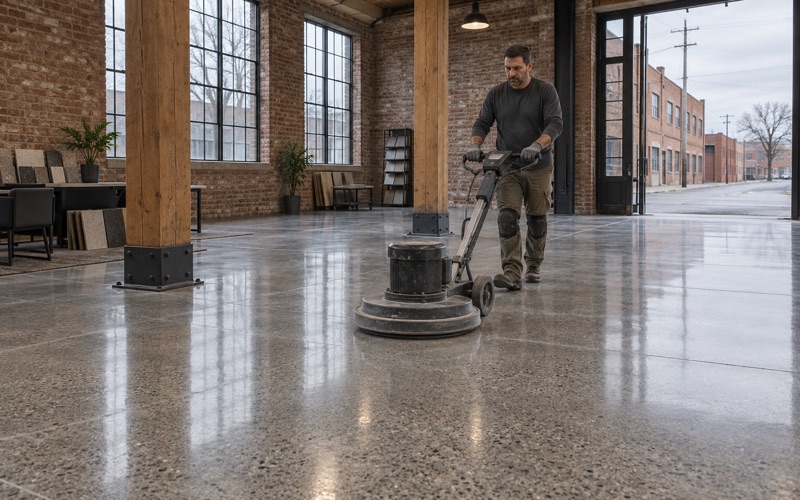
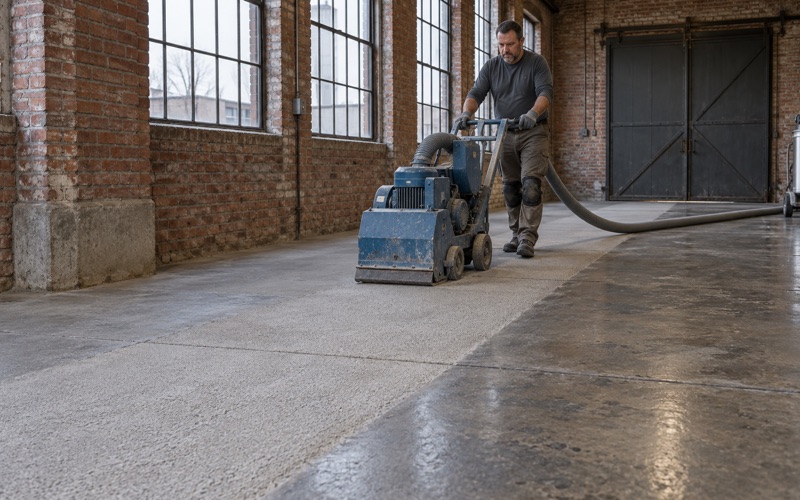
Grinding dust in an occupied building is its own problem. Our grinders are vacuumed at the machine, so the dust is captured where it starts instead of drifting into a pharmacy shelf or a recovery space next door. Shot blasting carries its own dust collector for the same reason.
Mopped Between Every Patient
In a busy practice the floor is disinfected after every patient, which can mean dozens of wet mop passes in a single day. That routine is good for the animals and hard on a weak finish: harsh chemistry softens some topcoats, and standing solution finds every pinhole. We pick a topcoat with the practice’s actual disinfectant in mind and ask for its product sheet before we finalize the system.
Texture is the other half of that decision. A floor that is wet several times an hour needs enough grip for staff carrying an animal, yet a texture too coarse holds dirt and resists the mop. We usually settle on a fine broadcast that a mop can still clean in one pass.
Weekend Work Windows and Floors for Dogs at Home
Working Around Clinic Hours
Elmwood Grove Animal Hospital lists its hours as 8:00 a.m. to 6:00 p.m. on weekdays and 8:00 a.m. to 2:00 p.m. on Saturday, closed Sunday. For any practice on a schedule like that, the realistic coating window opens Saturday afternoon and closes Monday morning, roughly 42 hours to prepare, coat and cure.
That window shapes the product, not the other way around. A full 100% solids epoxy build with a slow cure rarely fits inside it across a whole clinic, so we phase room by room or use fast-curing polyaspartic topcoats, and cure times are set by slab temperature and dew point rather than by the clock. Rooms that are not ready by Monday stay closed.
Phasing a Practice That Cannot Close
Some practices cannot give up a whole weekend. In that case we split the building into zones, coat the treatment and holding rooms on one closure and the exam rooms and lobby on the next, and keep a clean, cured path open between them. Each phase gets its own moisture readings, because two rooms on one slab do not always read alike.
Odor from new resin matters in a building full of animals with sensitive noses. Low-odor products and a long ventilated cure before Monday are part of the plan, and the pharmacy and recovery rooms are sealed off while work is under way. We confirm ventilation with the practice before the first grinder starts.
Mudrooms and Basements for Dogs at Home
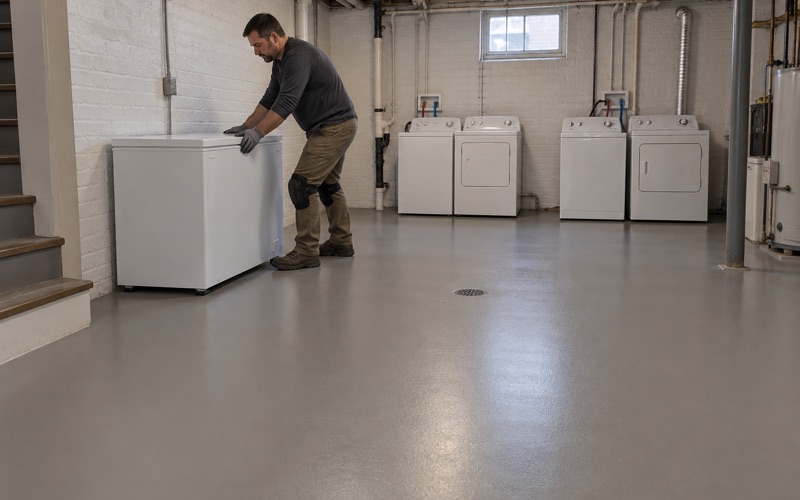
The same problems follow a family dog home. A basement laundry room where a puppy is crated, or a mudroom by the back door, takes urine, wet paws and claws in a smaller space, and River Grove has plenty of older housing: about 44 percent of its units were built before 1960. Older basement floors often carry paint, patching compound or old adhesive, and we check for each before choosing a system.
We are also honest about what a basement coating cannot do. It will not stop water coming up a floor drain, so the drain and backflow question comes first, and it is not radon reduction, which in Illinois is licensed mitigation work. Home jobs above the state threshold get a written contract and the Home Repair: Know Your Consumer Rights pamphlet before any grinding begins.
Garages That Double as Dog Entrances
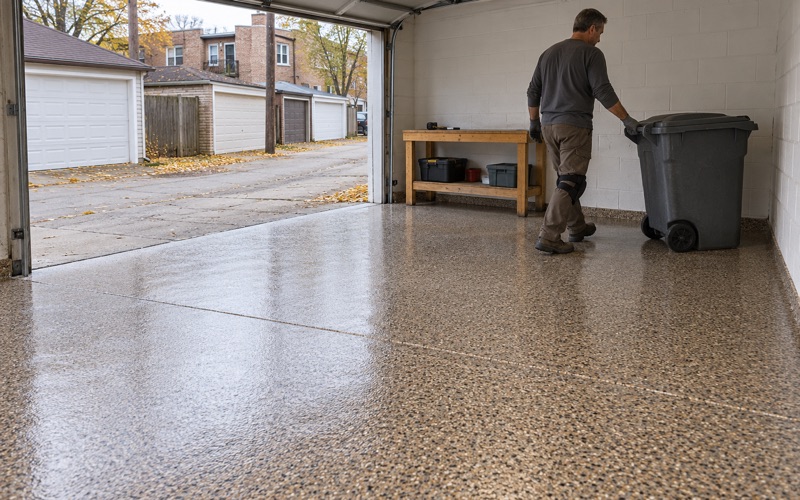
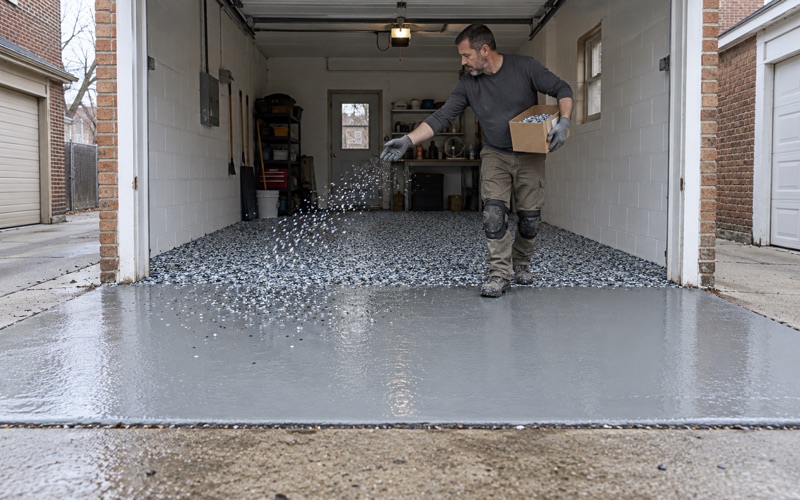
Where a household’s dog comes and goes through the garage, that floor also takes the brine and rock salt that ride in on tires each winter. We choose garage coatings to hold up to those deicers, and a vinyl flake broadcast hides the fine scuffs that claws leave better than a solid color.
Hot tire pickup is the other garage-specific risk, where warm tires lift a weak coating off the slab. It traces back to thin product and poor preparation far more often than to the car, which is why the grind and the full-thickness build named in the proposal matter more than the brand on the pail.
- 20+ Years on Concrete
- Moisture Tested Before Pricing
- Written Coat-by-Coat Proposals