
Cicero Epoxy Flooring installs polyaspartic floor coating systems in Cicero, IL, serving surrounding cities including Forest Park, Lyons, River Forest, Brookfield and Summit. We have been preparing and coating concrete for 20+ years, and polyaspartics are the materials where that experience shows most, because they cure fast and leave very little room for mistakes once they are mixed.
Polyaspartic coatings are prized for speed, color stability in sunlight and resistance to abrasion, hot tires and deicing salt. They are not a shortcut around preparation, though, and a fast-curing coating applied over a poorly prepared slab simply fails faster.
So every polyaspartic job starts the same way ours always do: diamond grinding or shot blasting rather than acid, a moisture test before the price is set and a written proposal listing the product line, the coat count and the finished thickness. You know what is going onto your floor before the first batch is mixed.
What Makes Polyaspartic Different
Fast Cure and Short Downtime
Polyaspartic coatings cure in hours rather than the day or more many epoxies need between coats. That lets a crew apply several coats in one working day and, on suitable floors, return a garage or shop to light use much sooner than an all-epoxy system allows.
The speed is the main reason businesses choose it. A retail floor, a service bay or a showroom can often be coated over a weekend and reopened on Monday, which matters when every closed day costs sales.
Color Stability Under Sunlight
Standard epoxy ambers, turning yellow under ultraviolet light from open garage doors, skylights and windows. Polyaspartic is aliphatic, which means it resists that yellowing and keeps clear topcoats clear and light colors true.
That makes polyaspartic the topcoat we usually specify wherever a floor sees daylight. A gray flake floor that stays gray for years looks very different from one that drifts toward yellow in its first summer.
Abrasion, Hot Tire and Chemical Resistance
Polyaspartic topcoats resist scuffing from foot and tire traffic and hold up well against hot tire pickup. They also stand up to oil, gasoline and many household and shop chemicals when spills are cleaned up in reasonable time.
For garages that take road salt, calcium chloride and brine all winter, that resistance protects the concrete underneath. The salt stays on the surface, where it can be squeegeed out instead of soaking into the slab.
Short Pot Life and Skilled Application
The same chemistry that makes polyaspartic cure fast also gives it a short pot life once mixed, sometimes only minutes. Crews mix in measured small batches, spread with a squeegee and back-roll quickly, and keep a wet edge so laps do not show.
This is where an experienced crew earns its cost. Hurried or uneven application shows up as roller lines, thin spots and trapped bubbles, and with a fast-curing material there is no time to go back and fix them before the coat sets.
Residential Polyaspartic Floor Coating
Polyaspartic Garage Floors
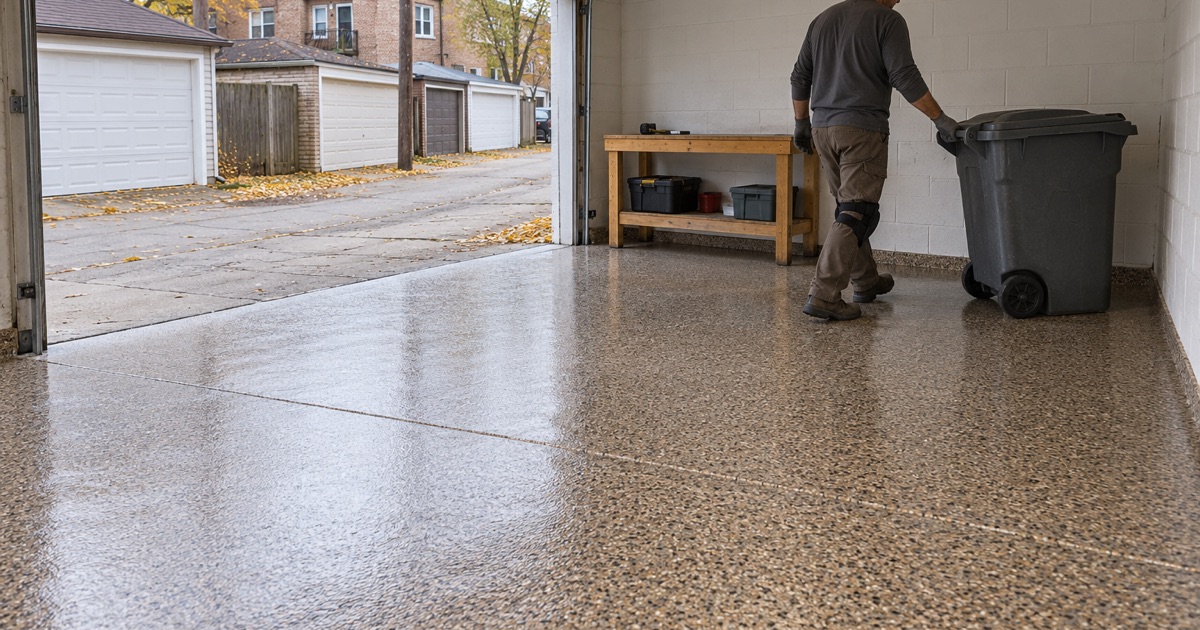
In a garage, polyaspartic is most often used as the topcoat over an epoxy or polyaspartic base with a full vinyl flake broadcast. The base builds thickness and holds the flake, and the polyaspartic top seals it with a UV-stable, salt-resistant wear layer.
Some garages are coated with polyaspartic from base to top in a single day. That works on a dry, sound slab with modest repairs, and we tell you up front if your floor is not one of them.
Detached and Unheated Garages
Many polyaspartic products are formulated to cure at lower temperatures than standard epoxy, which helps in an unheated detached garage in late fall or early spring. Cold slabs still slow the cure, and condensation is the bigger risk.
We measure slab temperature, air humidity and dew point spread before mixing. If the slab is too close to the dew point, moisture condenses on the surface and the coating can cloud or lose bond, so we wait rather than push ahead.
Basements and Moisture Concerns
Polyaspartic can be used in basements, but it is less tolerant of moisture vapor coming up through the slab than a dedicated moisture-mitigation primer. In older basements, many of which have no vapor retarder under the slab, we test first.
Where results run high, a mitigation primer goes down before any polyaspartic coats. That primer, not the topcoat, is what keeps the floor from blistering when vapor drive increases in summer.
Texture and Slip Resistance in Wet Garages
A smooth, glossy polyaspartic topcoat can get slick when snowmelt drips off a car. We add texture in one of two ways: a full flake broadcast that leaves a slightly rough surface, or a fine anti-slip aggregate mixed into the final coat.
The amount of texture is a trade-off between grip and how easily the floor cleans, since a rougher surface holds more dirt. We show sample boards with different textures so you can feel the difference before choosing one.
Commercial Polyaspartic Floor Coating
Retail, Showrooms and Service Bays
Businesses use polyaspartic where downtime is the biggest cost of a new floor. Showrooms, retail aisles, auto service bays and offices can often be coated in phases over evenings and weekends, keeping the doors open during regular hours.
The fast cure also helps in winter, when a long epoxy cure in a cold building would stretch a job for days. Polyaspartic keeps the schedule short without heating the space for an extended period.
Where Polyaspartic Is Not the Right Choice
Floors washed with hot water every shift, such as commercial kitchens and food plants, usually need urethane cement instead. Heavy industrial floors with steel-wheeled carts or severe impact loads may need a thicker system than a polyaspartic coating provides.
We match the material to the floor’s real conditions, and sometimes the right answer for a commercial space combines a urethane cement or thick epoxy base with a polyaspartic top only where daylight or appearance matters.
Recoating an Existing Polyaspartic or Epoxy Floor
A worn but well-bonded floor can often be renewed with a fresh polyaspartic topcoat instead of being ground back to bare concrete. The old surface is cleaned, lightly abraded to give the new coat a profile and checked for spots where the original coating has lifted.
Areas that have delaminated are cut back and repaired first, because a new topcoat over a loose base only fails along with it. Recoating is far less disruptive than a full replacement, which makes it a practical option for busy commercial spaces.
VOC Rules for Polyaspartic Products
Some polyaspartic products contain solvents, and Cook County sits inside the Chicago 2015 ozone nonattainment area. Illinois VOC limits for floor and industrial coatings, in 35 Ill. Adm. Code Part 223, apply to whoever applies the product, not only to the manufacturer.
We select polyaspartic materials that comply with those limits before they are ordered. That protects the building owner as well as the job, since a noncompliant product is a problem nobody wants discovered after it is on the floor.
Our Step-by-Step Polyaspartic Floor Coating Process
Step 1: Inspection and Moisture Test
We map cracks, spalls and existing coatings, test the slab for moisture and check the space for temperature and ventilation. The results decide whether a primer is needed and whether a one-day schedule is realistic.
Step 2: Grinding and Repair
The floor is diamond ground or shot blasted to the surface profile the system requires, and cracks and spalls are filled with fast-setting repair material. Dust is captured by vacuums at the grinder.
Step 3: Base and Broadcast
The base coat goes down in small batches, followed by a flake or quartz broadcast if the system calls for one. Excess broadcast is removed once the base has set.
Step 4: Polyaspartic Topcoat and Cure
The polyaspartic topcoat is applied with careful timing and a wet edge, then left to cure. We give you walk-on and drive-on times for the specific product and the conditions on the day.
- 20+ Years on Concrete
- Moisture Tested Before Pricing
- Written Coat-by-Coat Proposals