
Cicero Epoxy Flooring grinds and finishes polished concrete floors in Cicero, IL, serving surrounding cities including Forest Park, Lyons, River Forest, Brookfield and Summit. Polishing is a different trade from coating, and in more than 20 years on concrete we have learned that its results depend almost entirely on reading the slab correctly before the first diamond touches it.
A polished floor has no film to peel, blister or wear through. The concrete itself is ground in stages, hardened with a densifier and refined until it reflects light, so the slab you already own becomes the finished floor.
Because there is nothing to hide behind, we map cracks, patches, old coatings and oil staining at the first visit and tell you plainly how they will look once polished. Some floors are better served by an epoxy or urethane system, and we would rather say so than polish a floor you will not like.
Commercial Polished Concrete Floors
Warehouses and Distribution Floors
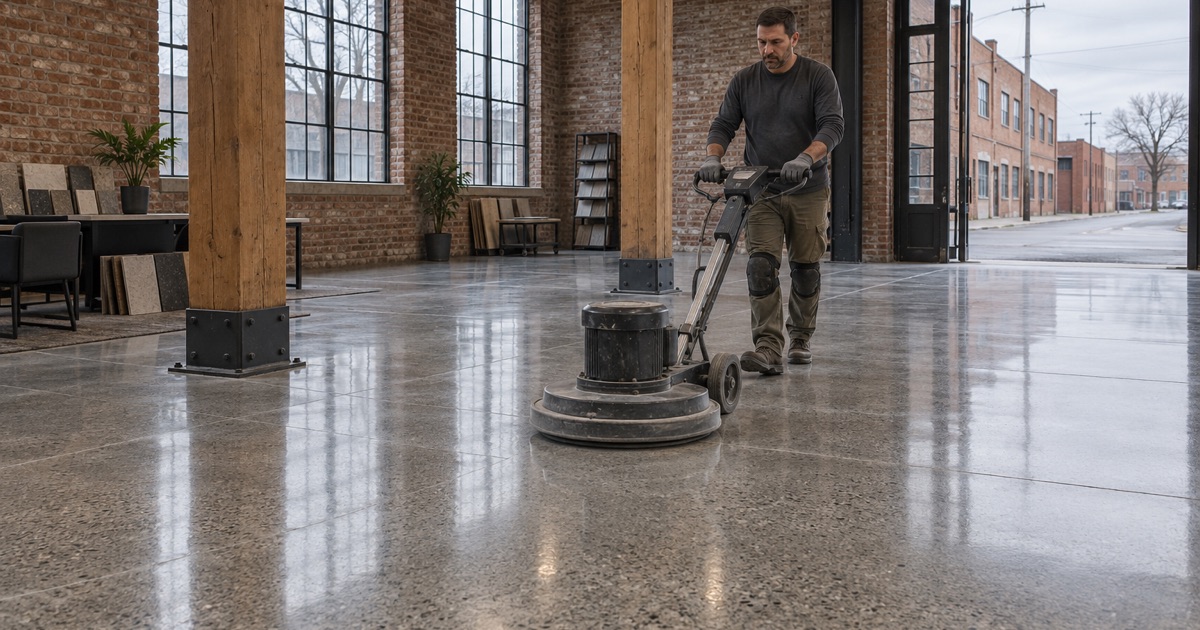
Warehouse slabs are often the best candidates for polishing: large, continuous pours with consistent concrete and steady forklift traffic. A densified, polished surface resists dusting, is easy to sweep and reflects overhead light, which can brighten aisles between tall racking.
Cicero’s floor stock includes large distribution space, such as the 500,000 square feet of warehouse at the Breakthru Beverage facility on South Laramie Avenue. Floors of that scale are polished in phases, aisle by aisle, so the building keeps shipping while the work moves through it.
Retail, Showroom and Office Floors
Retail stores, showrooms and offices choose polished concrete for a clean, modern look that holds up to carts and foot traffic. A medium or high sheen with salt-and-pepper exposure is common in these spaces, and color dyes can tint the floor without a coating.
Saw-cut lines, borders and logos can be added during the polishing process. Existing control joints are filled with a semi-rigid filler so cart wheels roll smoothly and debris does not collect in the cuts.
Former Shop and Industrial Floors
Cicero has a long industrial history, and some slabs in older buildings carry cutting oil, hydraulic fluid and metal-working residue deep in their pores. Polishing does not remove deep oil staining, it exposes it, so those floors can show dark shadows after grinding.
We test-grind suspect areas to see how far contamination runs. Where it is deep, we discuss either accepting the character marks or switching to a coating system that can be built over a properly cleaned slab.
Residential Polished Concrete Floors
Polished Basement Floors
A polished basement floor gives a finished look without a film that moisture could lift. That said, older basements often carry paint, patching compound and tile adhesive, and all of it has to come off before the polishing steps begin.
Efflorescence, the white salt deposit left by moisture moving through the slab, also has to be addressed. Polishing improves the look of a basement floor, but it does not stop water coming through cracks or up a floor drain, and those problems come first.
Main Floors and Garages
Some homes built on slabs, along with additions and finished garages, use polished concrete as the living-area floor. A lower sheen reads warmer in a home, and area rugs and furniture pads protect the surface in high-use rooms.
In a garage, plain polished concrete is more exposed to winter road salt than a coated floor. We discuss how the space is used before recommending polish over a chemical-resistant coating for a parking area.
Dyes and Color Options for Polished Floors
Polished concrete does not have to stay gray. Water- or solvent-based dyes can be applied during the grinding sequence, before the densifier, so the color sits inside the refined surface instead of in a film on top of it. Earth tones, charcoal and deep blues are common choices.
Dye takes differently across a slab, darker where the paste is open and lighter over dense patches, so the result is mottled rather than uniform. We dye a test area first so you can see how your particular slab accepts color before the whole floor is committed.
How a Polished Concrete Floor Is Made
Crack and Joint Repair Before Polishing
Cracks and spalls are filled before the fine grinding steps, using fillers that can be ground and polished with the surrounding concrete. Repairs remain visible as lines or patches, which many owners accept as part of the character of a polished floor.
Where a crack is still moving, a rigid fill will reopen. We check whether cracks are active before choosing the filler, and leave flexible joint material in control joints that need to move with the slab.
Grinding Through the Grit Steps
Polishing starts with coarse metal-bonded diamonds that flatten the slab and set the aggregate exposure. Each following pass uses a finer grit, removing the scratches left by the step before, until resin-bonded diamonds bring up the shine.
Skipping steps saves time but leaves swirl marks that show under light. We keep the sequence and inspect each pass under a work light before moving to the next grit.
Lithium Silicate Densifier
Partway through the grinding sequence, a lithium silicate densifier is applied. It reacts with the concrete to form a harder, denser surface that resists dusting and abrasion and polishes to a better shine.
The densifier soaks into the slab rather than sitting on top, so it cannot peel or delaminate. Its effectiveness depends on clean, open concrete, which is another reason the earlier grinding steps matter.
Aggregate Exposure and Sheen Levels
Cream finishes keep the top paste with almost no stone showing, salt-and-pepper exposes fine sand and small aggregate, and full exposure reveals larger stones. The deeper the grind, the more labor and diamond wear, which affects price.
Sheen ranges from a low satin to a high gloss, set by the final grit. We help match the sheen to the space, since high gloss looks striking in a showroom but shows dust and scuffs faster on a busy floor.
Stain Guard and Protection
A penetrating stain guard is applied after the final polish to help the surface resist oil, coffee and other spills. It is not a thick coating and is maintained by burnishing rather than stripping and recoating.
No stain guard makes polished concrete fully chemical-proof. Spills should still be wiped up promptly, especially acidic ones like vinegar, citrus or some cleaners.
Polished Concrete or an Epoxy Coating?
When Polishing Is the Better Choice
Polishing makes sense where the slab is sound, the traffic is dry and the owner wants low maintenance with no recoating schedule. Warehouses, retail floors and offices often fit that profile, and so do many basement floors that stay dry. A polished floor also avoids the cure-time downtime of a multi-coat system, which can matter for businesses that cannot close for several days.
Long-Term Upkeep Compared
A polished floor is maintained with dust mopping, neutral cleaners and periodic burnishing, and it can be refreshed with a light repolish years later. A coated floor is easier to keep spotless in wet, greasy spaces but eventually needs its topcoat renewed when traffic wears through.
Neither choice is free of upkeep. The question is which routine fits the building, and we spell out what each floor will need over its life before you decide.
When a Coating Wins
Floors exposed to deicing salt, harsh chemicals, hot water or constant wet cleaning usually do better with an epoxy, polyaspartic or urethane cement system. Badly pitted, patched or oil-soaked slabs also look better coated than polished. We lay out both options side by side when a floor could go either way, with the trade-offs in look, cost and upkeep spelled out.
- 20+ Years on Concrete
- Moisture Tested Before Pricing
- Written Coat-by-Coat Proposals