Cicero Epoxy Flooring has been doing epoxy flooring in Palos Heights and across the southwest suburbs for more than 20 years, and the floors we are asked about here are rarely simple. Chemical storage, standing water and bare feet all ask different things of a coating. We start by finding out which of those a floor actually faces before we name a system.
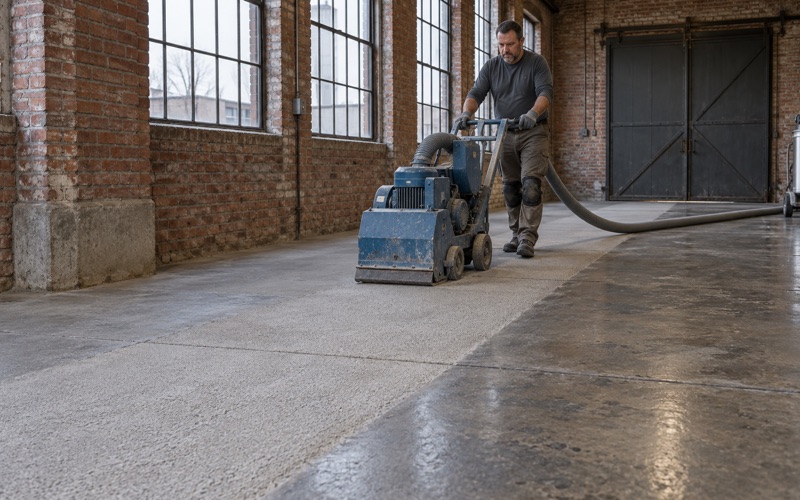
Every slab is opened mechanically, with a diamond grinder or a shot blaster, because an acid etch leaves too little profile for a coating to hold. Moisture testing goes into the scope before the price is settled, and the written proposal names the product line, the coat count and the finished thickness. That gives an owner or a facilities manager a quote they can measure the finished floor against.
We also map cracks, spalls and old coatings first, and we say so when a floor needs repair or replacement rather than a new finish. What a warranty excludes is explained before anything is signed, and moisture is the first exclusion we raise. The sections below cover the conditions that shape that work in this city.
A City Pool on College Drive and the Room Nobody Swims In
The city-run Palos Heights Pool sits at 7607 W. College Drive and first opened in 1972. In August 2024 it closed early, on August 18, so work could begin on what the city calls the largest renovation since that first season. The city’s own description names renovated mechanics of the pool, and the 2025 season that followed drew over 30,000 visits.
We mention it as a place, not a client. Which rooms were rebuilt, and what floors they carry now, is not something we have read, and we will not guess. What the pool does illustrate is a kind of floor that also exists in private clubs, swim schools and backyard pool houses across the area.
The filter and chemical room
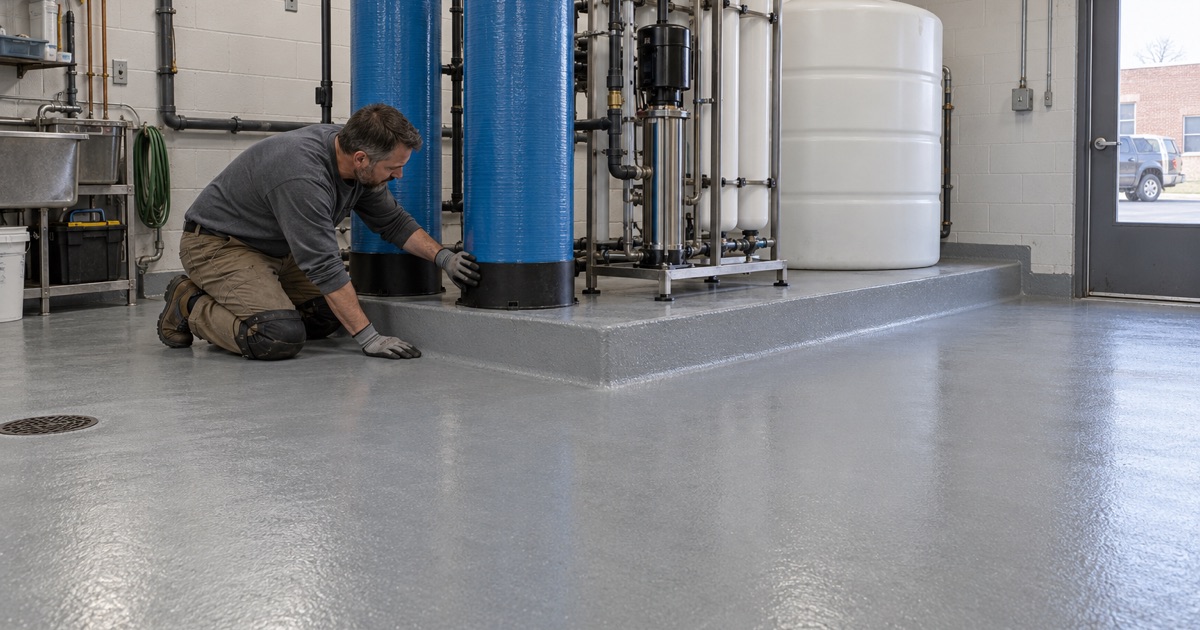
An outdoor pool usually has a room the swimmers never see, where the pumps and filters run and the water treatment is stored and dosed. In a typical chemical room that means liquid chlorine, usually sodium hypochlorite, and an acid used to pull the pH back down. Drums get dragged, transfer lines drip and spills land on the slab.
That room also stays damp for months at a time, with condensation on cold pipes and water from backwashing and hose-downs. A floor there has to tolerate splashes it cannot fully escape, drain cleanly toward a sump or floor drain, and stay readable, so a fresh spill shows up before it has sat for a week.
Why this matters more after new mechanics
New pumps, filters and feed equipment are a reason to look at the floor under them, not a reason to ignore it. Equipment pads, anchor points and pipe penetrations are where coatings tend to lift first. If those details are left bare during a mechanical upgrade, the floor around the new equipment can start to fail long before the equipment does.
We look at those details on any equipment-room job. The coating is turned up at the base of pads and walls as a cove, sealed around penetrations, and terminated at a ground-in key at doorways and drain edges, so liquid has no lip to slide under.
Looking for epoxy-flooring closer to Crestwood? See Epoxy-Flooring Services in Crestwood.
What Chlorine and Acid Do to Concrete
Bare concrete is a poor match for a pool chemical room. Acid attacks the cement paste and leaves the sand and stone standing proud, and chlorine solutions keep a slab wet and salty while they work into any open pore. Over enough seasons, the top of the slab turns soft and dusty, and stains travel deep enough that cleaning stops reaching them.
Coated is better, not invincible
A coating changes the problem rather than ending it. A properly built 100% solids epoxy base holds up well to the splashes a chemical room sees, and a chemical-resistant topcoat adds a layer that can be renewed. No floor we install is immune to concentrated chemicals left standing, and we say so in the proposal.
Some acids and concentrated hypochlorite will dull, soften or discolor even a good system if they sit. That is why we talk about where drums live, whether there is a spill pan, and how often the floor gets rinsed. Those habits decide the life of the coating as much as the product does.
Urethane cement where the room runs wet
Where a room is wet and warm for long stretches, urethane cement is often the stronger base. It tolerates more moisture in the slab and handles thermal swings that can stress a thin epoxy film. We pick between the two after testing, using ASTM F2170 in-situ relative humidity probes or an ASTM F1869 calcium chloride test.
Old pump rooms often hide a history: paint, patching compound, oil around motors and adhesive from earlier mats. Each of those has to come off before anything new goes down, and some leave the concrete needing a moisture-mitigation primer or repair before a coating is worth applying.
Ventilation and odor during the work
Chemical rooms tend to be small and tight, which matters during installation as well as afterward. We select products inside the Illinois VOC limits for floor and industrial coatings, which bind the applicator, and we plan air movement so cure fumes do not settle in a closed room or drift into an office next door.
Barefoot, Wet and Slip-Textured
The rest of a pool building is a different problem. Showers, restrooms, the concession front and the walk out to the deck carry bare feet, soap, sunscreen and a steady film of water. Here the floor is judged on grip and on how easily it can be kept clean, more than on chemical resistance.
At the Palos Heights Pool those areas serve swimmers headed for a Z-shaped main pool with a drop slide, diving board and body slide, plus a 2-foot wading pool for small children. That mix of ages and wet feet is exactly the traffic a slip-textured, seamless floor is meant for.
Texture that bare feet can live with
Grip on a wet floor comes from the broadcast, not the resin. A fine quartz aggregate broadcast locked under the topcoat gives traction that is still comfortable underfoot, while a coarse grit that suits a loading dock would scrape a barefoot child. We set texture by sample, wetting a test board so the owner can stand on it.
Too much texture has its own cost, because grime settles into it and cleaning gets harder. The right answer for a shower room is rarely the right answer for the deck walk, so we often vary the broadcast from one room to the next.
Seamless floors and coved edges
Grout lines and the joint where floor meets wall are where water sits and mildew starts. A seamless resin floor with an integral cove carried a few inches up the wall removes that corner, which makes a shower room or restroom far easier to hose down and squeegee at closing time.
Slope matters as much as finish. Before coating, we check that each wet room actually falls to its drain, because a coating follows the slab and will not fix a low spot that holds a puddle.
The concession front
A concession stand adds grease, syrup and dropped ice to the mix. Where food is handled, coved floor and wall junctures are a familiar sanitation detail under the FDA Food Code, and a textured finish keeps the counter line from becoming the slickest spot on the property.
Working Between September and June, at Pools Large and Small
A pool floor cannot be coated while people are using the pool. For an outdoor pool here that leaves one window, from the early-September close to the June opening. The city has announced that the Palos Heights Pool closes for the 2026 season on September 8, and its posted open-swim season has begun on June 6.
Fall is the better half of the window
Resin cure is set by slab temperature and the dew point spread at the surface, not by the calendar. September and October usually give warmer concrete and drier air than March, so we push owners to book fall work. An unheated pump room in January is told to wait, or to bring in temporary heat that holds the slab where the product needs it.
Spring work is possible, but it runs against the opening date. A floor that misses its temperature window in April can push the topcoat into late May, which leaves little room for a full cure before chemicals and swimmers return.
Drained equipment and damp slabs
Off-season does not mean dry. Equipment rooms are often shut up over winter with water still in low spots, and the slab can hold moisture well into spring. We run moisture tests in the off-season itself, not in July, so the system chosen matches the slab as it will be on the day we grind.
Home pool equipment rooms and pool houses
Homeowners with their own pools face the same floors at a smaller scale. A pool house with a shower, a changing room and a shed full of chlorine tablets and acid jugs is a chemical room and a wet area in one, and it is often a plain slab that has never been sealed.
For those rooms we usually separate the storage corner, with a chemical-resistant topcoat and a curb or tray, from the barefoot zone, which gets a finer texture. Home jobs over the state threshold get a written contract and the Home Repair: Know Your Consumer Rights pamphlet before any grinding begins.
Pool equipment often shares a basement or garage with a floor drain, and we say plainly that a coating will not stop water coming up that drain. The drain and its backflow protection are a separate question, and we raise it before the floor is priced.
- 20+ Years on Concrete
- Moisture Tested Before Pricing
- Written Coat-by-Coat Proposals