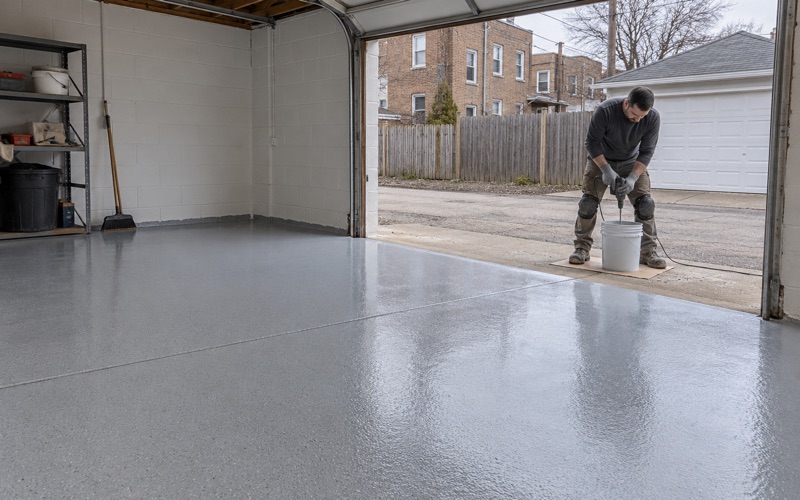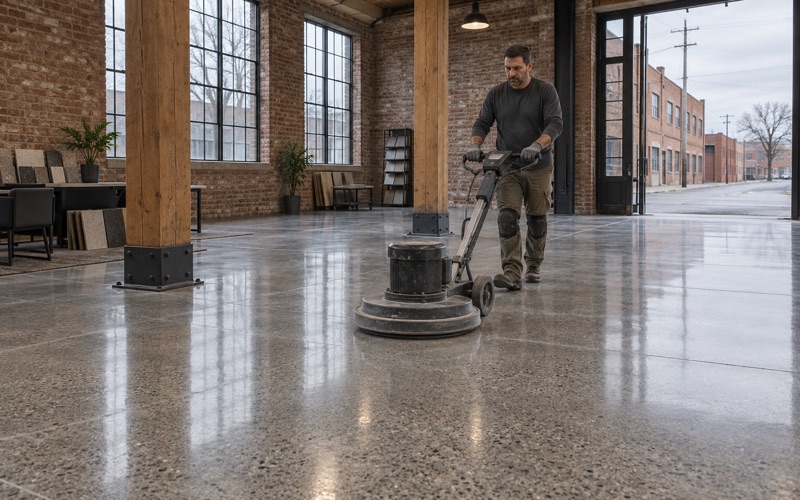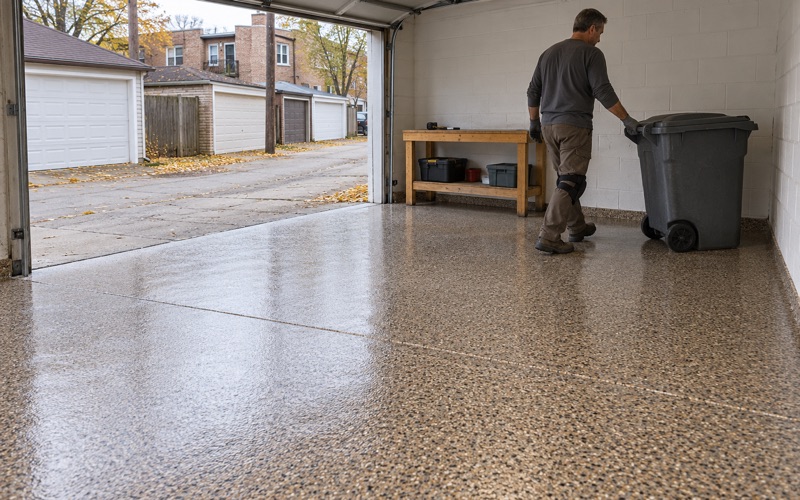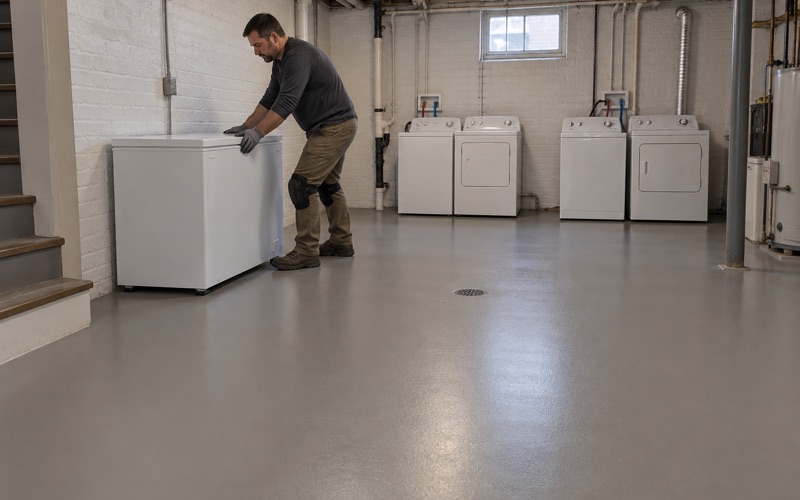
Cicero Epoxy Flooring has spent more than 20 years on epoxy flooring in Norridge and the surrounding area, and the floors we take most seriously are the ones that face abuse a garage never sees. A teaching lab is one of them. Acids, stains and broken glass land on the same surface that wheeled tables cross dozens of times a day, and the coating has to answer all of it at once.
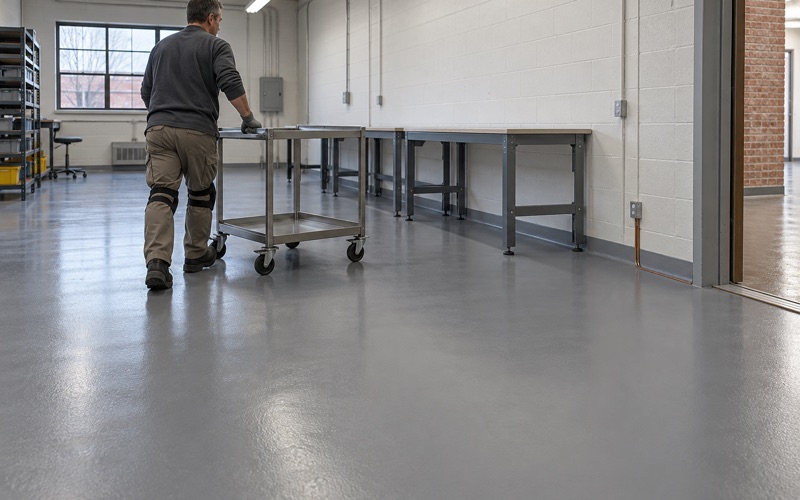
That kind of room calls for a different specification than a decorative flake floor. We look for a seamless surface with no joints for liquid to find, a cove that turns the coating up the wall, a resin chosen for the chemicals actually used in the room, and enough texture to keep footing when the floor is wet. Each of those choices is written into the proposal before work is scheduled.
Our proposals name the product line, the number of coats and the finished thickness, so a facilities manager or a building owner can check the installed floor against the quote. Every slab is opened mechanically first, and a moisture test sits inside the scope before the price is final. The sections below cover what a lab floor faces and how we build one to handle it.
A New STEM Lab on Montrose Avenue
Ridgewood’s Renovation Program
Ridgewood High School sits at 7500 West Montrose Avenue in Norridge, part of Ridgewood Community High School District 234, which enrolled 988 students in 2024-2025. Over the past decade the district has listed a field house, an auditorium, a band room, student commons space and a new STEM lab among its additions. Some of that work was funded in part by a Federal Aviation Administration sound abatement grant tied to O’Hare.
We did not install that floor and have not read its specification, so nothing here describes what is under the lab tables at Ridgewood. What the district does describe is useful anyway. Its STEM lab uses mobile furniture so the room can be reconfigured, and that one detail tells a flooring contractor most of what the surface underneath it has to survive.
Flooring Was Already Part of the 2011 Work
Floors at the school have changed before. In December 2011, Rep. Schakowsky toured a Ridgewood renovation that soundproofed the building against O’Hare noise and added new flooring and cabinets, funded through the O’Hare Noise Compatibility Commission’s School Sound Insulation program by way of the Chicago Department of Aviation and the FAA. At that time the school planned a STEM Education Coalition lab for a program starting the following fall.
We mention it as history, not as a claim about which floor went where. The point for a building owner in the village is that a lab floor is rarely a one-time decision. Rooms get renovated, furniture changes, and a coating chosen for one use is asked to carry another, so the specification should be written with the next decade in mind.
Where Lab Floors Show Up in Norridge
Norridge covers about 1.81 square miles, most of it in Norwood Park Township, Cook County, and with Harwood Heights it forms an enclave inside Chicago. A lab is a different job from a residential garage, which is why we treat each one as its own specification instead of a garage system in a different color. Science classrooms, makerspaces and small testing rooms all belong in this category.
Inspections for permitted work go through the Village of Norridge Building Department at 4000 North Olcott Avenue. Appointments are made at least 24 hours ahead, and a rough inspection comes before permitted work is closed or covered over. We build that timing into the schedule so waiting on an inspection never stalls a coating sequence.
Looking for epoxy-flooring closer to Northlake? See Epoxy-Flooring in Northlake.
What a Teaching Lab Spills, and What Rolls Over It
Chemicals in Teaching Quantities
Chemical spills in a school lab are usually small, but they are varied and frequent. Over a semester a bench can drip dilute acids, bases, staining indicators and solvents, and a student who knocks over a beaker rarely wipes the floor as fast as the bench. The coating has to resist each of those long enough for someone to notice and clean up.
That is why we ask for the room’s chemical list before choosing a resin. A standard 100% solids epoxy handles many bench chemicals well, while some solvents and stronger acids call for a novolac or a urethane cement system instead. We would rather match the product to the list than promise one coating resists everything.
Dropped Glassware
Glass breaks in labs, and a floor takes the impact before anyone sweeps up the pieces. A thin roll-on coating can chip where a flask lands, and a chip in a lab floor is a place for the next spill to soak into bare concrete. A broadcast system built to a stated thickness spreads that impact and gives the surface more body to lose before the slab shows.
Sweeping broken glass is also abrasive work. Shards dragged across a glossy topcoat leave scratches that dull it over time, so we pair the base coats with a polyaspartic or polyurethane topcoat suited to that wear. The proposal names both layers and the finished thickness, so a later dispute about wear can be checked against what was actually installed.
Furniture That Moves Every Period
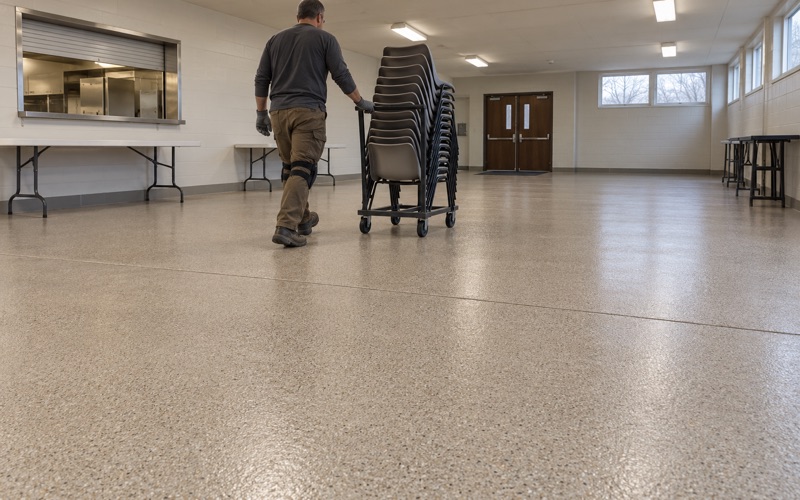
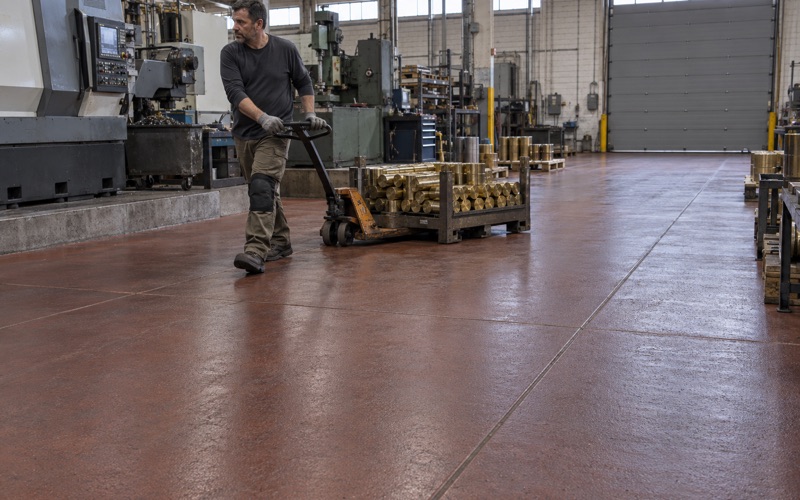
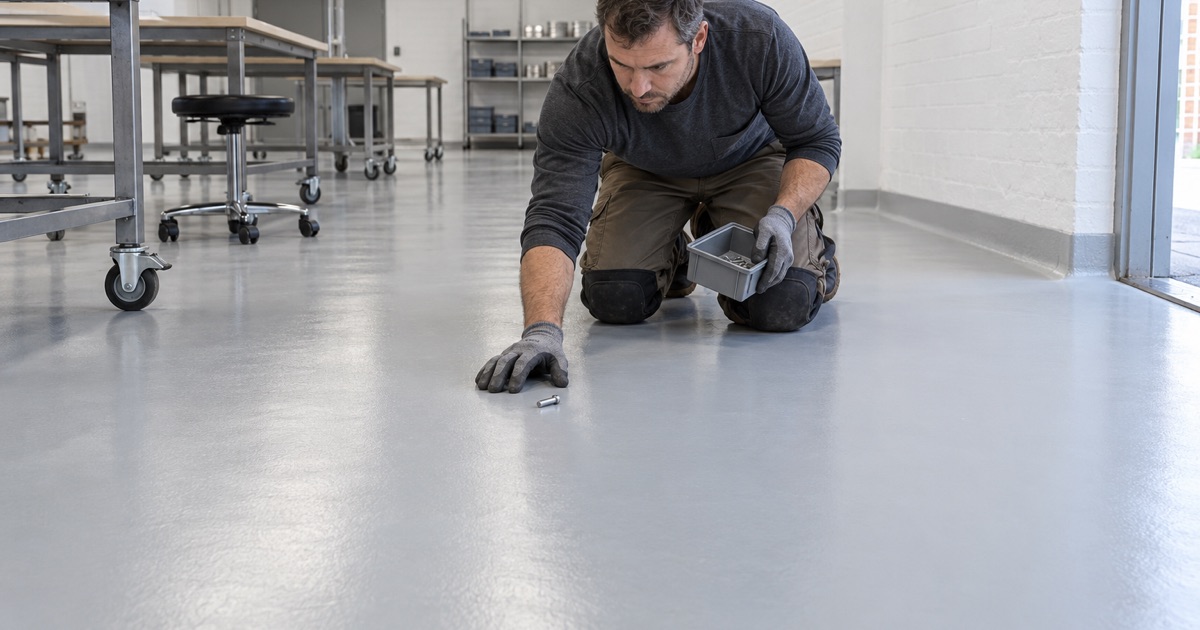
Mobile furniture changes the load pattern. A fixed bench puts weight on a few points that never move, but rolling tables, carts and stools travel the same lanes over and over, and each caster’s small contact patch concentrates weight. Over time those lanes show up as worn paths in a weak coating, especially where furniture pivots during a room change.
A room built to be reconfigured has no permanent traffic pattern, so the whole floor has to be treated as a high-wear lane. We grind to a profile the primer can bite into, never relying on an acid etch, and we check that the topcoat chosen tolerates hard casters. Where carts carry heavier equipment, we raise the finished thickness rather than hope the standard build holds.
Seamless With a Cove: Why Lab Floors Are Detailed Differently
No Joints for a Spill to Find
Tile and sheet goods have seams, and every seam is a path for a spilled liquid to reach the slab or the adhesive below it. A poured resin floor has none across the field of the room. That continuity is the main reason labs, clean rooms and similar spaces lean toward resin systems, and it is only as good as the details at the edges.
Existing control joints and cracks still have to be handled. We map the cracks, spalls and old coating on the slab before pricing, fill or honor joints as the slab requires, and tell the owner plainly when a floor needs repair before it should be coated. A seamless finish laid over a moving crack will open again along the same line.
The Cove at the Wall
The weakest line in most rooms is where the floor meets the wall. A rubber base or a square corner traps whatever is mopped toward it, and a spill that sits there can creep under the base. An integral cove carries the resin up the wall in a smooth radius, usually a few inches high, so liquid has nowhere to collect and a mop reaches the whole surface.
Coving takes more labor than flat work, because the radius is troweled by hand and the cap has to be straight. We price it as its own line so an owner can see the cost. Where a sink cabinet or fume hood base sits on the floor, we work the cove around it rather than stopping short.
Moisture Under a Sealed Floor
A seamless floor also seals the slab, so moisture coming up from below has nowhere to go but against the coating. That is why a moisture test is written into our scope before the price is final, using ASTM F2170 in-situ relative humidity probes or ASTM F1869 calcium chloride testing depending on the slab. High readings mean a moisture-mitigation primer goes down first.
Moisture is also the first exclusion we name when we explain a warranty, before anything is sold. A lab owner should know exactly what the coverage leaves out, and a slab that tests wet without mitigation is a frequent reason a coating lets go early. We would rather add a primer to the quote than leave that question open.
Texture That Stays Safe When the Floor Is Wet
Choosing the Right Aggregate
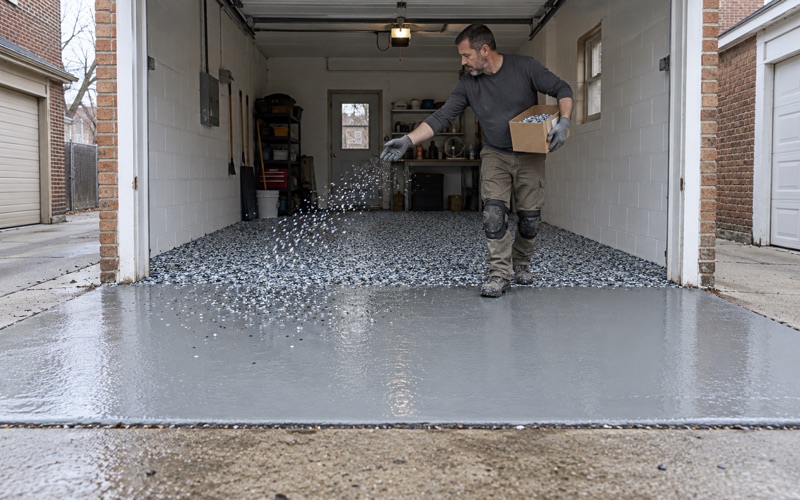
A lab floor gets wet on purpose and by accident, from eyewash testing, sink overflow and mopping. Smooth high-gloss epoxy turns slick under a film of water, so we broadcast fine quartz aggregate into the base coat or mix a grit into the topcoat. The texture is chosen to give footing without making the floor so rough that spills cannot be wiped clean.
That balance matters more in a lab than in a garage. Too little texture and a wet floor is a hazard to students carrying glassware; too much and residue lodges in the profile and stains it. We lay a sample board for the owner to try with a wet mop before the full floor is broadcast.
Preparing the Slab Underneath
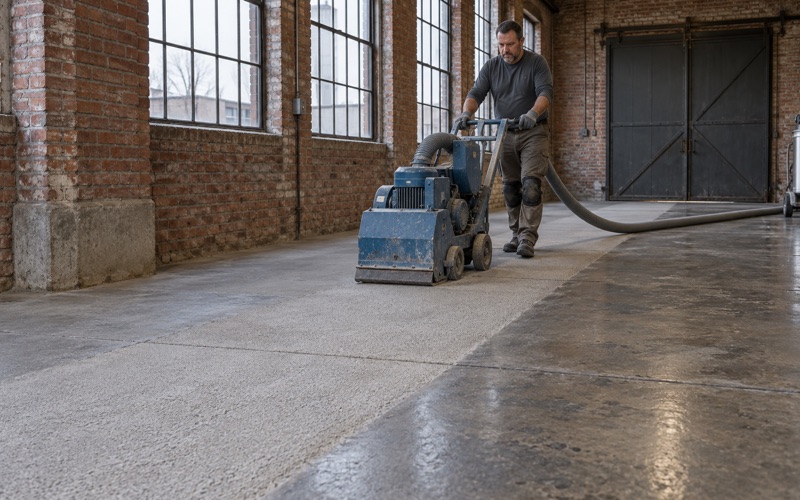
Texture only works if the coating stays bonded. We open every slab with a diamond grinder or a shot blaster to a concrete surface profile matched to the system, using the ICRI CSP scale, and vacuum the dust at the machine instead of washing it toward a drain. Old paint, patching compound and adhesive are found and removed before any system is chosen.
In an occupied building, that work has to fit around the people using it. Grinding is loud, and resin needs time to cure before carts can roll over it, so a lab is taken out of use until the coating is ready. We give the owner a written cure window for foot traffic and a separate, longer one for rolling furniture, so nobody wheels a table onto a soft floor.
What Goes in the Written Proposal
Every lab proposal we write lists the resin system, the number of coats, the finished thickness, the aggregate, the cove height and the moisture test method. That gives a school, a lab manager or a building owner something specific to compare against another bid and to check the finished floor against. If the room’s use changes later, the same document tells the next contractor what is already on the slab.
We keep the closing advice simple. A teaching lab, a makerspace or a small testing room in Norridge deserves a floor specified for its chemicals, its furniture and its wet days, not a garage finish moved indoors. Send us the room’s size, its chemical list and how the furniture moves, and we will come measure, test the slab and write the scope.
- 20+ Years on Concrete
- Moisture Tested Before Pricing
- Written Coat-by-Coat Proposals