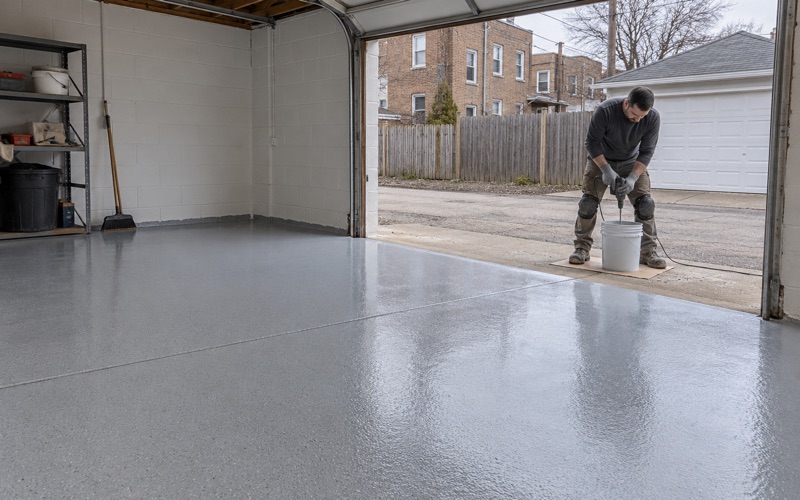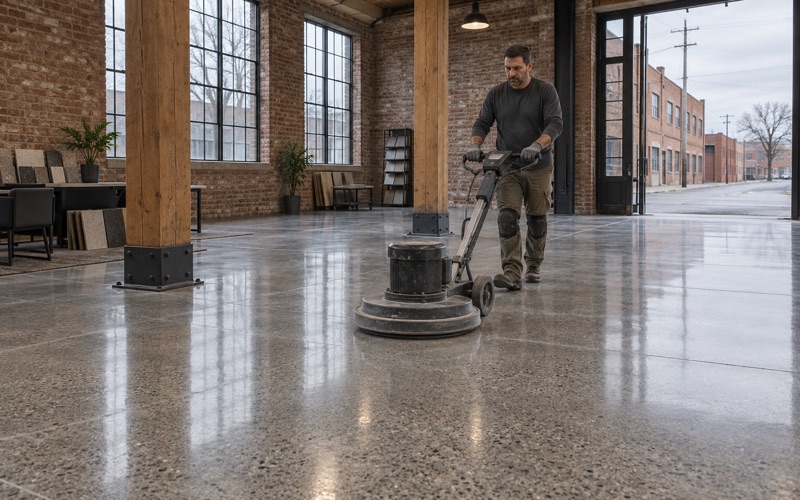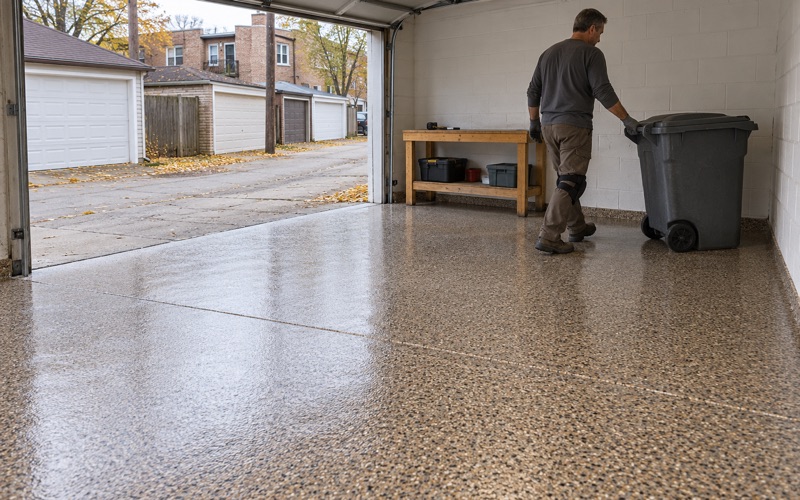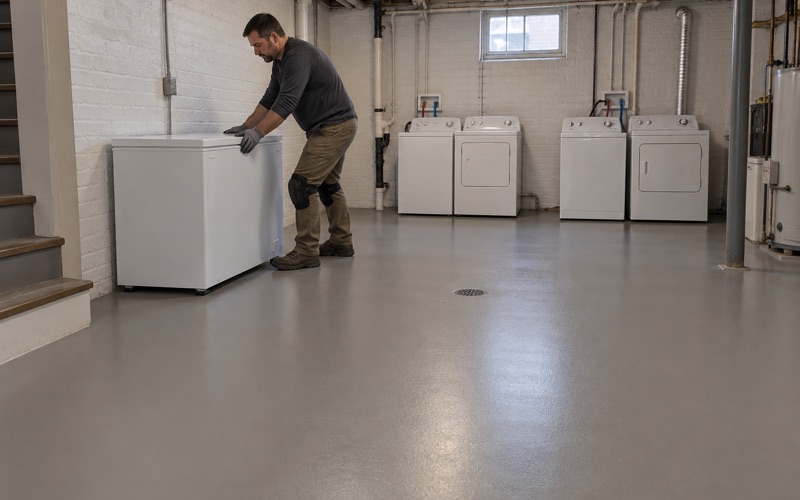
Cicero Epoxy Flooring has spent more than 20 years on epoxy-flooring in Hinsdale and across the west suburbs, and the floors that teach us the most are the ones that have to look perfect while carrying weight. A showroom slab, an indoor display gallery and a private car collection all share that demand. This page is about those floors.
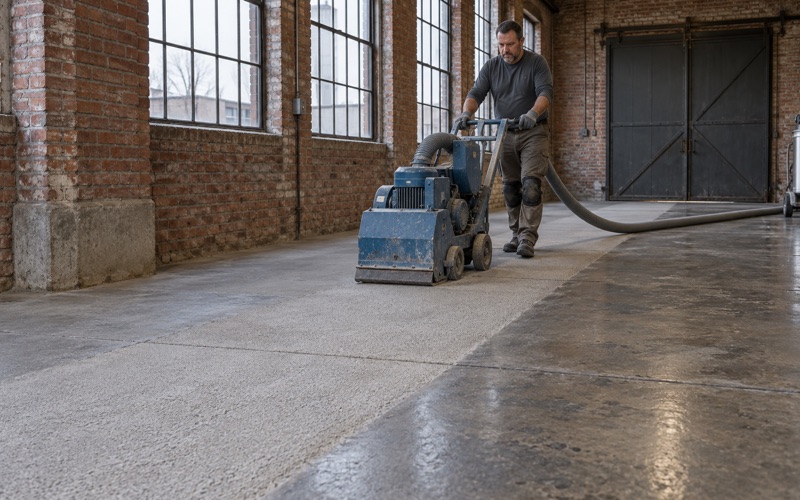
A floor that gets driven on and judged on its finish fails in a particular way. The coating can hold up to the weight and still lose, because a parked tire can pull it loose or stain it where everyone looks first. We build these systems from the slab up, starting with a diamond grinder or shot blaster rather than an acid etch, so the coating has a real profile to grip.
Every proposal we write names the product line, the number of coats and the finished thickness, so the floor can be checked against the quote once it is down. A moisture test is part of that scope before the price is final. The sections below cover what changes when the floor in question holds cars on display.
A Dealership Row on East Ogden Avenue
What Sits Along East Ogden
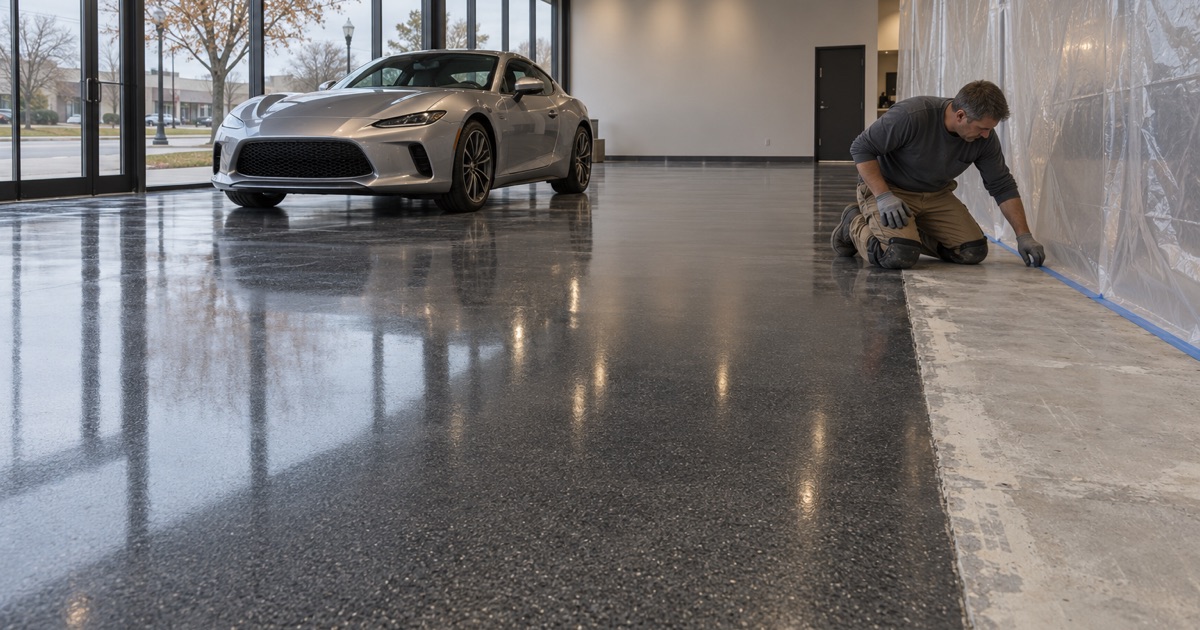
East Ogden Avenue, in the DuPage County part of the village, is a dealership row. Continental AutoSports at 420 E. Ogden describes itself as a family-owned official Ferrari dealer since 1975, with a remodeled showroom and an indoor pre-owned gallery. Jaguar Land Rover Hinsdale runs its certified pre-owned and service center at 336 E. Ogden, and both addresses geocode inside Hinsdale.
Current Automotive, a used electric-vehicle dealer, sits at 300 E. Ogden on the same stretch. None of these businesses is our customer, and we have not seen their floors. We name them because they show what kind of floor this part of Hinsdale asks for, and the same questions apply to any room where a car is parked to be looked at.
Driven On, Judged on Looks
A showroom or gallery floor carries vehicles, but nobody grades it on load. It is lit, walked by buyers and photographed for listings, so a scuff, a dull lane or a ring of tire marking shows up in every picture. That makes appearance the specification, with durability as the condition the finish has to survive.
The traffic pattern is also unusual. A car rolls in warm from the road, stops in one spot and may stay there for days under display lighting before it moves again. A warehouse floor sees wheels pass over it constantly, while a showroom floor sees the same four contact patches pressed into the same places for long stretches.
What We Look at Before Quoting
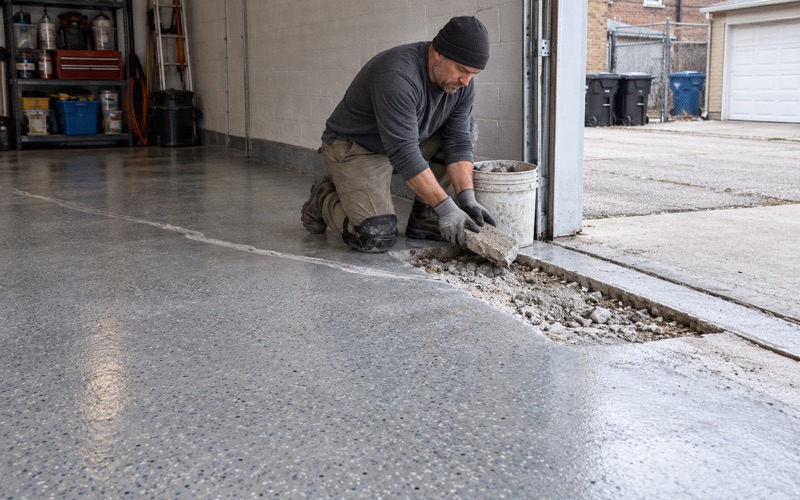
We start by mapping the slab: cracks, spalls, patched areas and any coating already on it. A showroom slab that has been coated before is a different job from bare concrete, because an old coating that has lost its bond will take a new topcoat down with it. If a floor needs repair or replacement before it should be coated, we say so.
Moisture comes next. We use ASTM F1869 calcium chloride testing or ASTM F2170 in-situ relative humidity probes, depending on the slab and the system, and the result goes into the written scope before the price is set. Moisture is also the first exclusion we name when we explain what a coating warranty does not cover.
Looking for epoxy-flooring closer to Schiller Park? See Epoxy-Flooring Services in Schiller Park.
Hot Tire Pickup: Why Parked Cars Lift Weak Coatings
How a Warm Tire Grabs the Floor
Hot tire pickup starts with heat. A tire warmed by driving passes that heat into the coating under it once the car is parked, and plasticizers in the rubber soften the surface they touch. As the tire cools, its footprint contracts and grabs. On a weak or poorly bonded coating, that grip can lift the film right off the concrete.
It does not usually show on day one. The failure typically appears weeks or months after installation, in the places where vehicles park repeatedly, which on a display floor means the exact spots under the lights. One coating vendor cites tire temperatures around 140 degrees in summer. It is a risk for a weak system, not a certainty for every floor.
Bond Comes From the Profile
The defense starts below the coating. We open the slab with diamond grinding or shot blasting to a measured ICRI concrete surface profile, so the primer bites into sound concrete instead of resting on a smooth trowel finish. We never rely on an acid etch for that grip, least of all on a floor that will hold parked tires.
Film build matters as well. A thin coat over a poorly prepared slab is the textbook setup for pickup, so we specify a 100% solids epoxy base at a stated thickness that the finished floor can be measured against. If the floor fails a moisture test, we discuss a moisture-mitigation primer before any color goes down.
Marking Versus Lifting
Not every tire problem is delamination. Plasticizer marking is a discolored shadow left in the tire footprint while the coating stays bonded, and it is a cosmetic failure that matters a great deal on a display floor. Lifting is the coating actually coming up. They have different causes, and we ask which one a floor is showing before recommending anything.
Marking is mostly a topcoat question, because the surface layer is what touches the rubber. Lifting points back to preparation, bond and film build. Treating a lifting floor with a new topcoat alone does not fix the cause, which is why we look at the edges of a failed patch to see what came up with it.
Gloss, Color and Topcoat Under Showroom Lights
Choosing the Gloss
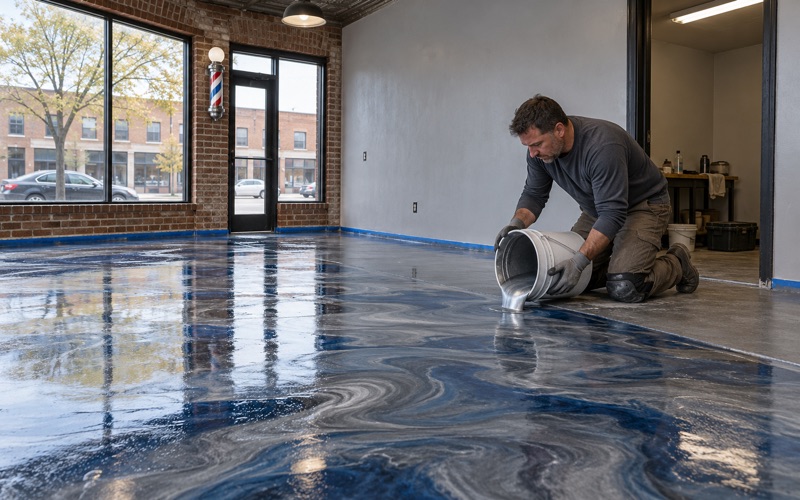
High gloss reads as clean and reflects a car’s paint back at the viewer, which is the appeal on a display floor. It also shows every scratch, swirl and smear under bright overhead fixtures. We walk owners through that tradeoff before they choose, because a finish that photographs well on install day has to keep looking that way after months of foot traffic.
A satin topcoat hides wear better and cuts glare in photographs, at the cost of some depth. An owner can split the difference, running gloss in the main display area and satin in the service lanes or entry. Either way, the sheen is written into the proposal by product name so there is no argument later about what was promised.
Color, Flake and Quartz
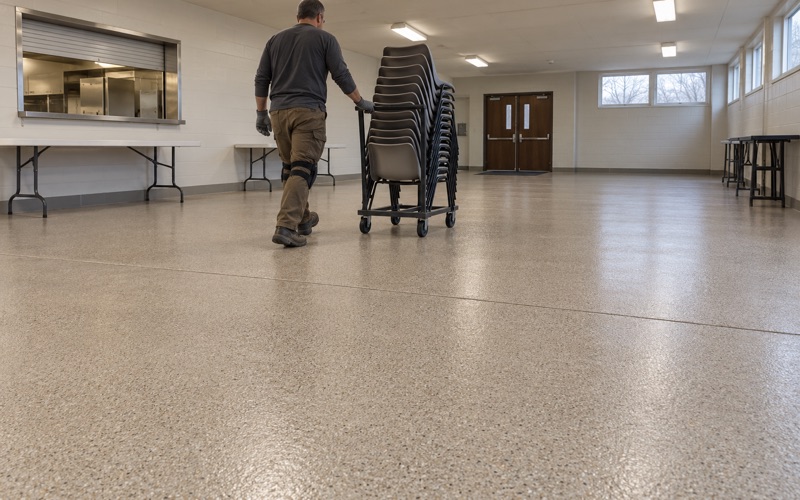
Solid colors in gray, white or black give a clean field that keeps attention on the cars. A vinyl flake broadcast adds texture and hides dust between cleanings, while a quartz aggregate broadcast builds a harder, more slip-resistant surface where people walk with drinks or wet shoes. The choice changes how the floor ages under display lighting as much as how it looks on the first morning.
Bright white floors under strong light can show tire marking more readily than a mid-tone gray or a flake blend. That does not rule white out, but it raises the stakes on topcoat choice. We put sample boards under the owner’s own lights when we can, because a color chip held at a desk tells you little about a lit showroom.
What the Topcoat Has to Resist
On a floor where cars sit for days, the topcoat does most of the work against plasticizer staining. The coating vendor that cited summer tire temperatures recommends polyaspartic topcoats paired with rigorous surface preparation, and we often look at polyaspartic or polyurea finishes for the same reason. A good topcoat over a weak bond still fails, so we never sell one as a substitute for the other.
Those topcoats also handle the cleaning that comes with a display floor: regular dust mopping, auto-scrubbing and the occasional fluid drip under a service car. They hold color better under constant light than a plain epoxy surface, which can amber over time. We match the topcoat to the gloss and color already chosen so the three decisions land together.
Working in Sections, From Showroom to Home Garage
Phasing Around the Inventory
Emptying a showroom for a floor job is often not an option. We plan showroom work in sections, moving cars off one zone, grinding with dust collection at the machine, coating it and letting it cure before the cars move back and the next zone opens. Seams between phases are placed along natural lines such as tile borders, column lines or lane edges so they read as design.
Overnight and weekend windows help where sales hours cannot move, the same way we phase factory and warehouse floors around shifts. The schedule is written down before work starts, zone by zone, so the sales floor knows which part of the room is closed and for how long. Odor and ventilation are planned the same way, since staff and customers stay in the building.
Cure Set by the Slab, Not the Calendar
A zone goes back into service when the coating has cured, not when the schedule says it should. We read the slab temperature and the dew point spread at the surface before each coat, because a cold or damp slab slows cure and can leave amine blush on an epoxy layer. Blush under a topcoat is a bond problem waiting for a warm tire.
Rolling a car onto a coating that is dry to the touch but not fully cured is one of the easiest ways to start hot tire pickup on a new floor. We give a written return-to-service time for each zone and hold to it. An unheated building in January gets told to wait rather than rushed.
The Same Problem in a Home Collector’s Garage
Owner-occupancy in Hinsdale is 89.9 percent, and 5,087 of its housing units are single-family detached houses. A collector who keeps a car parked in the same spot for weeks, then drives it warm back into that spot, is running the showroom problem at home. The same preparation, film build and topcoat logic applies.
Home jobs over the state threshold get a written contract and the Illinois Home Repair: Know Your Consumer Rights pamphlet before any grinding starts. Illinois has no state flooring license, so we check the Village of Hinsdale’s own contractor registration, bond and insurance requirements, and whether Community Development wants a permit, before the job is booked.
- 20+ Years on Concrete
- Moisture Tested Before Pricing
- Written Coat-by-Coat Proposals