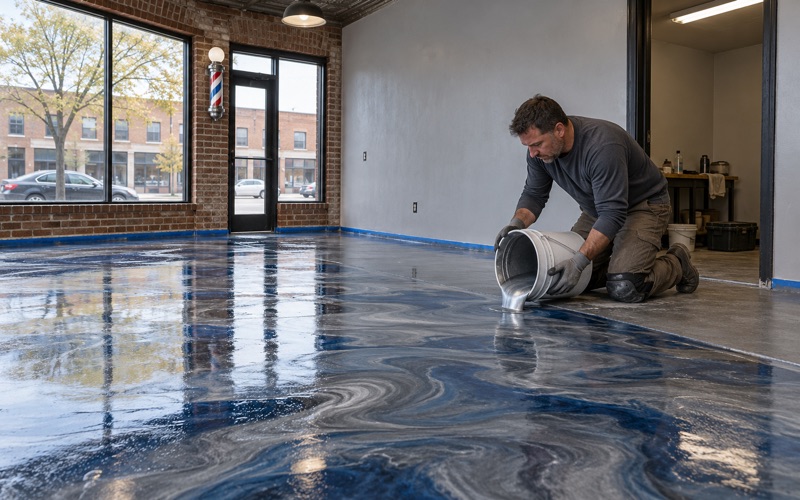
Cicero Epoxy Flooring has spent more than 20 years putting epoxy flooring in Hickory Hills garages, basements and shops, and the first thing we look at on any slab is where people and tires actually travel. A floor rarely fails evenly. It fails along a path, and the coating we specify follows that path instead of the average square foot.
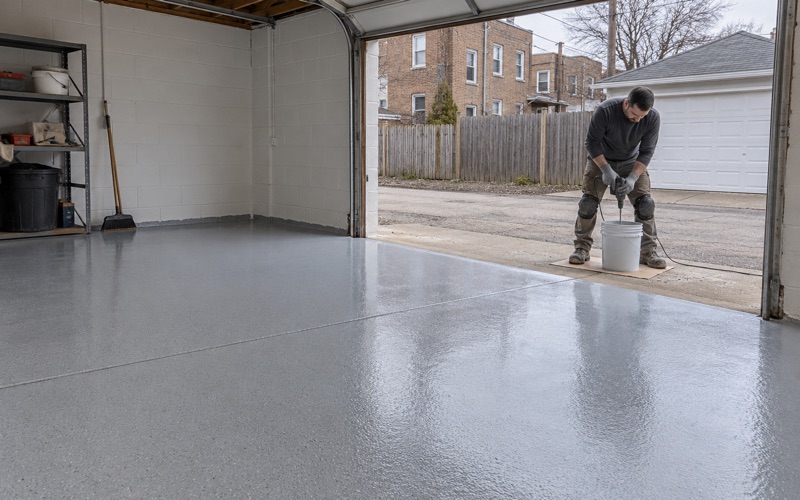
Every job starts the same way. We open the concrete with a diamond grinder or a shot blaster rather than an acid etch, and we write a moisture test into the scope before the price is final. The proposal then names the product line, the number of coats and the finished thickness, so you can check the floor you get against the quote you signed.
What changes from one floor to the next is the wear pattern. A two-car garage, a basement workshop and a small warehouse aisle each concentrate traffic in different places, and a system built for those places tends to outlast one spread uniformly across the slab. The sections below explain how we find the worn path and what we put on it.
A Walking Track on 88th Avenue
The Hickory Hills Park District runs its fitness center, gym and indoor walking track inside the Krueger Park Recreation Center at 9100 S. 88th Avenue. The district’s 2011 renovation included a 21,400-square-foot expansion of the fitness center, and the building opens at 6:00 a.m. on weekdays. We mention it because a track is the clearest picture we know of how floors get used.
Few people walking laps drift across the whole width of a lane. Most walkers settle into the inside line, cut the turns the same way each time and pass on the same side. We have not seen the surface of that track and make no claim about its condition; the point is the pattern, which shows up on garage and shop floors just as plainly.
Floors Wear in Lanes, Not Evenly
On a coated garage floor the same thing happens with tires. The car enters on two narrow strips, stops in roughly the same spot every night and backs out over the same strips in the morning. Those two bands and the stopping zone take most of the abrasion, while the corners under shelving may see almost none for a decade.
That is why we walk a floor before we price it. Scuffed gloss, gray haze in the old coating, rubber marks and a polished strip of bare concrete all tell us where the traffic runs. A coating priced by the square foot alone ignores that information, and the lanes are where it gives out first.
Turns, Starts and Stops
On a track the turns tend to wear before the straights, because every foot pushes sideways as it changes direction. A garage has its own turns: the spot where the front wheels swing while you maneuver in, and the place a tire scrubs when the steering is turned at a standstill. Grit trapped under a turning tire acts like sandpaper on a topcoat.
Starts and stops matter as much as turns. Braking and accelerating put shear into the surface, and a warm tire in summer can soften a thin, under-cured coat enough to lift it, which the trade calls hot tire pickup. We treat those zones as the hardest-working square feet on the floor, not as an average.
Looking for epoxy-flooring closer to Hinsdale? See Epoxy-Flooring in Hinsdale.
Finding the Worn Path on Your Floor
Before we write a scope, we map the slab. Cracks, spalls, old paint, adhesive and patching compound all go on the sketch, and so does the traffic. If a floor needs repair or replacement before it should be coated, we say so plainly at this stage rather than after the grinder has opened it up.
Tire Tracks in the Garage
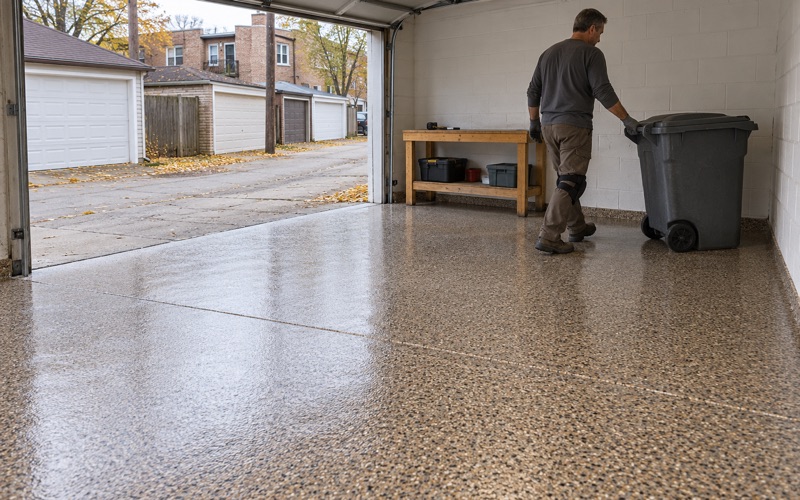
In a garage the worn path is usually two parallel tracks running from the door apron to where the car parks. Brine and rock salt ride in on those tires all winter and dry into a gritty film exactly where the wheels roll. We choose garage systems that stand up to that salt, and we plan the heaviest protection along those tracks.
A two-car garage often has a third lane people forget, the strip a mower, snowblower or bike takes to the side door. It carries less weight than a car but drags more grit, especially from a snowblower that has just cleared the driveway. We mark that strip on the sketch as well, so the topcoat plan covers it.
The Door-to-Door Walk
The second path in a garage belongs to people. It runs from the driver’s door around the hood to the step into the house, and it is walked in wet shoes and boots several times a day. That lane sees fine grit ground in under soles, and on many floors it is the first place the gloss goes dull.
Because the walk is wet so often, we look at texture there as well as hardness. The same broadcast that adds wear resistance also gives a shoe something to grip, so one decision serves both. Away from the walk, near the back wall or under storage, the texture can stay lighter and easier to sweep.
Basements, Shops and Aisles
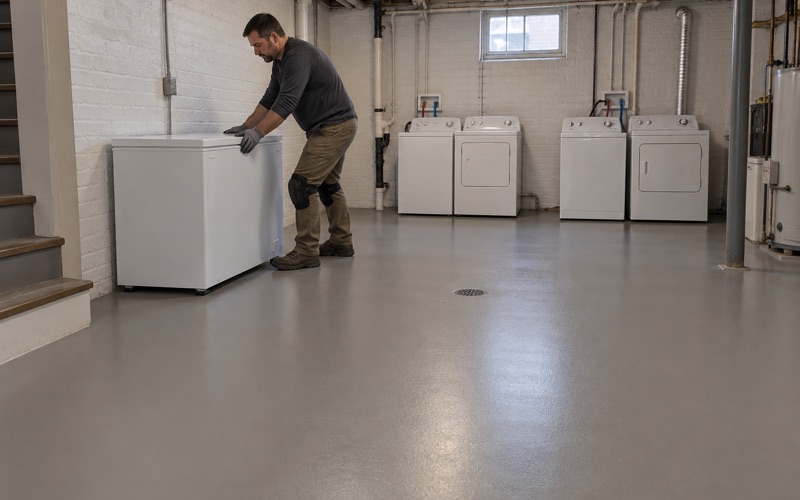
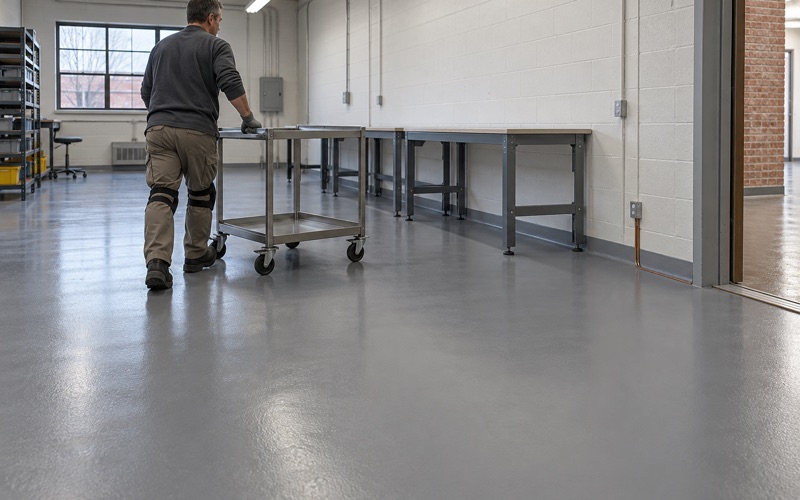
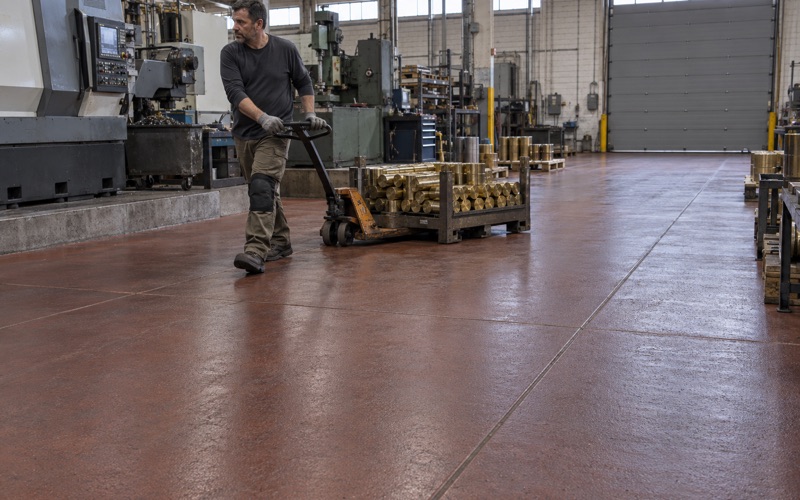
Basement floors have paths too: the stair landing, the route to the laundry and the space in front of a workbench. In a shop or small warehouse the lane is the aisle a pallet jack uses, and forklift and pallet jack wheel loads concentrate wear on a strip far narrower than the aisle itself. For commercial floors we phase the work around shifts, with overnight or weekend windows when a line cannot stop.
Building the Topcoat for the Lane
Once the paths are on paper, the system gets built around them. The base coats stay consistent across the slab so the floor looks uniform, but what goes into the top layer, and how much of it, can change where the traffic runs. That keeps cost sensible without leaving the busiest strips underprotected on a floor used every day.
Preparation Comes First
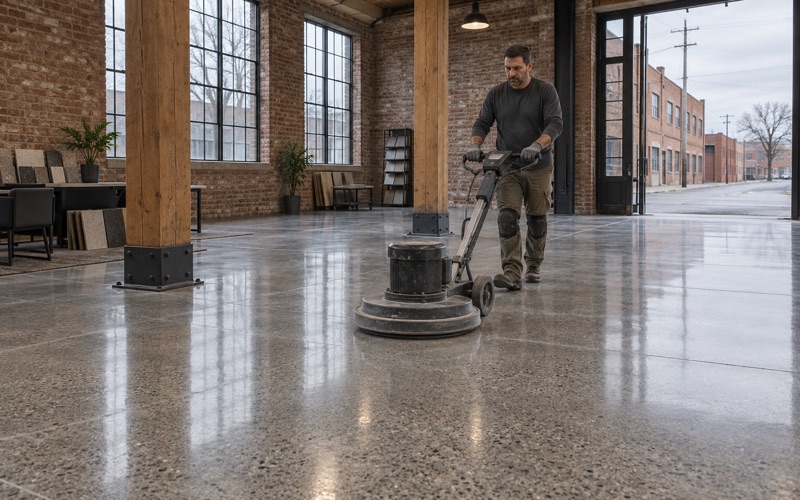
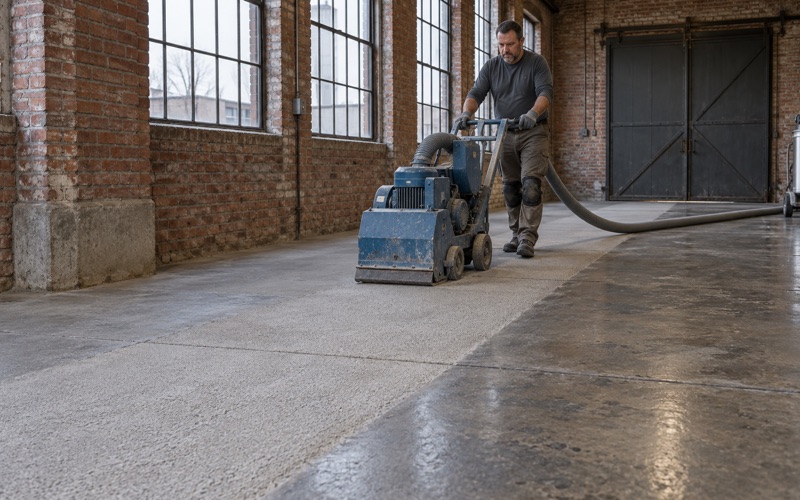
No topcoat survives on a weak bond, so the lane strategy starts with the grinder. Diamond grinding or shot blasting opens the slab to a measured concrete surface profile on the ICRI CSP scale, and we pick the profile the primer and build thickness call for. Acid etching does not give a repeatable profile, which is why we do not use it.
Moisture is checked in the same visit. Depending on the slab, that means ASTM F2170 relative humidity probes, an ASTM F1869 calcium chloride test or a simple ASTM D4263 plastic sheet as a first look. A slab that reads wet gets a moisture-mitigation primer or a frank conversation, and moisture is the first exclusion we name when we explain the warranty, before the job is sold.
Grit Where the Feet and Wheels Go
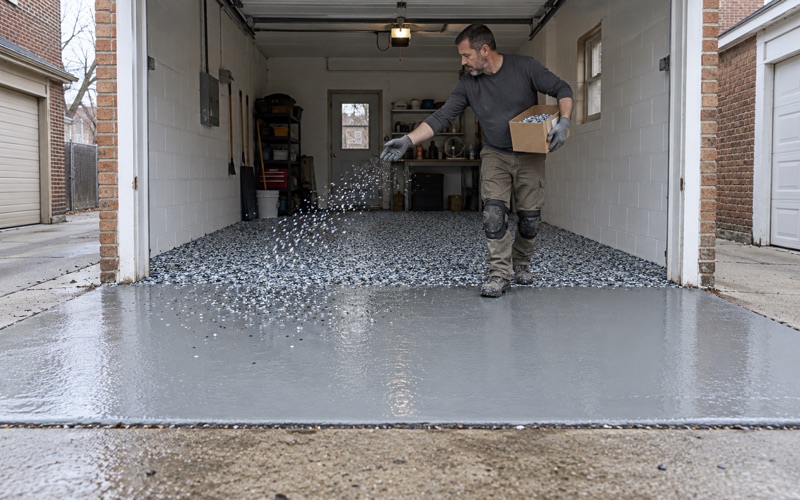
In the traffic lanes we specify a harder, grit-loaded topcoat. Aluminum oxide in the topcoat, or a quartz aggregate broadcast locked in with a clear coat, gives the surface hard particles that take the abrasion instead of the resin. Polyaspartic and polyurea topcoats suit garages well here, since they resist salt and hold their gloss under tires.
Under that topcoat, a 100% solids epoxy base with a full vinyl flake broadcast builds the thickness the lanes need. Because the build is written down, the thickness in the tire tracks can be measured against the quote rather than taken on trust. Where a shop takes hot fluids or heavy impact, urethane cement may be the better base.
Curing to the Slab, Not the Calendar
A grit-loaded topcoat is only as hard as its cure. We time each coat by slab temperature and the dew point spread at the surface, since a cold, damp slab invites amine blush and a soft finish. An unheated garage in January is told to wait, and a properly cured lane holds up far better than a rushed one.
Recoating Before the Path Wears Through
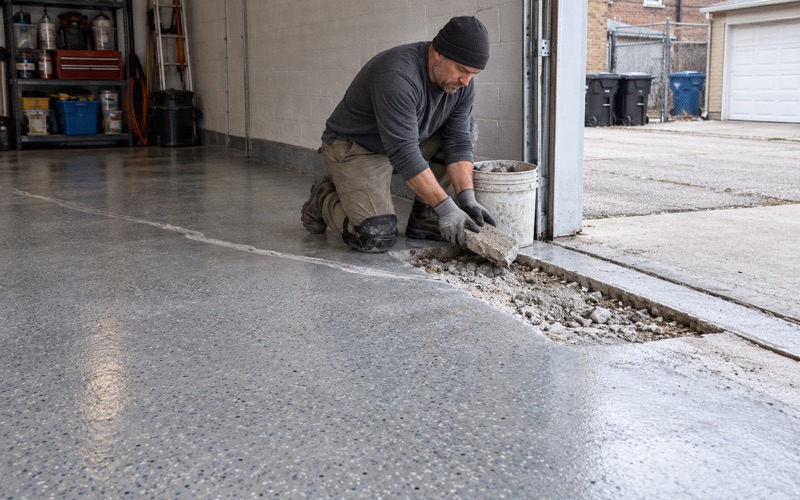
Even a well-built lane wears eventually; the question is whether it gets attention while the base is still intact. A topcoat refresh over sound epoxy is a modest job. A lane worn down to bare concrete means grinding, patching and rebuilding that strip, and the repair rarely blends perfectly with the floor around it in color or texture.
Signs the Lane Is Ready
We tell owners to watch the tire tracks and the door-to-door walk, not the whole floor. When the gloss there has gone flat, the flake edges feel sharp or the broadcast grit has rubbed smooth, the topcoat is thinning. Those are the signs to book a recoat, ideally while the color coat underneath still looks whole.
A flashlight held low across the floor shows it quickly. Compare the sheen in a tire track with the sheen in a corner nobody walks; a difference you can see is a difference in remaining topcoat. If the lane has dulled and the corner has not, the recoat can usually focus on that path.
What a Recoat Involves
A recoat starts with cleaning off salt film and tire residue, then a light mechanical abrasion of the existing topcoat so the new layer bonds. Grinding dust is captured by a vacuum at the machine rather than rinsed toward a floor drain. We then lay down fresh topcoat with new grit in the lanes and blend it across the rest.
Products are chosen within the Illinois VOC limits for floor and industrial coatings, which apply to whoever puts the coating down. Cure timing follows the same slab temperature rules as the original job, so a winter recoat in a cold garage may wait for a milder stretch. Planning the recoat ahead keeps that from becoming a scramble.
Booking a Walkthrough in Hickory Hills
Hickory Hills sits principally in Palos Township in Cook County, and most of its housing units are detached houses, so a garage floor is a likely place to start. When we visit, we walk the floor the way you use it and mark the tire tracks and the walk before we quote a system. The result is a floor specified for its busiest path, not its quietest corner.
- 20+ Years on Concrete
- Moisture Tested Before Pricing
- Written Coat-by-Coat Proposals