
Cicero Epoxy Flooring installs epoxy garage floor systems in Cicero, IL, serving surrounding cities including Forest Park, Lyons, River Forest, Brookfield and Summit. After 20+ years of grinding and coating concrete, we know that most garage floors that fail were not let down by the epoxy itself but by what happened to the slab before the first coat.
That is why our garage work starts with a diamond grinder or a shot blaster rather than a bottle of acid, includes a moisture test before the price is final and maps every crack and spall on the slab. If a garage floor needs repair or replacement before it is worth coating, we say so at the first visit.
The proposal you receive names the product line, how many coats go down and how thick the finished floor will be. That turns the quote into a checklist you can hold the finished garage against.
Garage Floor Systems and Finishes
Flake Epoxy Garage Floors
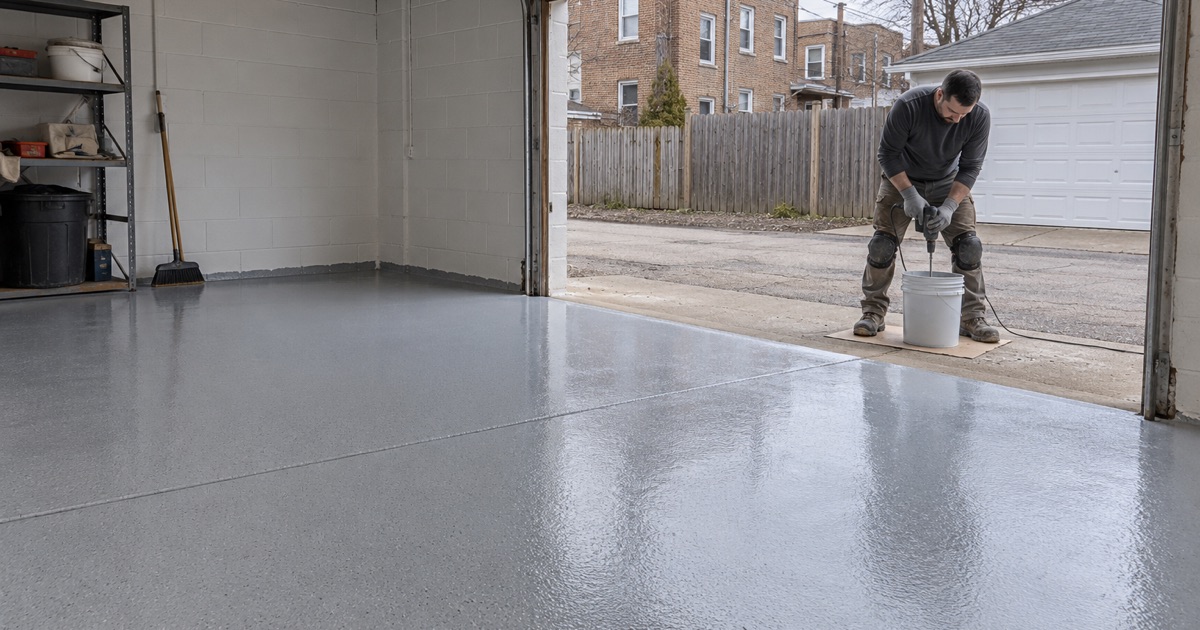
The most requested garage system is a 100% solids epoxy base with a full vinyl flake broadcast and a clear topcoat. The flake hides dust, tire marks and small imperfections in the slab, and the chip blend sets the color, from tight granite-style grays to bolder, larger-chip mixes.
A full broadcast means the wet base coat is covered until no more flake will stick, then scraped and topcoated. That adds thickness and texture compared with a light, decorative sprinkle of chips, and it is the version that holds up best under daily parking.
Polyaspartic and Polyurea Topcoats
The topcoat takes the wear, so we choose it carefully. Polyaspartic and polyurea topcoats cure quickly, resist ultraviolet ambering when the garage door is open to the sun and stand up to hot tires better than standard epoxy topcoats.
Many of our garage floors pair an epoxy body coat, which builds thickness and bonds well to ground concrete, with a polyaspartic top that handles abrasion and chemicals. Each layer does the job it is best at.
Solid Color and Metallic Garage Coatings
A solid color coat with a light anti-slip texture suits a working garage where dropped screws and bolts need to stand out. Metallic epoxy creates a marbled, showroom look, though it shows scratches more readily, so we discuss how the space is actually used before recommending it.
Preparing the Garage Slab
Diamond Grinding to a Measured Profile
We grind the garage slab to a concrete surface profile matched to the coating system, using the ICRI CSP scale. Grinding removes laitance, sealers, paint and contamination and opens the surface so the epoxy can soak in and lock on mechanically.
Grinding dust is collected by vacuums attached to the machine. We do not wash slurry down the driveway or toward a floor drain, which matters in a town where storm water and sewage share the same pipes.
Cracks, Spalls and Old Repairs
Before coating, every crack is cut open and filled, spalled areas are patched and the repairs are ground flush with the surrounding floor. Control joints are either filled or honored as visible lines, depending on whether the slab is still moving.
With most of Cicero’s housing built in 1939 or earlier, many garage slabs carry old patches, broken edges and decades of oil staining. Those conditions are noted at the first visit and priced into the proposal instead of being discovered mid-job.
Moisture Testing When There Is No Vapor Retarder
IRC R506.2.3 allows garage slabs to be poured without the vapor retarder required under living spaces. Moisture from the ground can then rise through the concrete and push a coating off from below.
We screen garage slabs with an ASTM D4263 plastic sheet test and, where the numbers matter, measure vapor emission with ASTM F1869 calcium chloride kits. If moisture runs high, a moisture-mitigation primer goes down before the build coats.
Detached Alley Garages
Many Cicero garages are detached buildings at the back of the lot, reached from the alley rather than the street. They are often unheated, sometimes have no outlet strong enough for a grinder and may have a slab that slopes toward the alley door.
We plan power, staging and ventilation for those garages before install day, and we check the slope so water from melting snow still runs out the door after the floor is built up. Where the town has rebuilt an alley as a green alley, we keep equipment off the permeable paving.
Garage Floors Through a Chicago-Area Winter
Road Salt and Brine on Garage Concrete
Calcium chloride, rock salt and brine come in on the tires every winter, melt off in the garage and soak into bare concrete. Each freeze and thaw of that salty water breaks down the surface paste, which is why unprotected garage slabs scale and pit.
A coated epoxy garage floor keeps the deicer on top, where it can be squeegeed out the door. We specify chemical-resistant topcoats and full-build systems so salt cannot work its way under thin spots and lift the floor at the edges.
Hot Tire Pickup
When a hot tire sits on a thin coating, it softens the film, and as the tire cools it grips and pulls the coating up. Hot tire pickup is the classic failure of thin one-part paints applied over unprepared concrete.
A ground slab, a 100% solids base coat and a hard polyaspartic or urethane top prevent it. Thickness and bond, not a special product name, are what keep the floor where it belongs.
Cold Garages and Cure Timing
Epoxy needs the slab itself to be warm enough and the surface to stay several degrees above the dew point while it cures. Chicago Midway Airport averages 106.3 nights a year at or below 32 degrees, and an unheated alley garage in January rarely meets the conditions.
Coating under those conditions risks amine blush, a greasy film that weakens the bond between coats, and a soft, cloudy finish. We measure slab temperature and dew point spread before each coat and reschedule rather than force it.
Keeping a Coated Garage Floor Clean
A coated floor is cleaned with a squeegee, a soft mop and a neutral cleaner, and salt residue comes up far more easily than it does from bare concrete. Pushing slush out the door during a thaw keeps standing brine from sitting on the surface for weeks.
Mats under tire contact points, felt pads under jack stands and a piece of plywood under a kickstand all spread point loads that could dent the topcoat. A recoat of the top layer, years down the road, refreshes the finish without starting over.
Our Step-by-Step Epoxy Garage Floor Process
Step 1: Slab Walk and Moisture Check
We look at the floor, map cracks and old coatings, check for oil saturation and test for moisture. Access matters too, so we note whether the garage opens onto an alley, since we stage equipment from the alley side whenever we can.
Step 2: Written Proposal and Contract
You receive a proposal naming the product line, coat count and finished thickness, plus the warranty terms and exclusions, with moisture named first. Home jobs over the state threshold get a written contract and the Illinois consumer-rights pamphlet before any work begins.
Step 3: Grinding and Repair
The slab is diamond ground or shot blasted, vacuumed and repaired. Cracks and spalls are filled and ground flush so the floor is flat and open before any coating is mixed.
Step 4: Base Coat, Broadcast and Topcoat
The base coat goes down, followed by the flake broadcast if one is specified, then scraping and the topcoat. Each coat is timed by slab temperature and dew point readings rather than a fixed schedule.
Step 5: Cure and Return to Parking
We give you the walk-on and drive-on times for the system that was installed. Leaving the floor alone until then is the last step that protects the bond.
- 20+ Years on Concrete
- Moisture Tested Before Pricing
- Written Coat-by-Coat Proposals