Cicero Epoxy Flooring brings more than 20 years of epoxy flooring experience to Franklin Park, and we treat every floor as a question about what will land on it. A garage slab sees parked tires and dropped tools, while a production room may see acid, solvent and a steady fall of fine dust. The resin, the thickness and the topcoat all follow from that answer.
Every job starts the same way. We open the concrete with a diamond grinder or a shot blaster rather than an acid etch, we map cracks, spalls and old coating before choosing a system, and we put a moisture test into the scope before the price is settled. If a slab needs repair or replacement first, we say so before anyone mixes resin.
This page is written for the owners and plant managers who run working floors in the village. It covers how we approach a shop where wet chemistry and dry machining share a building, what we ask before recommending a resin, and how we schedule the work so a line keeps running while its floor is redone.
A Circuit Board Maker on Wolf Road
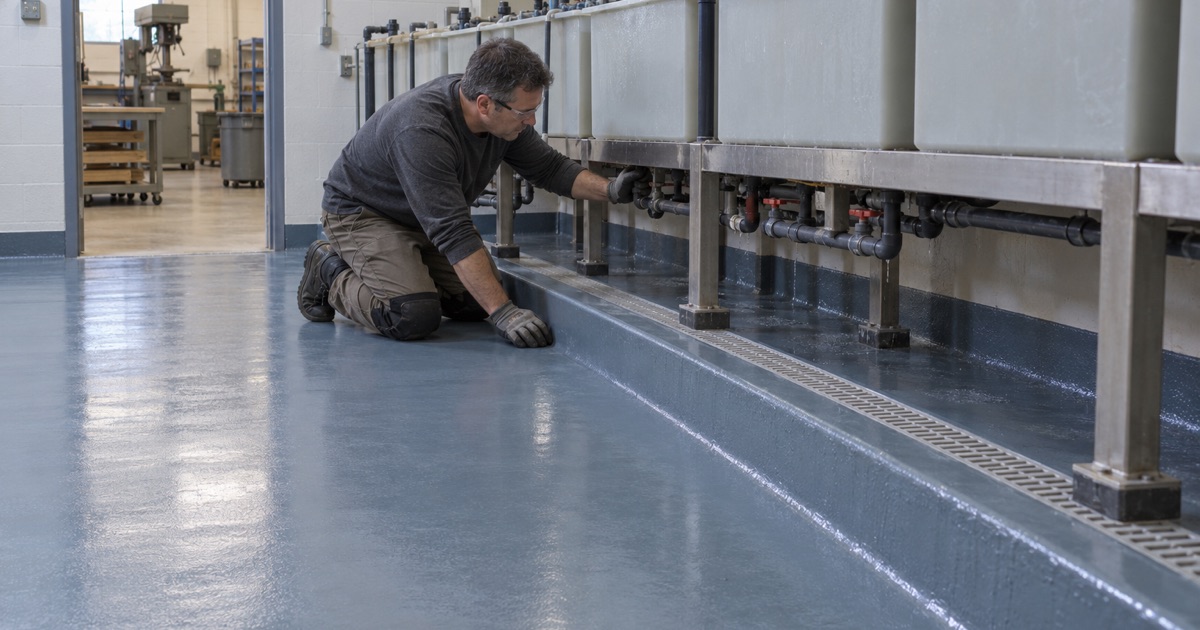
Franklin Park is a village in Cook County, counted at 18,467 residents in the 2020 census and named for Lesser Franklin, a real estate broker who bought up acres of what was then mostly farm fields. Those fields are long gone, and the village now holds a working industrial base, including a fabricator of printed circuit boards on Wolf Road.
New Drilling and Routing Capacity in 2026
United Electronics Corporation describes itself as a domestic manufacturer of high-reliability printed circuit boards, and its listed address, 3615 Wolf Road, falls inside the village in Leyden Township. On July 22, 2026, the company announced two new machines from Schmoll Maschinen GmbH at its Franklin Park facility, which published summaries describe as added drilling and routing capacity.
We mention the company as a local landmark of the trade, not as a client, and we have not seen its process list or its floor specification. What the announcement does show is that board fabrication is active here, and that brings a floor problem most coating contractors meet only occasionally: two very different kinds of room under one roof.
Two Kinds of Room in a Board Shop
Across the industry, a board shop generally splits into dry rooms and wet rooms. The drill and rout rooms throw off fine glass-epoxy and copper dust, while on the wet-process lines, where panels are etched, plated and rinsed, acid and alkaline drips and rinse water reach the floor. The coating that suits one side of the wall is often the wrong choice on the other.
That is why we specify a board shop room by room. In the wet rooms, chemical resistance is usually the deciding question, more than abrasion. In the dry rooms, the floor has to release dust to a vacuum and hold up to carts, and it rarely needs the same heavy chemical build that the plating side may call for.
Looking for epoxy-flooring closer to Norridge? See Norridge Epoxy-Flooring.
Acid, Alkali and Rinse Water on the Floor
Wet-process rooms are where a floor coating earns its keep or fails quickly. The general pattern in board fabrication is a sequence of tanks and conveyors with drips at every transfer point, and the floor beneath them sees chemistry that changes from one end of the line to the other. Our job is to know what lands where.
Etchant and Plating Drips
Etching and plating chemistry in the trade runs from strong acids to alkaline solutions, and a resin that shrugs off one can soften or stain under the other. A general-purpose 100% solids epoxy handles many splashes well, but sustained acid exposure is where we look at chemical-resistant epoxy grades, novolac-type systems or urethane cement instead.
Concentration, temperature and dwell time matter as much as the chemical name. A drip that is rinsed within minutes is a different test from a puddle that sits under a tank over a weekend, so we ask how spills are cleaned and how often before we match a resin to the room. Those answers often decide the system more than the label on the drum does.
Rinse Water and Footing
Rinse stations can keep a wet-process floor damp for much of a shift, and a smooth, glossy coating turns slick under a film of water. We usually broadcast quartz aggregate into the body coat in those areas and lock it in with the topcoat, which gives boots something to grip without leaving a texture too rough to squeegee.
The texture is a balance we settle with the people who clean the floor. Too little grit and the aisle is a hazard; too much and spilled chemistry hides in the profile, so we often make a sample board for the room before the full pour and let the maintenance crew try it with their own mop.
Coves, Trenches and Transitions
Chemistry that gets under the edge of a coating does the damage, so the details at walls, drains and doorways matter. Where the room calls for it, we run the resin up the wall as an integral cove, carry it into trench drains and terminate it in a keyed edge rather than a feathered one that a spill can lift.
The line between a wet room and a dry room deserves the same care. We keep the two systems from overlapping in a thin, weak lap, and we place the joint where a threshold or a doorway already marks the change, so the seam is easy to inspect and repair later.
Drilling and Routing Dust: A Floor That Sweeps Clean
The dry side of a board shop asks a different question. Drilling and routing panels made of glass-reinforced epoxy and copper foil sends up a fine dust that settles everywhere, and the floor’s main job is to give it nowhere to hide. Bare concrete fails that job twice over, by holding dust in its pores and shedding its own.
Glass-Epoxy and Copper Dust
For drill and rout rooms we lean toward a smooth, dense finish that a vacuum or a damp mop clears in one pass. A thin-build epoxy with a polyaspartic or urethane topcoat is a common choice, because the topcoat resists the fine scratching that fiberglass grit and dragged carts leave on softer finishes.
Flake broadcasts look good in a garage but are a poor fit here, since the slight texture of a chip floor holds fine dust a smooth finish would release. Where a room is densified rather than coated, lithium silicate can stop the concrete itself from dusting, though it adds little chemical resistance and belongs only where nothing wet is handled.
Asking Which Chemicals a Floor Has to Stand Up To
Before we recommend a system for any process room, we ask for the safety data sheets on what is used there, along with spill frequency, cleaning products and water temperature. We do not guess at a plant’s chemistry, and we do not assume it from the type of product the plant makes.
With that list in hand, we check each chemical against the manufacturer’s resistance charts for the resin and topcoat we have in mind. There is no single floor that suits every board shop, so the choice rests on the chemistry and the exposure, not on a standard spec sheet. Where two resins both pass, we favor the one that is easier to repair in place.
Preparing a Slab That Has Seen Years of Process
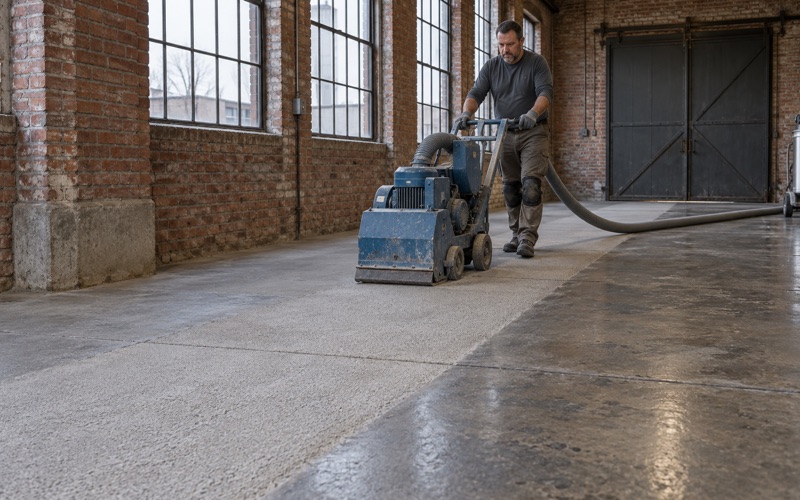
Older process floors often carry absorbed oil, old coatings and patching compounds, and chemistry that has soaked into concrete keeps working against new resin from below. We grind or shot blast to an ICRI concrete surface profile matched to the system, coarser for thick builds than for thin ones, and we test any contaminated area before deciding it can be coated.
Moisture gets the same attention. A slab-on-grade with no vapor retarder beneath it can push vapor into a new coating, so we run an ASTM F2170 relative humidity probe or an ASTM F1869 calcium chloride test before the price is final, and a moisture-mitigation primer goes into the scope when the readings call for one.
Small Electronics Shops Across the Village
The board fabricator is not the only electronics business in town. One water account in five here is commercial or industrial, with 1,237 such customers against 4,664 residential accounts in 2024, and smaller component shops sit among them. Their rooms raise many of the same questions, often on a smaller scale.
Component Shops on Franklin Avenue and Domenic Court
Business directories list electronics-component makers on Franklin Avenue and Domenic Court, T.J. Assemblies on Franklin Avenue among them. We know these firms only from those listings, but assembly and component rooms of this kind tend to need clean, smooth floors, light chemical resistance near solvent benches and good footing near any wash area.
Smaller shops often cannot clear the whole floor at once. We can split the job into halves, moving benches and racks from one side to the other, so the shop keeps working on a cured half while the other half is ground and coated. The seam lands along an aisle line, where it is least noticed.
Scheduling Around a Running Line
We phase factory and shop floors around shifts. When a line cannot stop, we work overnight or over a weekend, and fast-curing polyaspartic topcoats can shorten the time a room stays closed, though the base coats underneath still need their full cure before carts and chemistry return.
Cure is set by the slab, not the calendar. We read slab temperature and the dew point spread at the surface before each coat, because a cold or damp slab invites amine blush and a weak bond, and a schedule that ignores either is a schedule for a recoat.
What We Put in Writing
Every proposal names the product line, the number of coats and the finished thickness, so a plant manager can check the installed floor against the quote. It also lists what the coating warranty excludes, and moisture is the first exclusion we point to, before anyone signs.
We also select products inside the Illinois VOC limits for floor and industrial coatings, since those limits bind the applicator as well as the manufacturer. On a process floor, the proposal adds a room map showing which system goes where and where each wet-to-dry joint falls.
- 20+ Years on Concrete
- Moisture Tested Before Pricing
- Written Coat-by-Coat Proposals