Cicero Epoxy Flooring brings more than 20 years of slab work to epoxy flooring in Forest Park, and the floors we take most seriously here are the ones that get washed hardest. A garage that sees a hose twice a year and a room that is disinfected after every use need different systems, different prep and a different conversation before anyone signs.
Every one of those floors starts the same way with us. We open the slab with a diamond grinder or a shot blaster, because an acid etch leaves too little for a coating to grip, and we put a moisture test in the written scope before the price is final. A wet room with a floor drain is exactly where skipping that test comes back to bite.
The proposal you get names the product line, the number of coats and the finished thickness, so whoever manages the building can hold the installed floor up against the paper. Before that proposal is final we also spell out what the warranty leaves out, and moisture is the first exclusion on the list.
A Funeral Home and Crematory on Cemetery Ground
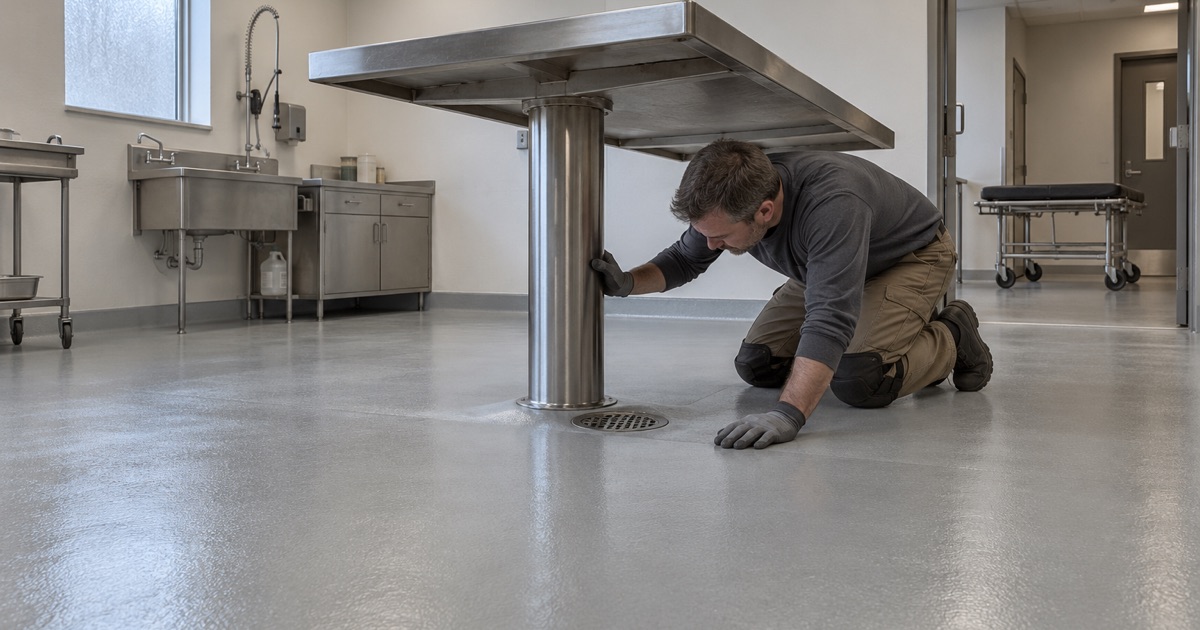
One of the more demanding floor types in the village has an address on West Cermak Road. Woodlawn Funeral Home & Memorial Park, at 7750 W. Cermak Road, geocodes inside Forest Park in Proviso Township, Cook County, and its operator says the funeral home and crematory opened on the cemetery property in 2006. The services it lists include embalming, direct cremation and three chapels seating 50 to 100.
To be clear, Woodlawn is not a customer of ours, and we have not seen or specified any floor on that property. We use it because it shows what a funeral home with a private crematory puts on one property, and that combination is what we would plan for at any mortuary or crematory project in the area.
Why the Preparation Room Is a Regulated Floor
The preparation room is where embalming happens, and it is a regulated workplace. OSHA’s bloodborne pathogens standard, 29 CFR 1910.1030, covers funeral-home employees who can reasonably expect exposure, and it requires the worksite to be kept in a clean and sanitary condition. Equipment, environmental and working surfaces that contact blood or other potentially infectious materials must be cleaned and decontaminated.
Embalming also falls under OSHA’s formaldehyde standard, 29 CFR 1910.1048, which sets a 0.75 ppm eight-hour limit, a 2 ppm 15-minute limit and a 0.5 ppm action level. Neither rule names a floor material. They govern the work and the air, and the floor simply has to hold up to the cleaning and chemistry those rules produce.
Who Decides the Floor
On a floor like this the coating is one line in the facility’s own decontamination plan, so the funeral director or operator decides what goes down, not the installer. Our job is to bring the product data, the prep method and a schedule that keeps the room out of service for as short a stretch as the cure allows.
Looking for epoxy-flooring closer to Lyons? See Epoxy-Flooring Services in Lyons.
Decontaminated After Every Procedure: What It Asks of a Coating
The bloodborne pathogens rule sets three moments when contaminated work surfaces must be decontaminated with an appropriate disinfectant: after procedures are finished, immediately or as soon as feasible after a spill, and at the end of the work shift. On a busy day that is a lot of wet, chemical contact for whatever surface sits under the table.
Check the Chemistry Against the Data Sheet
No floor coating is certified for this kind of room, and we make no germ-fighting claims for any of them. What we can do is take the disinfectant the staff actually uses, along with the embalming chemicals that reach the floor, and check each one against the manufacturer’s chemical-resistance chart before a product is named in the proposal.
That usually points toward a 100% solids epoxy base with a chemical-resistant topcoat, or toward urethane cement where hot water and harsh cleaners are part of the routine. A polyaspartic topcoat cures quickly, which helps a room that cannot close for long, but it is chosen only if its resistance chart covers the chemicals on that list.
Traction That Still Scrubs Clean
A floor that is wet several times a shift needs grip, and a quartz aggregate broadcast locked in with a topcoat is the usual way to get it. The trade-off is cleanability: the coarser the texture, the harder it is to wipe down completely, so we sample two or three profiles and let the people who clean the room choose.
Vinyl flake looks good in a chapel corridor or a staff area, but it is a decorative layer rather than a traction strategy, and we keep it out of the wettest part of the room. Wherever flake goes, it gets a full clear topcoat so there are no loose chip edges to catch a mop or hold residue.
Drains, Seams and the Wall Line in a Wet Room
In a preparation room, embalming chemicals and body fluids are meant to run toward a floor drain, and every place the coating stops is a place they can get underneath it. Wet-room coatings tend to fail at an edge rather than in the middle of the floor, so the details below get more of our attention than the color does.
Pitch and the Drain Body
A coating follows the slab it is put on, so it will not fix a floor that pitches away from the drain or holds a puddle in one corner. We map the low spots, cracks, spalls and any old coating first, and if the pitch is wrong we say the slab needs correcting, or replacing, before anything is applied.
At the drain itself, we cut a keyed edge into the slab so the coating ends at full thickness tight to the drain body instead of feathering out thin. A feathered edge at the lowest, wettest point on the floor is where peeling usually begins, and once fluid works under it the damage travels outward.
Joints, Cracks and the Wall Line
Control joints and cracks in a wet room are filled and bridged so the surface reads as one continuous skin. Where the floor meets the wall, the coating is carried up a few inches and sealed, because a gap at that joint collects whatever the mop pushes there and gives fluid a path behind the finish.
Seams matter outside the wet room too. Corridors that connect the preparation room to the rest of the building see the same cleaners tracked out on cart wheels and shoes, so we plan to carry the chemical-resistant topcoat past the doorway rather than stopping it at the frame.
Moisture Under a Washed Floor
A floor that is wet on top every day can still be failing from below. We test the slab with ASTM F2170 in-situ relative humidity probes or an ASTM F1869 calcium chloride test, and if the numbers are high, a moisture-mitigation primer goes into the proposal as its own line rather than turning up later as a warranty dispute.
An ASTM D4263 plastic sheet test is a quick first look, but it is not a number a manufacturer will write a warranty against, so on a room like this we go to the quantitative tests.
Rolling Loads, Retort Heat and the Same Problem at Home
Between the preparation room, the crematory and the chapels, a funeral home floor carries traffic most commercial floors never see. Cots and casket trucks roll on small, hard wheels, often loaded, and they cross the same thresholds over and over.
Small Wheels and Thresholds
Small wheels concentrate load, so the build matters more than the color. We plan a thicker, broadcast system on the main routes and pay particular attention to transitions, where the coating meets a door saddle, a chapel’s finished floor or an older floor. A raised or chipped edge at a doorway is the first thing a loaded cot finds.
Heavier equipment that moves between rooms gets the same treatment: we ask for its wheel type and loaded weight and size the system to that, instead of assuming a garage-grade build will cope.
Heat and Cleanup Around a Retort
A cremation retort puts heat into the room around it, and the floor near it also takes equipment traffic and regular cleanup. We do not guess at operating temperatures. We ask for the retort manufacturer’s clearance and floor requirements, compare them with the coating’s published heat limits, and leave any zone the coating is not rated for to the material the equipment maker calls for.
Scheduling matters just as much here. A funeral home rarely can close its preparation room for a week, so we phase the work room by room, use overnight and weekend windows, and set cure times by slab temperature and dew point rather than by the calendar. A room goes back into service when the coating is ready, not when the schedule says so.
The Same Chemistry in a Smaller Room
Mortuary work is a specialty, but the same thinking applies to a home utility room, a basement laundry or a wash area off the back door. These rooms get wet, see bleach and cleaners, and often have a floor drain, which makes them small cousins of a preparation room.
Nearly half of Forest Park’s housing went up before 1940, and basement floors that old often carry paint, patching compound or old adhesive from earlier projects. We check for each before choosing a system, since a coating bonded to a failing layer fails with it.
We are also plain about drains: a floor coating will not stop water coming up through one, so the drain and backflow question comes first. Home jobs over the state threshold get a written contract and the Illinois Home Repair: Know Your Consumer Rights pamphlet before any grinding starts.
Illinois has no state flooring license, so before a job is booked we confirm what the Village of Forest Park requires for contractor registration, bonding and insurance, and any permit question goes to the village Building Department.
- 20+ Years on Concrete
- Moisture Tested Before Pricing
- Written Coat-by-Coat Proposals