
Cicero Epoxy Flooring installs flake epoxy floor systems in Cicero, IL, serving surrounding cities including Forest Park, Lyons, River Forest, Brookfield and Summit. Flake floors are the most requested system we put down, and after 20+ years of coating concrete we know that the chips are the easy part to choose. What makes a flake floor last is the ground slab, the moisture test and the base and topcoat that hold the chips in place.
A flake epoxy floor combines a pigmented base coat, a broadcast of colored vinyl chips and a clear topcoat. The chips add texture, hide dust and small imperfections and give the floor a speckled, terrazzo-like look in nearly any color combination.
Every flake floor starts with a diamond-ground slab, never an acid-etched one, and a moisture check before the price is set. The proposal names the base and topcoat products, the broadcast type and the finished thickness, so you know exactly what is going down.
Choosing a Flake Floor
Flake Size and Blend
Vinyl flakes come in several sizes, from small chips that create a tight, granite-like finish to large ones that give a bolder, busier look. Larger chips hide dust, tire marks and small slab flaws especially well, while smaller chips read cleaner and more uniform across a large room.
Blends combine several colors, typically grays, blacks, tans or whites with occasional accent colors. We bring physical sample boards so you can see blends under your own lighting, since a color that looks warm in a catalog can read cooler in a garage lit by an open door.
Full Broadcast or Partial Broadcast
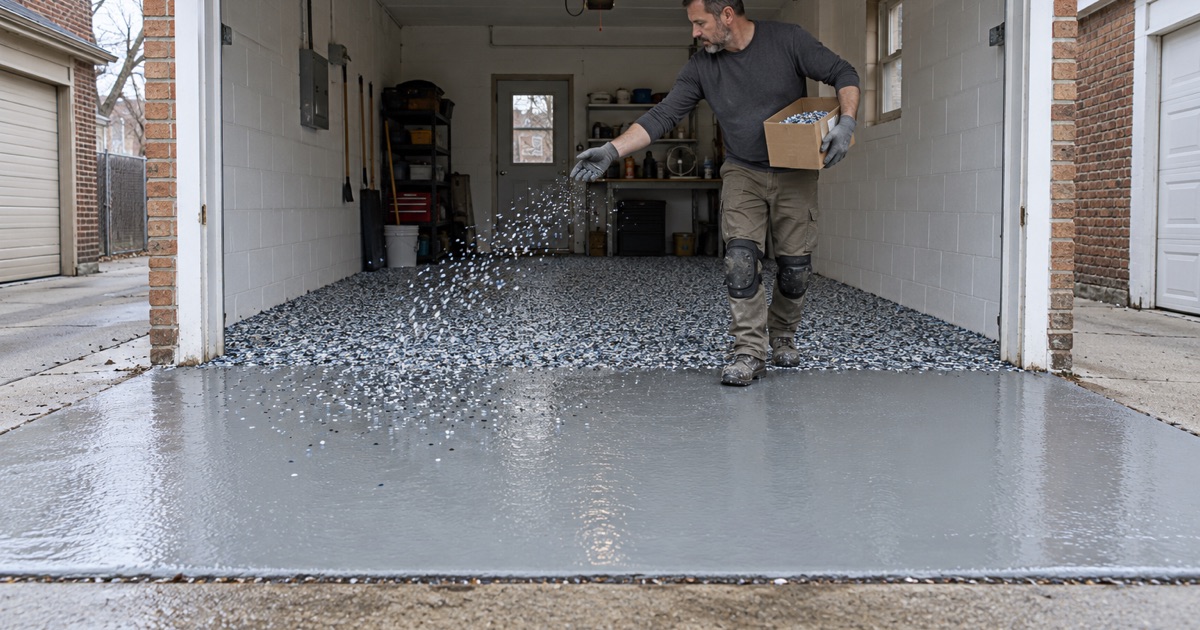
A full broadcast covers the wet base coat with flake until it is completely saturated, so no base color shows through. The excess is scraped and vacuumed off, leaving a thicker, textured layer that is then sealed with a clear topcoat.
A partial or decorative broadcast scatters chips more lightly over a colored base. It costs less in flake and shows more base color, but it is thinner and shows wear and dirt sooner, so we recommend full broadcasts for garages and busy floors.
Base Coat Color
With a full broadcast, the base coat color barely shows, but it still matters at edges and in any spots where flake coverage is lighter. We tint the base to match the dominant color in the blend so the floor reads evenly.
With a partial broadcast, the base becomes a major part of the look. Gray, tan and charcoal bases are the most common choices because they pair well with most blends and hide dirt between cleanings.
How a Flake Floor Is Installed
Grinding, Repair and Moisture Testing
The slab is diamond ground or shot blasted to the profile the base coat needs, and old paint, sealers and adhesive are removed. Cracks and spalls are filled and ground flush, and the floor is tested for moisture, with a mitigation primer added where readings run high.
Flake hides small repairs better than any other finish, which makes it a good choice for older slabs with patches and character. It cannot hide a slab that is still moving, though, so we flag active cracks before quoting.
Base Coat and Broadcast
The base coat, usually a 100% solids epoxy or a polyaspartic, is rolled out in sections. While each section is still wet, flake is thrown into it by hand in an even pattern until the surface will not take any more.
After the base cures, loose flake is scraped and vacuumed off, leaving a uniform layer locked into the base. Scraping also knocks down sharp chip edges so the topcoat goes on smoother.
Clear Topcoat and Texture
A clear topcoat seals the chips and becomes the wear surface. We usually specify a polyaspartic or urethane top for its resistance to abrasion, hot tires, salt and ultraviolet light, and apply enough material to fully encapsulate the flake.
Texture is controlled by topcoat thickness and additives. Thinner tops leave more grip from the chips, while thicker tops create a smoother, easier-to-clean surface, and a fine anti-slip aggregate can be added for wet areas.
Where Flake Floors Work Best
Garages and Basements
Flake floors are the standard choice for garages because they hide tire marks, dust and the salt residue that rides in every winter, and their texture adds grip on wet days. In basements, they create a clean, bright floor for laundry rooms, workshops and storage areas. Older basement floors are checked for paint, patching compound and old adhesive before the system is chosen, and moisture testing is especially important in basements without a vapor retarder.
Locker Rooms, Break Rooms and Lobbies
Commercial spaces with steady foot traffic use flake floors because they wear evenly and look clean between cleanings. Locker rooms and break rooms benefit from the slip resistance of a textured topcoat, while lobbies and offices often choose finer blends for a more polished look. We can add integral cove bases in wet areas so floor and wall meet in a sealed, cleanable curve.
Houses of Worship and Event Spaces
Churches, halls and event spaces often use flake floors under seating and in fellowship areas, where chairs and tables are moved constantly. The broadcast hides scuffs, and repairs blend in easily if an area is damaged. Some spaces pair flake under seating with a metallic or solid color aisle, using borders or saw cuts to separate the two systems cleanly.
Living with a Flake Floor
Cleaning and Care
Dust mopping and damp mopping with a neutral cleaner keep a flake floor looking new. In winter, squeegeeing salty slush out of the garage keeps brine from sitting on the surface, and mats at entries catch grit before it scratches the topcoat. Avoid harsh acidic cleaners and abrasive pads, which can dull the topcoat over time.
Repairs and Recoating
If a section is gouged or damaged, it can be ground out, recoated and rebroadcast with the same blend, and the random chip pattern makes the repair hard to spot. Heavily used floors can receive a fresh topcoat years later without regrinding the whole system, restoring gloss and protection.
- 20+ Years on Concrete
- Moisture Tested Before Pricing
- Written Coat-by-Coat Proposals