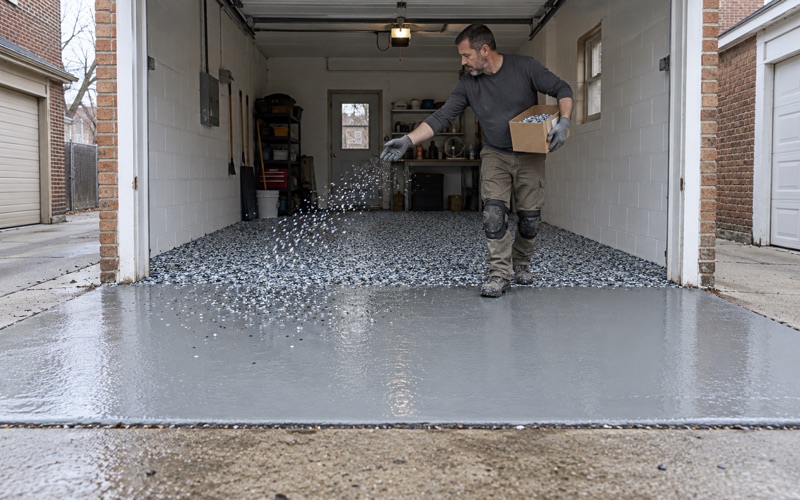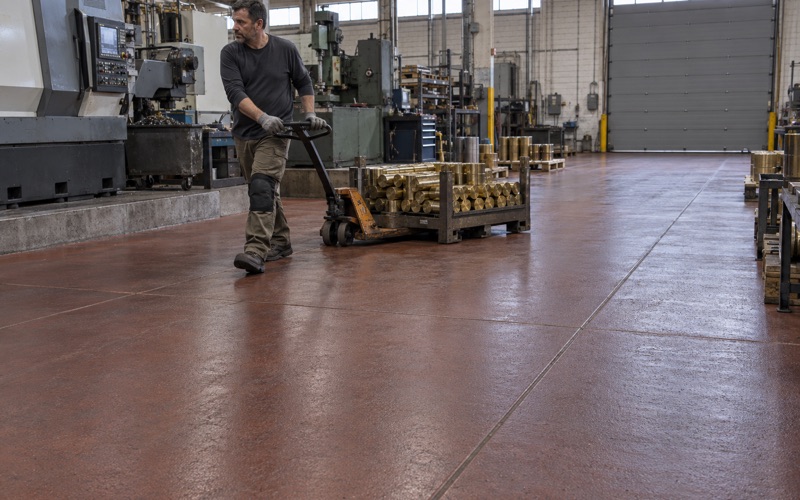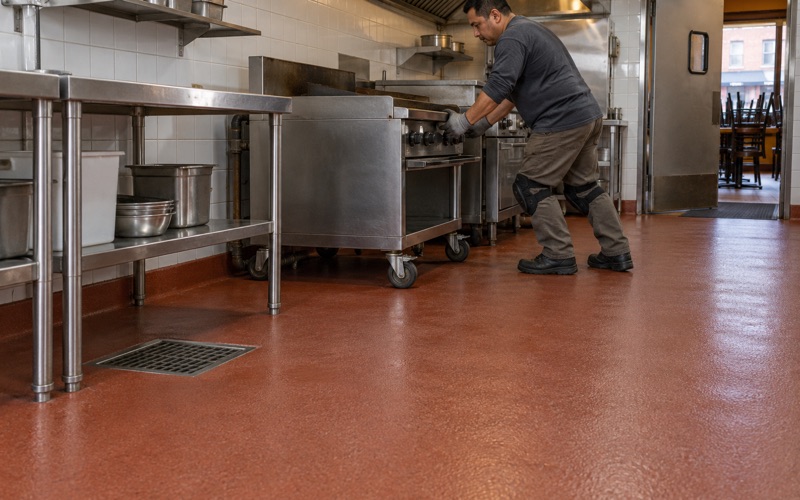
Cicero Epoxy Flooring has put more than 20 years into epoxy flooring in Crestwood and the surrounding suburbs, and much of that work starts with a question about use. A floor that suited a phone store or a clothing rack can fail fast once a mixer, a coffee machine and a mop bucket arrive. We plan the coating around what the room will do next, not what it did before.
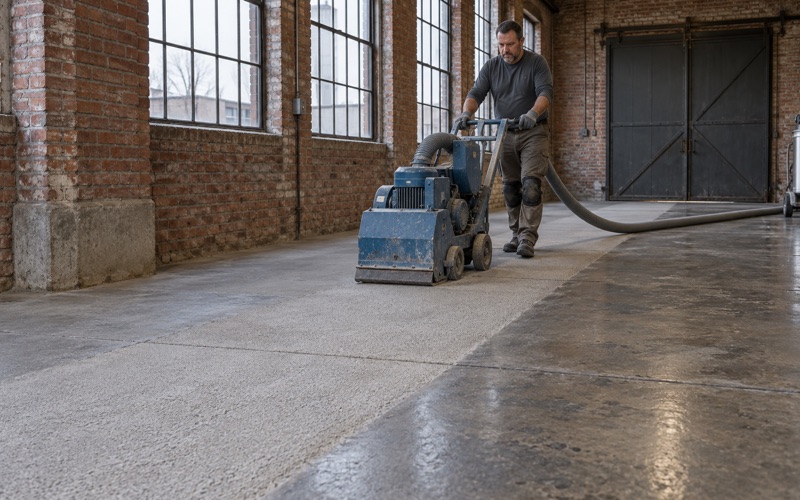
Every job opens the same way. We grind the slab with diamonds or clean it with a shot blaster to a real concrete surface profile, because an acid etch leaves a coating too little to hold. Then we map cracks, spalls and leftover coatings, and if the slab needs repair or replacement first, we say so before anyone pays for a finish.
The written proposal names the product line, the number of coats and the finished thickness, so an owner or a landlord can hold the floor up against the quote. It also spells out what the warranty leaves out, and moisture is the first exclusion we explain. That way nobody learns the limits of the coverage after the floor is already down.
New Food Tenants on Cicero Avenue
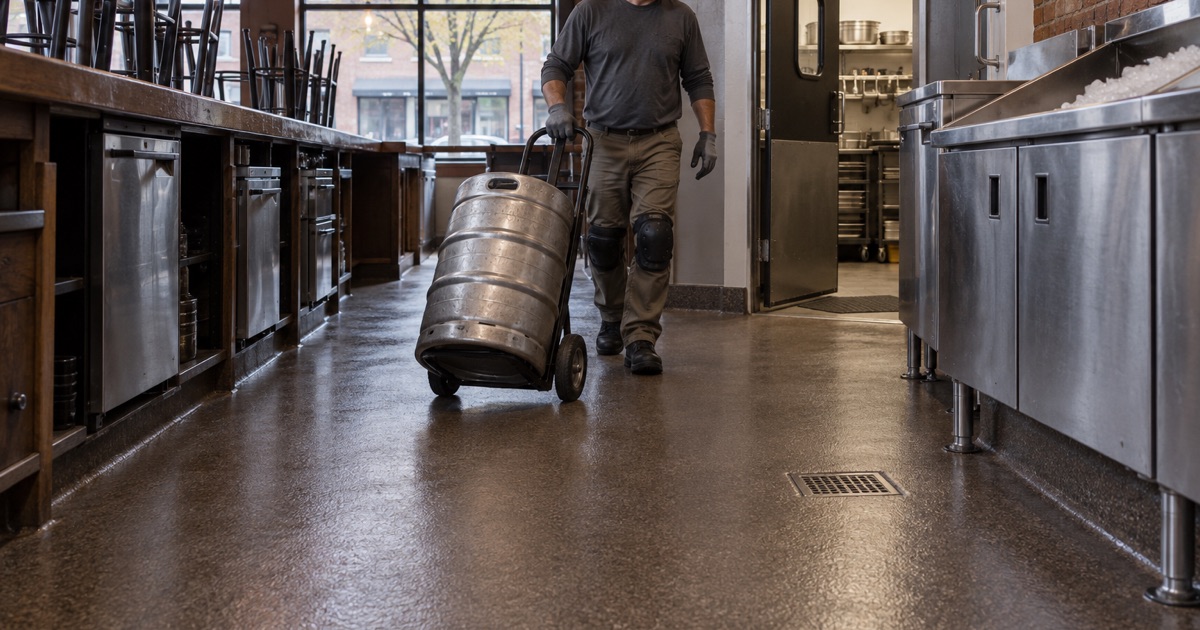
Crestwood is a village of about 3.08 square miles in Cook County, spread across Worth and Bremen townships, and a long stretch of its commercial frontage runs along Cicero Avenue. In 2025, while the Cicero Avenue streetscape project was moving toward completion, the village’s Committee of the Whole minutes kept recording food businesses taking over space built for other uses.
A Cookie Bakery in RiverCrest
In June 2025 the mayor reported that Crave Cookies and a Verizon store would open in RiverCrest next to Potbelly, and by September the minutes said the Crave Cookies and Total Wireless build-out was going well. Crave Cookies is a fresh-baked cookie shop at 13140 Cicero Ave. We had no part in that build-out, and we have not seen what floor went in.
The pattern is the useful part. RiverCrest, the shopping center at 13200 Cicero Avenue, holds tenants such as Burlington, Five Below and Portillo’s, and many of its bays were fitted out for retail. When one of those bays becomes a place that bakes, the floor under the ovens and the sink line has to change with it.
Restaurants That Reopen as Something New
Restaurant space in Crestwood changes hands too. The August 2025 minutes noted that LaStella had closed but planned to reopen with a different concept, and in November the village reported that Fat Tommy’s, a bar and grill, had taken over the old At the Office space and would open shortly. A new concept often means a new kitchen layout on an old slab.
Drains, hood lines and prep sinks move, and the trench or floor sink that served one menu may sit in the wrong place for the next. Patches where plumbing was cut in leave the old floor uneven and porous along the seams. We map those patches before choosing a system, since a coating laid over a poor patch can show the seam soon after opening.
A Coffee Shop Still on Paper
Not every plan in the minutes is a business yet. Bella Brew Coffee sent the village a letter of intent for a site on Cal Sag Road, and in late 2025 it was still described as interested in Cal Sag locations. A letter of intent is the right moment to ask what a cafe floor will need, before a lease locks in the schedule.
Looking for epoxy-flooring closer to Wood Dale? See Wood Dale Epoxy-Flooring.
When a Retail Store Becomes a Bakery or Cafe
A shop floor is usually judged on looks and foot traffic. A food floor is judged on whether it can be scrubbed and wet-mopped every night without opening a seam, and whether sugar, milk and grease wipe off instead of soaking in. Those are different jobs, and a coating chosen for the first rarely does the second well.
Continuous, With No Seams to Hold Water
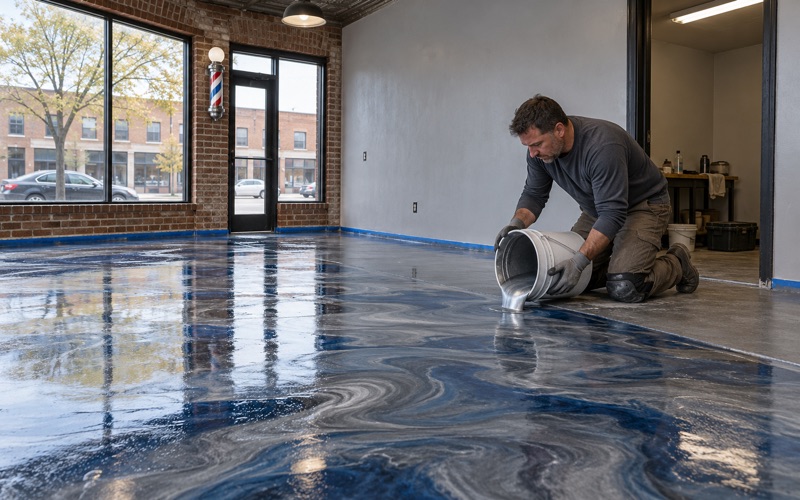
Vinyl tile, carpet tile and laminate all have joints, and joints are where mop water and spilled syrup collect. A resinous system such as 100% solids epoxy goes down as one continuous film over the ground slab, so there is nothing for liquid to track into. Where the room needs more body, a urethane cement system takes heat and wet cleaning well.
Before the old floor comes up, we check what is under it. Retail slabs often carry tile adhesive, leveling compound and paint, and each has to be ground off rather than coated over. We grind to the ICRI CSP number the product line calls for and vacuum the dust at the machine, so none of it is rinsed toward a drain.
Sealed at the Walls and Drains
The weak point of most food floors is the edge. The FDA Food Code, at 6-201.13, describes coved, closed junctures where a floor meets a wall, and a resin cove base carried up the wall does that job in one piece with the floor. At each floor drain and floor sink, we key the coating to the drain body so water runs in rather than under.
Which rules apply to a particular kitchen is a question for food plan review, which for suburban Cook County businesses appears to run through the Cook County Department of Public Health, and the tenant should confirm that early. We do not claim any agency requires epoxy. We build a floor whose sealed, cleanable surfaces a tenant can show to that review with confidence.
Sugar, Dairy, Grease and Hot Water
A bakery drops sugar and butter, a cafe spills milk and syrup, and a grill line throws grease and runs hot water across the floor at closing. Dairy acids and fats can dull or soften a thin coating, and repeated hot-water cleaning is hard on systems not rated for it. That is why we ask what the menu is before we name a product.
Grease matters beyond the floor as well. In September 2025 the village minutes noted a bar and grill on Cal Sag Road whose cooking grease was clogging the sewer. A sealed floor makes spills easier to squeegee and scrape up dry, and we tell kitchen tenants plainly that a coating is not a substitute for proper grease handling at the drain.
Texture Where Floors Stay Wet
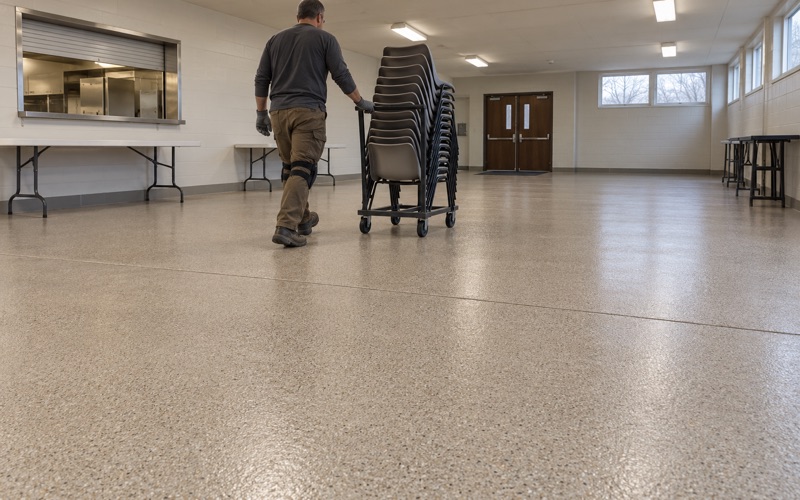
A glossy floor that looks clean in a showroom can be slick behind a counter. The Food Code’s 6-201.11 allows antislip floor coverings in areas subject to moisture, and we usually build texture into prep and dish areas with a quartz aggregate broadcast under a sealing topcoat. Customer seating can stay smoother, so the space reads finished without giving up footing where staff work.
Working Inside a Tenant’s Build-Out Schedule
A food tenant’s opening date is usually set before the floor is, and the floor has to fit between demolition and the arrival of equipment. We like to coat after the plumbing and drains are set and the walls are closed, but before ovens, counters and shelving go in. Coming in later means working around fixed equipment and leaving edges that are hard to seal.
Moisture Testing Before the Price Is Final
A storefront slab can look dry and still push vapor up through a new coating. We write a moisture test into the scope before the number is final, using ASTM F2170 in-situ relative humidity probes or ASTM F1869 calcium chloride kits depending on the system. If the readings run high, a moisture-mitigation primer goes into the price now rather than into a failure later.
Cure Time and Opening Day
We set cure times by slab temperature and the dew point spread at the surface, not by a calendar promise. A cold, closed-up shell in winter cures slowly and can develop amine blush on an epoxy coat, so we may ask for the heat to be on for days before we start. Polyaspartic topcoats can shorten the return to foot traffic when the room allows it.
Other trades need to know when the floor is off limits. We give the general contractor a written window for grinding, coating and cure, and we ask that no carts, ladders or equipment cross the floor until it has reached the hardness the product line requires. A scuffed topcoat days before an inspection costs more time than the wait would have.
Registering With the Village
Crestwood asks every contractor to register with the village before working there, at $100 for a general contractor and $25 for a sub-contractor, with an insurance certificate naming the village as additional insured. We take care of that before the job is booked. The Building and Zoning Department at 13800 S. Cicero Ave. lists painting and carpeting as permit-exempt but does not mention floor coatings, so we ask rather than assume.
Crestwood’s Own Garages and Home Floors
Homes make up the other half of the picture. The village’s housing leans on the 1970s, which account for about 30 percent of all units, and fewer than 3 percent were built since 2010. Detached homes are mostly from the 1950s through the 1970s, so many garage slabs have had decades of salt, oil and patching before we see them.
Salt, Brine and Older Slabs
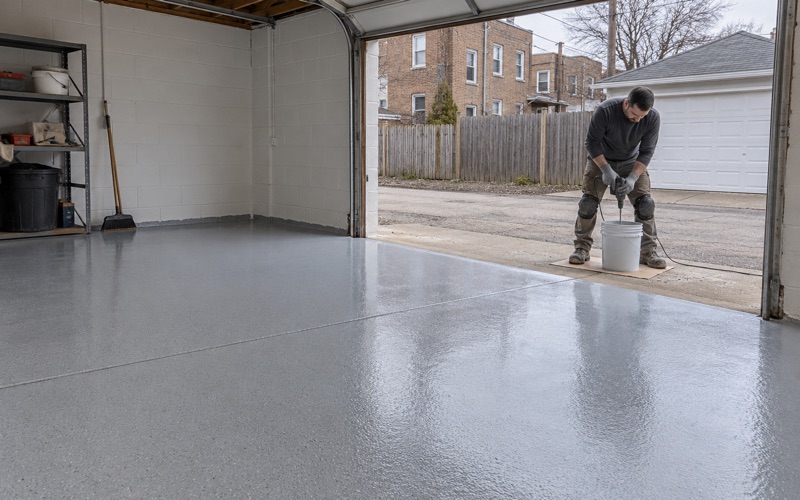
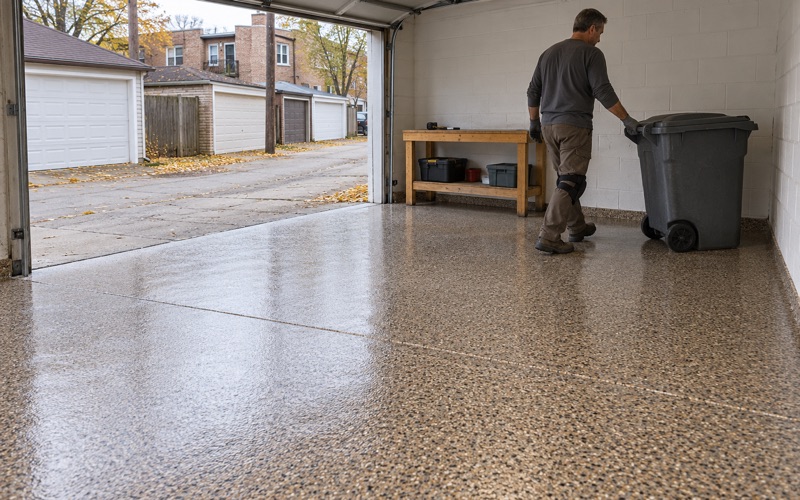
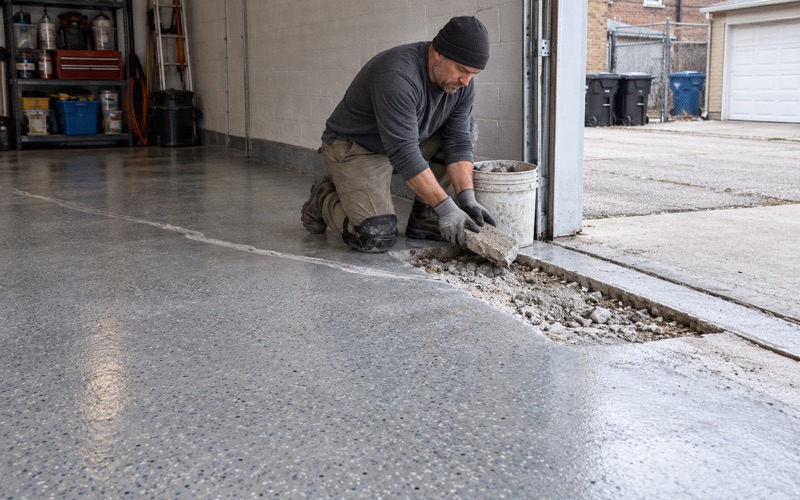
Winter tires carry rock salt and calcium chloride brine into the garage, and that brine can work into thin paint-style coatings and lift them. We choose garage systems for that exposure, often a 100% solids epoxy base with a vinyl flake broadcast and a polyaspartic topcoat that resists hot tire pickup. Old oil stains get ground out and cleaned before any primer goes down.
Garage slabs often sit on no vapor retarder at all, since the residential code’s R506.2.3 exception does not require one under a garage floor. That makes a moisture check as important in a garage as in a basement, and it is part of our scope either way. In January, an unheated garage is told to wait for weather that lets the coating cure properly.
Basements, Drains and Contracts
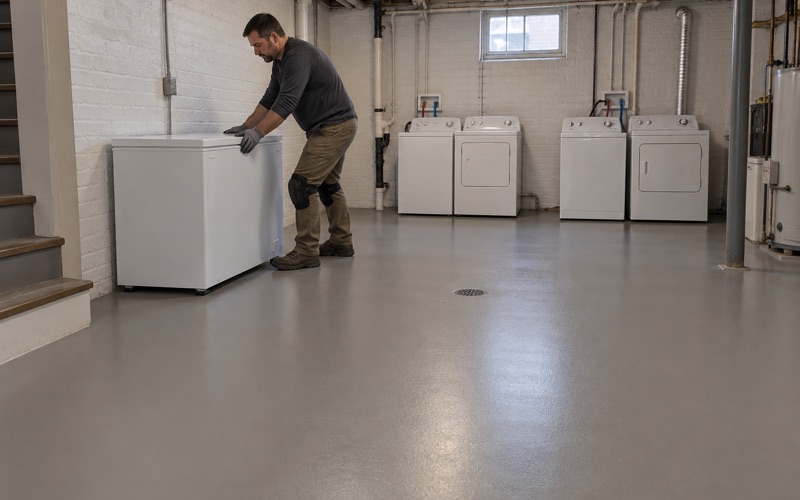
Older basement floors often carry paint, patching compound or old adhesive, and we check for each before picking a system. We also say plainly that a coating will not stop water coming up a floor drain; that is a drain and backflow question to settle first. And a floor coating is never a radon fix, since radon mitigation in Illinois is licensed through IEMA.
Home jobs above the state threshold get a written contract and the Home Repair: Know Your Consumer Rights pamphlet before grinding starts, as the Illinois Home Repair and Remodeling Act expects. Every product we use sits inside the Illinois VOC limits for floor and industrial coatings, which apply to us as the applicator. Those steps cost a homeowner nothing and settle questions before they become disputes.
- 20+ Years on Concrete
- Moisture Tested Before Pricing
- Written Coat-by-Coat Proposals