
Cicero Epoxy Flooring installs commercial kitchen flooring in Cicero, IL, serving surrounding cities including Forest Park, Lyons, River Forest, Brookfield and Summit. Kitchen floors are the most demanding floors we coat outside heavy industry, and over 20+ years of grinding and coating concrete we have seen how quickly the wrong system fails under hot water, grease and daily cleaning.
Restaurants, taquerias, bakeries, cafeterias and food plants need a floor that is seamless, cleanable, slip resistant and able to survive hot wash-downs every shift. For most of these spaces that means urethane cement with an integral cove base, rather than a standard epoxy that softens and cracks under thermal shock.
Our proposals name the system, coat count and finished thickness, along with the cove height and drain details. We also explain what the warranty excludes before the job is sold, so a kitchen owner knows exactly what the floor is built to handle.
Meeting Food Code Expectations
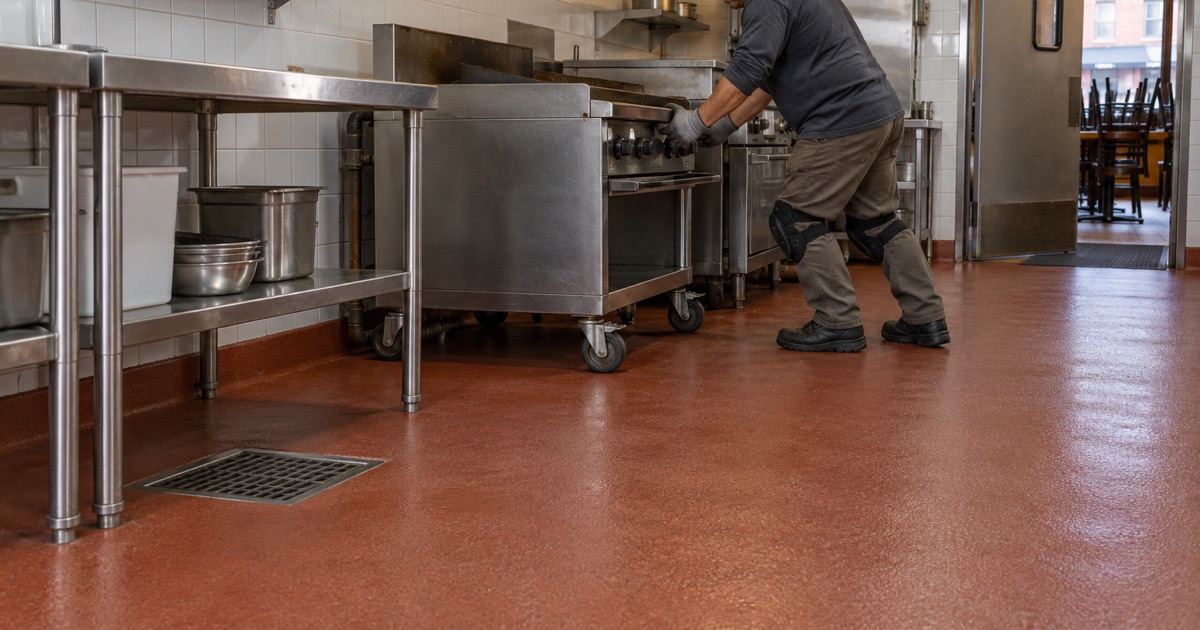
Smooth, Durable, Easily Cleanable Floors
FDA Food Code section 6-101.11 calls for floor surfaces in food areas that are smooth, durable, nonabsorbent and easily cleanable. Grout lines, cracked quarry tile and worn sealers all fail that test over time, because they absorb grease and give bacteria a place to live.
A seamless resinous floor removes the joints where dirt collects. Illinois has adopted the 2022 FDA Food Code, and local health officials apply it when they inspect food establishments.
Anti-Slip Texture Where Safety Needs It
Section 6-201.11 requires floors to be smooth and easily cleanable, but it expressly allows anti-slip floor coverings in areas where they are needed for safety. That exception is what lets a kitchen floor carry textured aggregate near fryers, dish stations and walk-in coolers.
We vary texture by zone, coarser where grease and water are constant and finer in prep areas where easy cleaning matters more. The goal is grip where people move fast with hot pans, without a surface that traps dirt everywhere.
Coved Floor and Wall Junctures
Section 6-201.13 addresses the juncture where floor meets wall, and a sealed, coved transition is one of the first details a health inspector checks. Square corners trap grease and water and are hard to clean, especially behind equipment.
We form integral cove bases from the same resin system as the floor, so floor and cove are one continuous surface with no seam. Cove height is agreed in the proposal and carried around walls, columns and equipment bases.
Why Urethane Cement for Kitchens
Hot Water, Steam and Thermal Shock
Commercial kitchens and food plants are cleaned with hot water, steam and sanitizers, sometimes several times a day. Standard epoxy expands and contracts differently from the concrete beneath it under these temperature swings, which leads to cracking and debonding.
Urethane cement is designed to handle thermal cycling and constant moisture. It moves more like concrete, tolerates hot wash-downs and keeps its bond where an epoxy would let go.
Grease, Food Acids and Cleaners
Cooking oils, animal fats, vinegar, citrus, dairy and sugar solutions all attack floors over time, as do strong degreasers and sanitizers. Urethane cement resists these far better than standard epoxy and does not soften under daily exposure. We review the cleaning chemicals you use and check them against the manufacturer’s resistance data, so the floor and your cleaning routine are compatible from the first day.
Where Epoxy Still Fits
Dry storage rooms, offices, restrooms and some front-of-house areas do not face the heat and moisture of the cook line. Epoxy or polyaspartic systems with flake or quartz broadcast work well there and cost less. We often combine systems in one building, using urethane cement in the kitchen and dish areas and epoxy elsewhere, with clean transitions at doorways.
Preparing and Installing Kitchen Floors
Removing Tile and Failing Floors
Many older restaurants have quarry tile with broken grout and loose tiles, or old coatings that have worn through near the cook line. Loose material under a new floor will crack the new system, so we remove failing tile, grout and coatings down to sound concrete.
The slab is then shot blasted or diamond ground to the profile urethane cement requires. Saw-cut keyways at edges, drains and doorways anchor the system so it does not peel at its terminations.
Drains, Slopes and Moisture
Kitchen floors need to slope toward floor drains and trench drains so water does not pond. We rebuild slopes with urethane mortar where needed and detail drain edges so the floor seals tightly to them.
Kitchen slabs are tested for moisture too. Urethane cement is more tolerant of slab moisture than epoxy, but test results still guide the primer and installation timing.
Scheduling Around Service
Restaurants cannot close for long, so we plan installations around slow days, weekends and holiday closures. Urethane cement cures quickly enough that many kitchens can return to service within a short window, depending on the system and temperature. Equipment moves, gas and plumbing disconnects and reinstallation are coordinated in advance with your staff and trades, so the closure is as short as possible.
Bakeries and Food Plants
Bakeries and food processing plants combine kitchen conditions with industrial traffic, including carts, pallet jacks and wash-downs every shift. Cicero is home to several bakery and food operations, and floors in these spaces need heavier urethane cement systems, more texture and careful drain detailing. Work in these facilities is phased by area and scheduled around production, with overnight and weekend windows where lines cannot stop.
- 20+ Years on Concrete
- Moisture Tested Before Pricing
- Written Coat-by-Coat Proposals