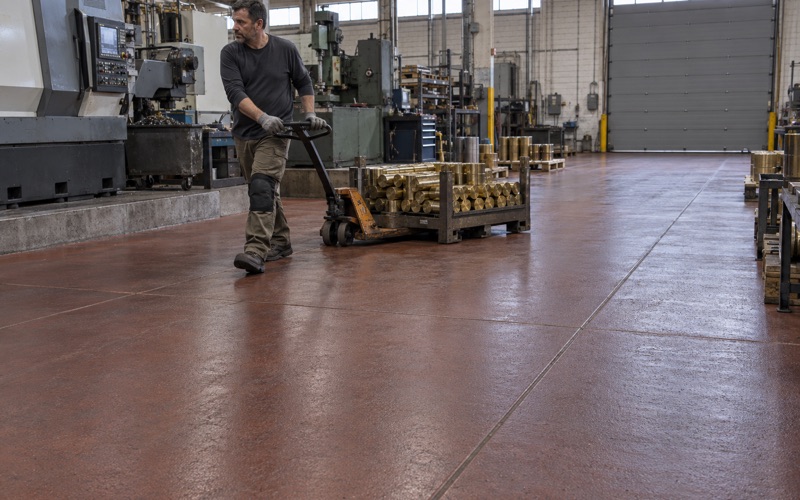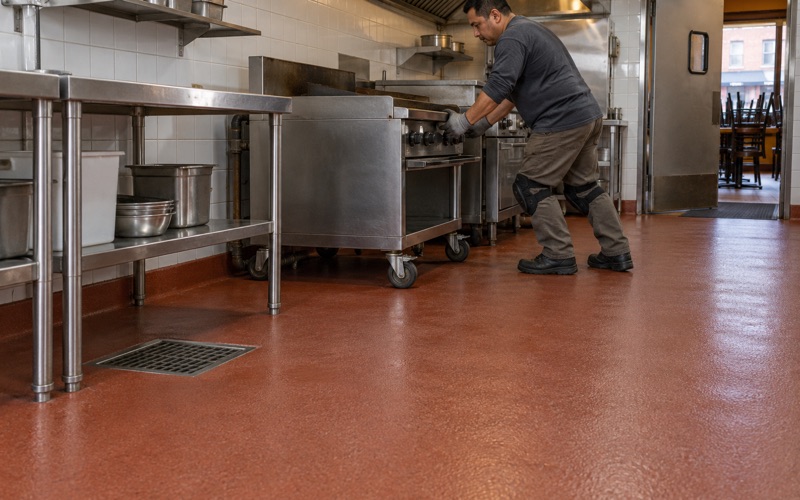
Cicero Epoxy Flooring has handled epoxy flooring in Burr Ridge and across the area for more than 20 years, and this page is about one kind of floor in particular: the working slab inside a shared distribution building. We coat concrete where pallet jacks and forklifts run all shift, then set the aisle lines, staging boxes and zone colors into that coating instead of painting them onto bare concrete.
Every job starts the same way. We open the slab with a diamond grinder or a shot blaster, never an acid etch, and we map the cracks, spalls and old coating before we recommend anything. If a section of floor needs repair or replacement before it can carry a coating, the proposal says so rather than burying it under a fresh color.
That written proposal also names the product line, the number of coats and the finished thickness, so a property manager can check the finished floor against the quote. For a building where shipping cannot stop, we phase the work around shifts and use overnight and weekend windows, one aisle or bay at a time.
Tower Drive Buildings and the OSHA Aisle Rule

The multi-tenant strip on Tower Drive
Burr Ridge sits at the I-294 and I-55 intersection, and its Cook County side, in Lyons Township, holds a strip of multi-tenant industrial buildings along Tower Drive. One of them, 44 Tower Road, is a 73,785-square-foot building that Plymouth Industrial REIT bought in January 2019. At that sale its tenants were World PAC, an automotive parts distributor, and Hydra-Stop, which makes insertion valves and line stops.
We have not checked who leases space there now, and none of those companies is a customer of ours. What matters is the building type. In a shared distribution building, each tenant’s share of the slab is laid out in picking aisles, staging zones and dock lanes, and those layouts are usually drawn on the floor.
What OSHA 1910.176(a) says
The federal rule behind aisle marking here is OSHA 29 CFR 1910.176(a). Where mechanical handling equipment is used, it calls for sufficient safe clearances at aisles, loading docks, doorways and anywhere a turn or passage must be made. It requires aisles and passageways to be kept clear and in good repair, and it says permanent aisles and passageways shall be appropriately marked.
Read it closely and notice what it leaves out. The rule requires marking; it does not require a coating, a particular product or a set of colors. That choice belongs to the building owner and the tenant, and our job is to make whatever marking they choose last under the traffic it actually sees.
Good repair is part of the rule
The phrase people skip is the one about good repair. A marked aisle with a spalled joint, a broken slab edge at a dock plate or a patch of lifted paint is hard to call good repair, and a pallet jack wheel finds every one of those defects. That is why our crack and spall map comes before any discussion of colors.
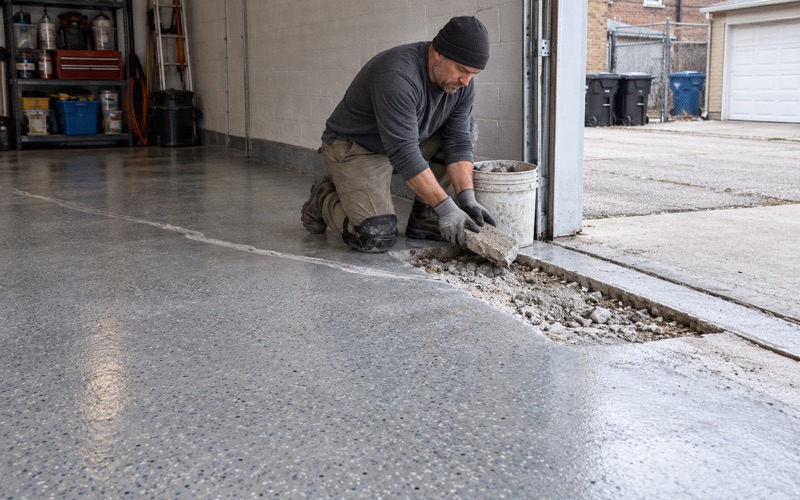
Joints and cracks in an aisle are filled and ground flush before the base coat goes down, so the wheel rolls across one plane. If a slab section has broken up badly enough that a coating would only hide it, we say that in writing and price the repair separately, so the owner can decide on it alone.
Looking for epoxy-flooring closer to Worth? See Worth Epoxy-Flooring.
Why Painted Lines on Bare Concrete Wear Off
Wheels, turns and dock lanes
Aisle paint fails first where the wheels concentrate. A loaded pallet jack pivots on a small, hard wheel at every end-of-aisle turn, and a forklift scrubs its tires in the same few square feet each time it swings into a rack bay. Those turning points and the lanes leading to the dock doors are where a painted stripe goes from crisp to faint.
Faded marking is more than a looks problem in a shared building. When the line between one tenant’s staging zone and the main aisle disappears, pallets drift into the travel path and the clearance the rule asks for shrinks. A manager then repaints the worst stretch, and the floor ends up as a patchwork of fresh and worn lines.
Paint has nothing to hold
Bare warehouse concrete usually carries a troweled, dusty or densified surface, and traffic paint rolled onto it sits on top rather than bonding into it. Add the oil and tire residue a working dock lane collects, and the paint loses its grip quickly under steady wheel loads. A stripe that peels at the edges then catches more wheels and lifts faster.
Profile is the missing piece. A coating system needs the slab opened to a measured texture on the ICRI CSP scale, typically by diamond grinding or shot blasting, before anything goes down. Paint rolled over an unprepared floor skips that step entirely, which is why the same aisle gets repainted again and again.
Repainting at every re-rack
Paint-only lines also have a second cost that shows up at lease time. When a tenant moves its racking, the old stripes stay on the concrete as ghost lines next to the new ones, and grinding them off bare concrete leaves pale scars. A floor that has been re-racked twice can carry three generations of aisle marking at once.
Confusing old lines are the opposite of appropriate marking. A forklift operator new to the building has to guess which stripe is current, and the staging boxes stop meaning anything. Repainting between tenants without removing the old marking hands the next one a floor that reads as a maze. That is the problem the coated approach is built to solve.
Lines and Zone Colors Built Into a Coated Floor
Testing the slab before the price is final
A moisture test is part of the written scope before we finalize a price, whether the floor is a warehouse bay or a home garage. On a large slab that usually means ASTM F2170 in-situ relative humidity probes at several points, sometimes with ASTM F1869 calcium chloride tests alongside. The readings decide whether a moisture-mitigation primer belongs under the system.
Moisture is also the first exclusion we explain in any coating warranty, and we explain it before the job is sold rather than after a blister appears. We do not assume an older industrial slab was poured over a vapor retarder. Where that is unknown, the test answers it, and the proposal states what was found.
Where the lines go in the build
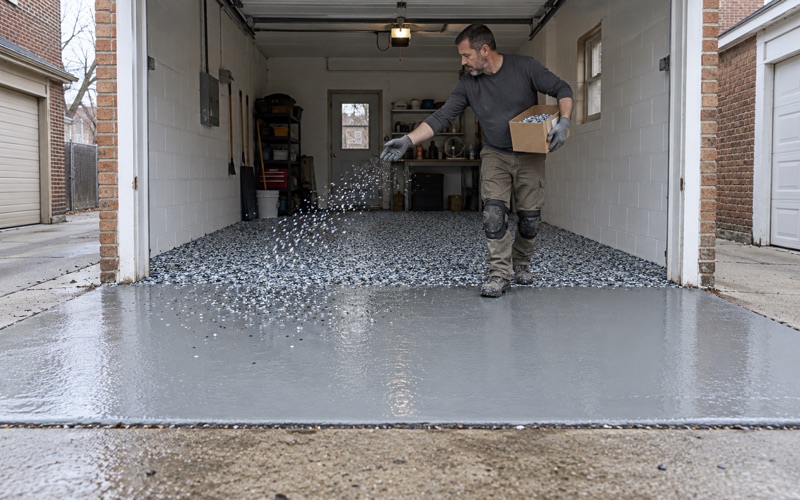
In a coated floor the marking is part of the system rather than a coat of paint on top of it. Over the ground and primed slab we lay a 100% solids epoxy body coat, then mask and apply the aisle lines, staging boxes and zone colors, and seal the whole floor with a clear polyaspartic or urethane topcoat that the wheels actually ride on.
Because the topcoat takes the wear, the color underneath stays sharp at the turns and dock lanes where paint gave out. Where a drive lane needs grip, quartz aggregate can be broadcast into that lane alone. The colors themselves are the tenant’s call; OSHA asks for appropriate marking and leaves the palette to the people running the floor.
Working around shifts and cure
Cure is the limit on how fast a section returns to service. We set cure times by slab temperature and the dew point spread at the slab surface, not by the calendar, because a coating laid on a cold slab near its dew point can develop amine blush and a weak bond. A dock bay with its doors open needs that reading taken on the day.
Sequencing follows from that. Racking and stock clear one section, it is ground, coated, marked and cured, and it goes back to work before the next section opens, so the tenant does not lose the whole floor at once. The products we use are selected inside the Illinois VOC limits for floor and industrial coatings, which bind whoever applies them.
When a Tenant Re-Racks or Moves Out
Re-striping on a coated floor
This is where a coated floor pays back in a multi-tenant building. When the next tenant brings a different rack layout, we lightly abrade the topcoat over the old lines, recoat the field color where those stripes ran, and lay the new aisle marking and staging boxes in the same system. The old layout comes up cleanly instead of leaving ghost lines on raw concrete.
The work is smaller than the first coating because the profile, moisture answer and body coat are already in place. We still walk the floor before quoting it, since a departing tenant can leave behind anchor holes from removed racking, forklift gouges or oil at the dock. Those get mapped and repaired first, so the new marking goes onto a sound floor.
Village license, bond and insurance
Illinois licenses no flooring or coatings contractor, so the binding requirements here are the village’s own, and we check them before a job is booked. Under Village of Burr Ridge Community Development rules, every contractor and subcontractor on permitted work holds a village license, at $200 for a general contractor with subcontractors and $100 for all others, valid one year from issuance.
Each licensed contractor also needs a $10,000 surety bond naming the village, liability insurance of at least $1,000,000 aggregate with the village as additional insured, and workers’ compensation or a self-employment letter. Whether a given floor job needs a permit depends on its scope, since the village exempts finish work such as painting, and we confirm that with the department rather than guess.
The truck terminal that is not in Burr Ridge
One clarification for anyone searching for freight-terminal floors here: the village has no truck terminal of its own. In June 2024, reviewing a proposal for the 110-acre CNH property, Mayor Gary Grasso said no one wants truck terminals in Burr Ridge, and he described the Saia LTL Freight terminal as sitting in unincorporated DuPage County next to the village.
That matters for how we describe the work. The industrial floors inside Burr Ridge include multi-tenant distribution and flex buildings like the Tower Drive strip, rather than a cross-dock terminal running around the clock. Our proposals for those floors cover the aisle marking, staging zones and dock lanes a tenant actually uses, and nothing it does not.
- 20+ Years on Concrete
- Moisture Tested Before Pricing
- Written Coat-by-Coat Proposals