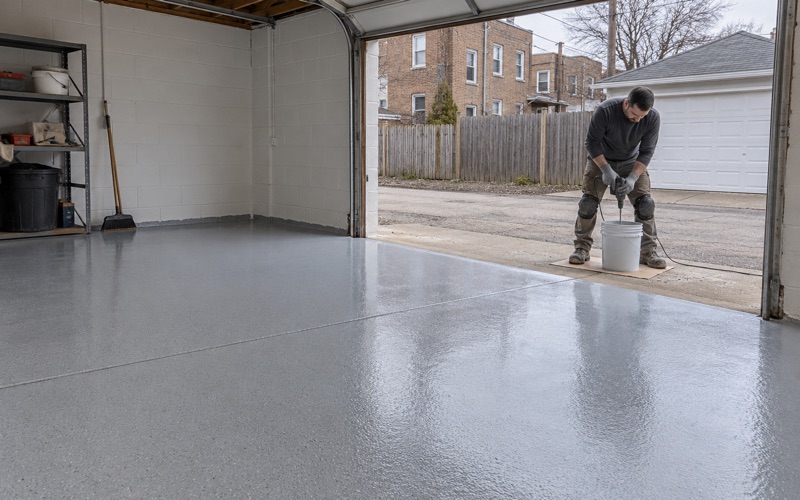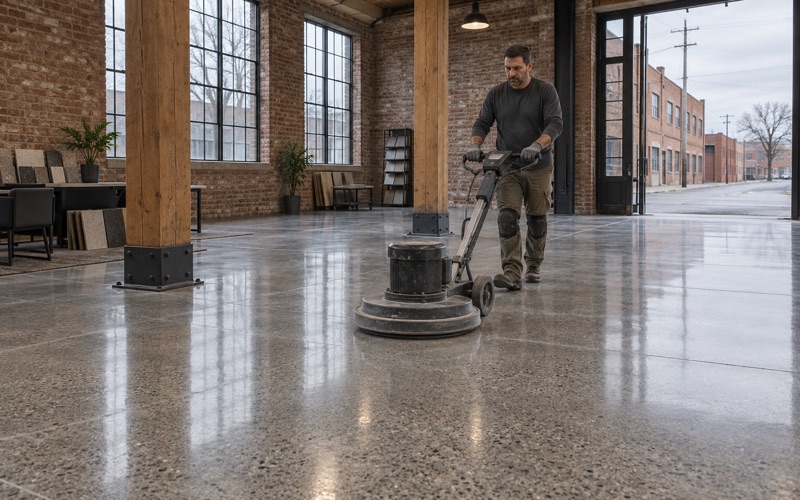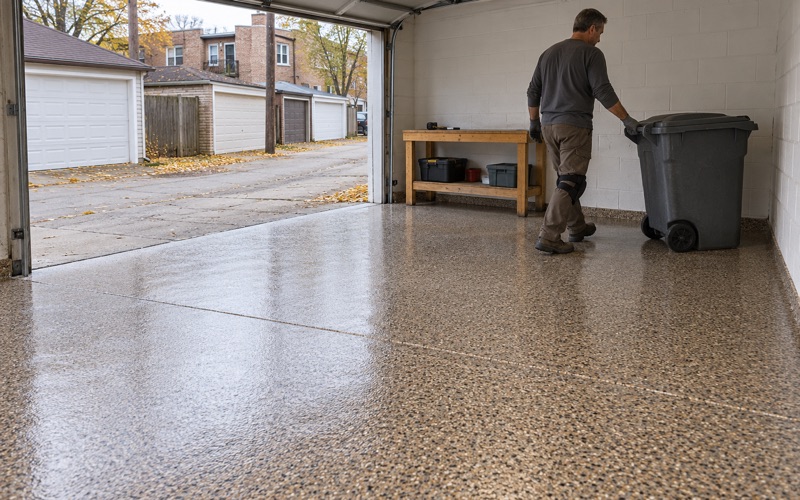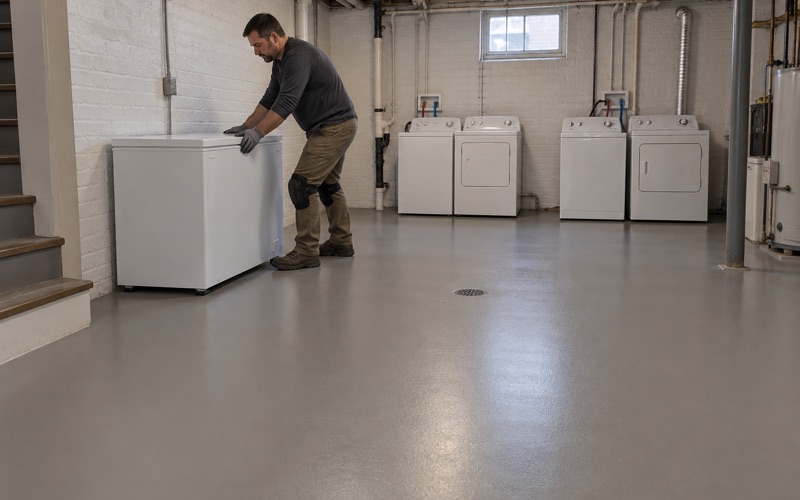
Cicero Epoxy Flooring has spent more than 20 years on epoxy flooring in Bridgeview and the surrounding industrial suburbs, and the floors we think hardest about here are the ones a railroad runs into. A slab with steel rail set into it does not behave like an open warehouse floor. It moves, cracks and wears along lines the track decides, and the coating plan has to start there.
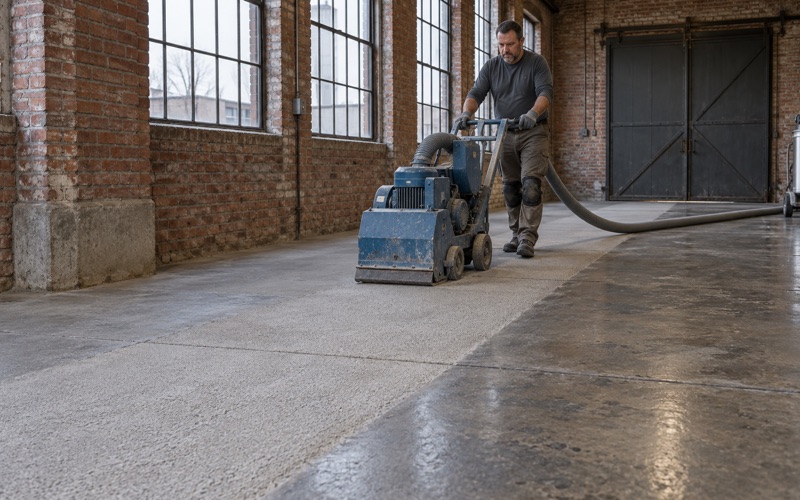
Every job begins with a diamond grinder or shot blaster, never an acid etch, because a resin system needs an open profile to grip. Before we price the work we walk the slab and map each crack, spall and patch of old coating, and if a section near the track should be repaired or replaced before anything goes over it, we say so in writing.
The proposal names the product line, the number of coats and the finished thickness, so a facility manager can hold the floor against the quote. Moisture testing is written into that scope before the number is final, and moisture is also the first warranty exclusion we explain, before anyone signs.
Railroad Track Inside Bridgeview Warehouses
Rail-Served Buildings on S. 78th Avenue
Bridgeview has warehouses where the railroad does not stop at an outside spur but continues through the wall. TLP Bridgeview Logistics Center, at 7557-7575 S. 78th Avenue in Lyons Township, covers 254,425 square feet and was described at its 2019 sale as having interior and exterior rail service from the Indiana Harbor Belt, alongside 37 dock doors and 78-plus trailer positions.
Next door, 7601 S. 78th Avenue is a 148,000-square-foot building served by CSX with four interior rail spots. We have not seen the floors in either building and do not work for their owners or tenants; they matter here because they show what kind of slab this part of the village holds.
What Interior Rail Changes About a Floor
An interior rail spot puts a boxcar inside the building, so the floor has to share space with a track bed, a dock edge at car height and the traffic that moves between them. Forklifts load and unload through the car door, pallet jacks run along the track, and the slab takes wheel loads right up to the steel.
That changes the order of work. On an open warehouse floor we can grind, repair and coat in broad passes, but next to an interior track the edges come first, the open field comes second, and the plan is written around where the rail sits.
Bridgeview zones a large share of its land for industry, and the rail-served buildings are part of that base. Floors like these are judged by forklift wheel loads and pallet jack traffic, not by how a garage looks, and we pick systems on that basis.
Working Around a Live Building
A rail-served warehouse usually cannot stop for a floor. We phase the work around shifts and car schedules, taking a section of slab at a time and using overnight and weekend windows when the dock cannot close, so cars can still be spotted and unloaded at the rest of the building.
Grinding dust is collected at the machine by vacuum rather than swept toward the track bed or a drain. Cure times are set by slab temperature and the dew point spread at the surface, which matters near a large rail door that lets cold air in whenever a car is moved.
We agree in advance which spots and doors stay open each night, and the schedule is written into the proposal. When the building runs cars on a tight cycle, the floor is done in smaller sections over more nights rather than in one long closure.
Looking for epoxy-flooring closer to Western Springs? See Epoxy-Flooring in Western Springs.
Where Steel Rail Meets the Slab
Why the Rail Line Cracks
Concrete and steel rail move differently under load and temperature, and the joint between them takes every wheel that crosses or runs beside it. That is why the rail-to-concrete line is a common place for slabs to crack and spall in rail-served buildings, with edges breaking away in chips and small chunks.
We describe that as a pattern to look for, not a condition we have recorded on S. 78th Avenue. Each floor gets its own walk-through, and the crack map we draw is what the repair scope is built on. A spall coated over without repair simply breaks out again, taking the new film with it.
Repairing the Edge Before Coating
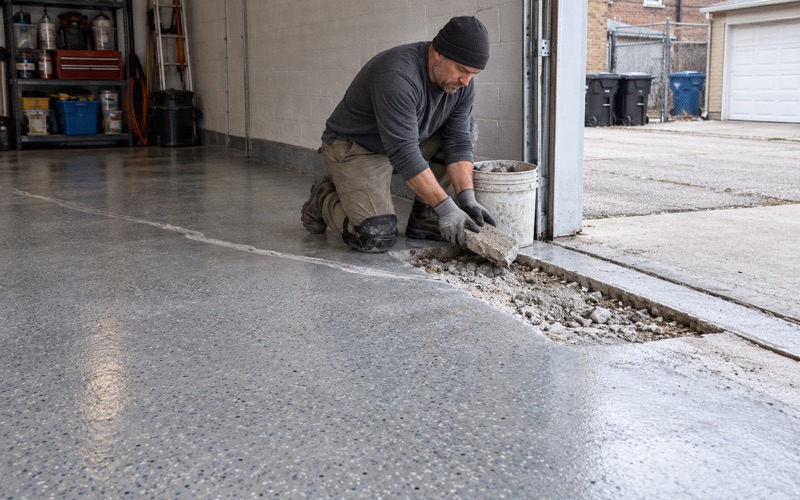
Loose concrete along the rail is cut back to sound material, and the broken edge is rebuilt with a repair mortar or epoxy mortar suited to wheel traffic before any coating goes down. Where the damage runs deep or the slab has settled beside the track, we tell the owner it needs replacement rather than a patch and a topcoat.
Some rail work also sits outside our trade. The track, its fastenings and anything structural beneath them belong to whoever maintains the track, so we repair concrete up to the rail and leave the rail itself alone.
Testing a Slab Beside a Track Bed
A recessed track can leave the slab beside it thinner or poured in separate sections, and the moisture picture is not always the same across the building. We test it using ASTM F2170 in-situ relative humidity probes or ASTM F1869 calcium chloride kits, and compare the readings with the product’s limits.
If the numbers run high, a moisture-mitigation primer goes into the system rather than hoping the coating holds. A failed reading changes the system and the price, which is why it happens before the proposal rather than after the grinder arrives.
The Rail Dock Edge, Bridge Plates and Grit
Bridge Plates Into Boxcars
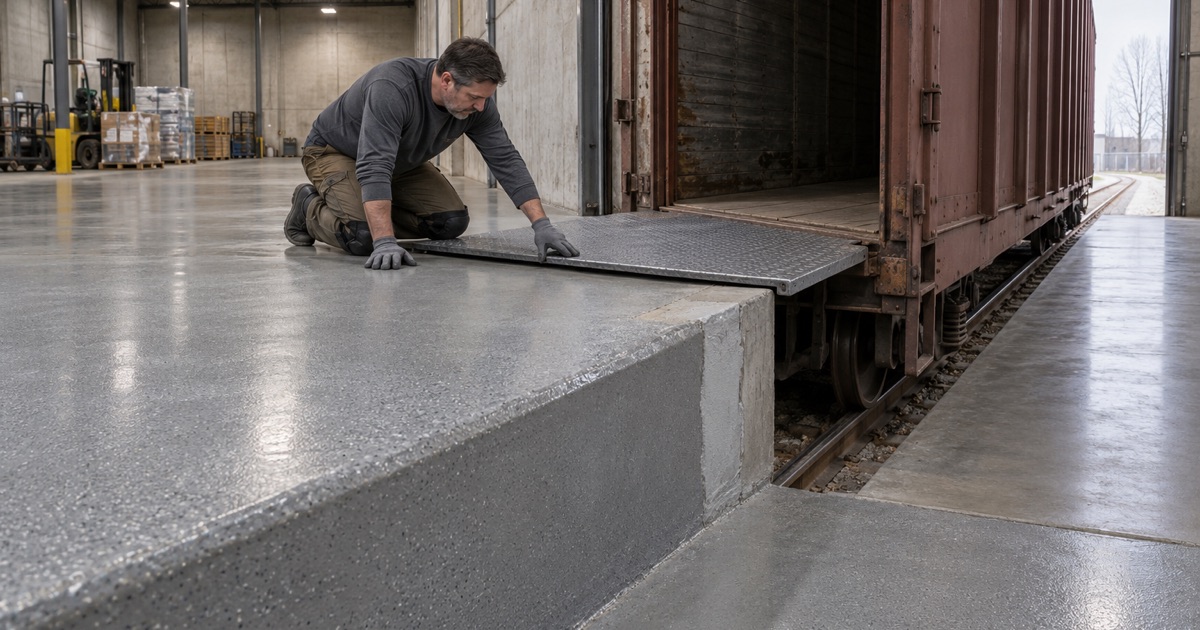
At a rail dock, forklifts cross into the boxcar on a bridge plate laid from the dock edge to the car floor. Every crossing drops a loaded wheel onto that edge, and the plate itself can scrape and chip the concrete as it is set, shifted and lifted between cars.
The dock edge is the other place a rail-served slab commonly spalls. We rebuild a damaged edge before coating, and we may stop the coating short of the nosing and treat that strip with a lithium silicate densifier instead, because a thin film at the point of impact wears through quickly.
Grit and Debris From the Cars
Boxcars bring the railroad in with them. Ballast grit, dirt from the car floor and debris from the doors get picked up on forklift tires and carried across the warehouse, and that grit acts like sandpaper on a coating that is too soft or too thin.
For the traffic lanes near the track, we lean toward a 100% solids epoxy body with a quartz aggregate broadcast, which gives the surface hardness and texture, then lock it in with a wear-resistant topcoat. A smooth, glossy finish looks good on day one but shows scratches and turns slick under fine grit.
Polyaspartic and polyurea topcoats cure fast enough to return a lane to service quickly, which helps when a section has to reopen before the next car arrives. Where forklifts turn hard or loads sit in one spot, we weigh that speed against the thicker build of a urethane cement system.
Keeping the Floor Clean Enough to Coat
Grit is also a problem during the job. A floor that has seen years of car traffic carries embedded dirt, so the grinding pass has to cut below it, and the surface is vacuumed and checked before primer goes on.
We grind to a profile in the ICRI CSP range the chosen system calls for, usually heavier for a broadcast floor than for a thin sealer. If a car is moved in while a section is curing, that section is closed off and the route is changed rather than risking tracked grit in wet resin.
Lane Marking Beside the Track
Once the floor is down, the area beside an interior track usually needs clear lane lines and keep-out zones so forklift drivers know where the rail and the dock edge begin. We can lay those lines in the coating system itself, under the topcoat, so they wear with the floor instead of flaking like painted stripes.
The owner or tenant decides the layout, since it follows their equipment and safety plan. We mark it out on the bare slab with them before coating, because moving a line after the topcoat cures means grinding it off.
Finishing Cleanly at the Steel
A Clean Stop Line at the Rail
A coating should stop at the steel, not bridge over it. Resin pulled across the joint between rail and concrete cracks as soon as the two move apart, and once it lifts at the rail, water and grit get under it and the peeling spreads into the field.
We saw-cut or grind a clean termination line a short distance off the rail, key the coating into that edge so it has a defined end, and leave the joint at the steel free to move. The result is a floor that ends neatly at the track instead of one that slowly unzips from it.
Rail Docks Versus Truck Docks
A truck dock typically has a leveler, a trailer at a fairly consistent height and a door that opens to the yard. An interior rail dock has a track bed in the floor, a car that sits inside the building and a bridge plate that moves from car to car, so the edges, the traffic pattern and the debris are all different.
We scope the two separately, even in a building that has both. A rail-served warehouse in Bridgeview may need a heavy broadcast system and edge repair along the track, while its truck doors only need a standard high-traffic coating, and the proposal shows each area with its own product, coats and thickness.
Permits and the Village Building Department
Building work in the village runs through the Village of Bridgeview Building Department at 7500 S. Oketo Avenue, which does not issue a permit without drawings. Illinois has no state flooring or coatings license, so before we book a job we check the village’s own contractor license and insurance requirements and confirm whether the scope needs a permit.
Products are chosen inside the Illinois VOC limits under 35 Ill. Adm. Code Part 223 for floor and industrial coatings, which apply to whoever puts the coating down. In a closed warehouse with a car parked indoors, low-odor systems also make it easier to keep the rest of the building working.
- 20+ Years on Concrete
- Moisture Tested Before Pricing
- Written Coat-by-Coat Proposals