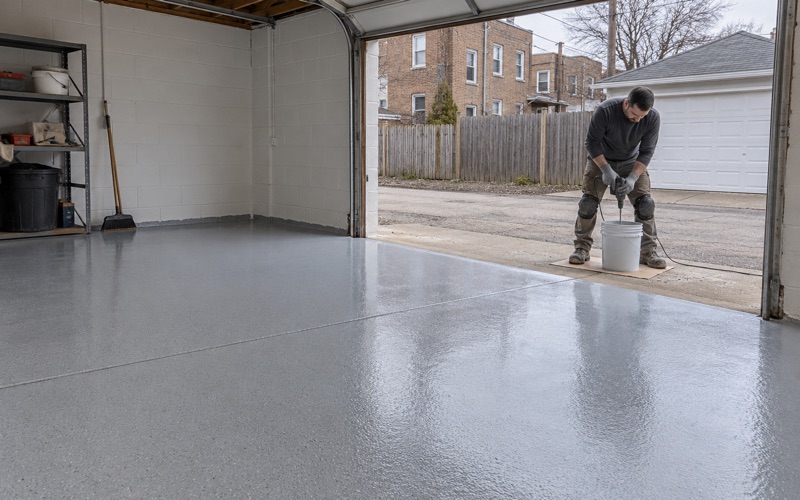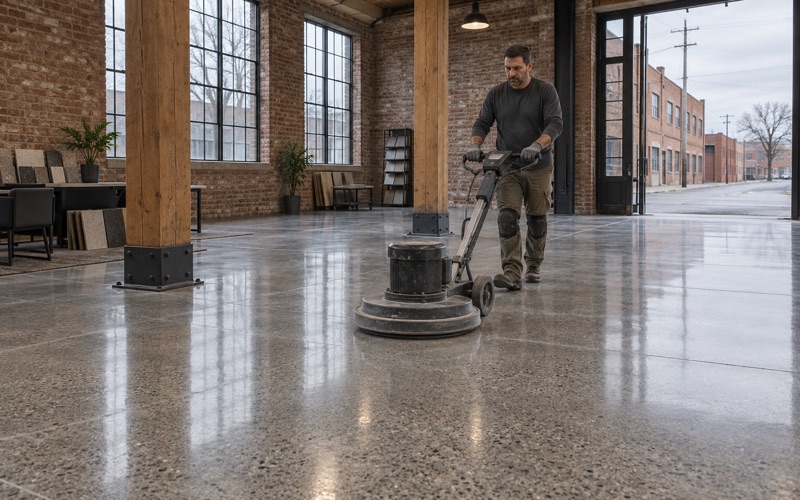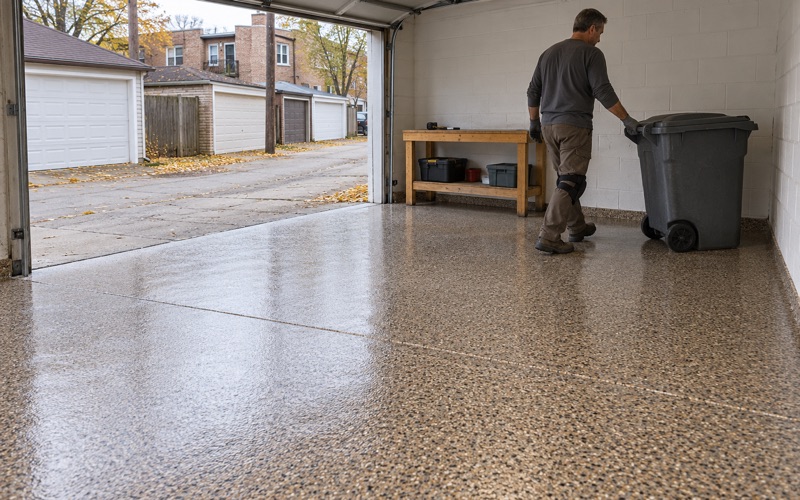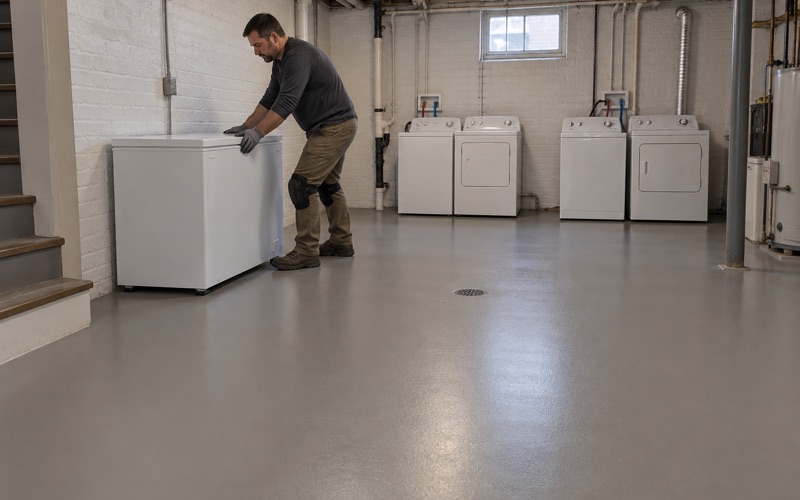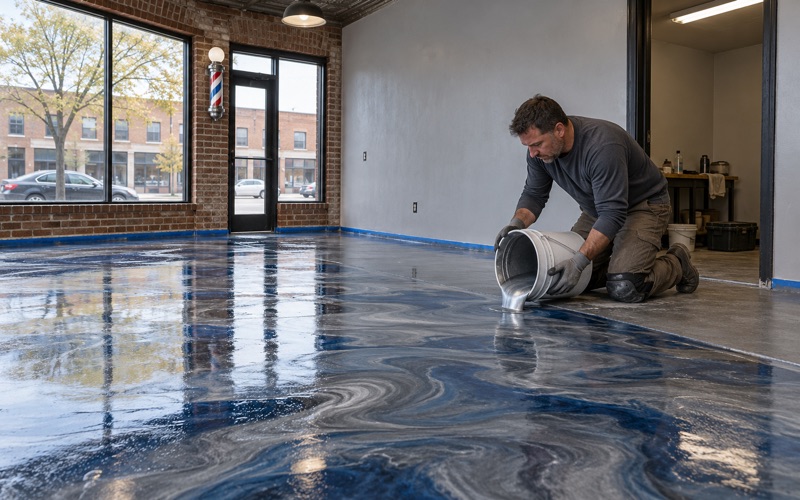
Cicero Epoxy Flooring has spent more than 20 years on epoxy flooring in Bensenville and the surrounding suburbs, and this page focuses on one demanding kind of floor: the work room where glass is shaped with heat. We coat garages and basements here as well, but a glassworking floor asks harder questions of a coating, and the answers decide which system belongs on the slab.
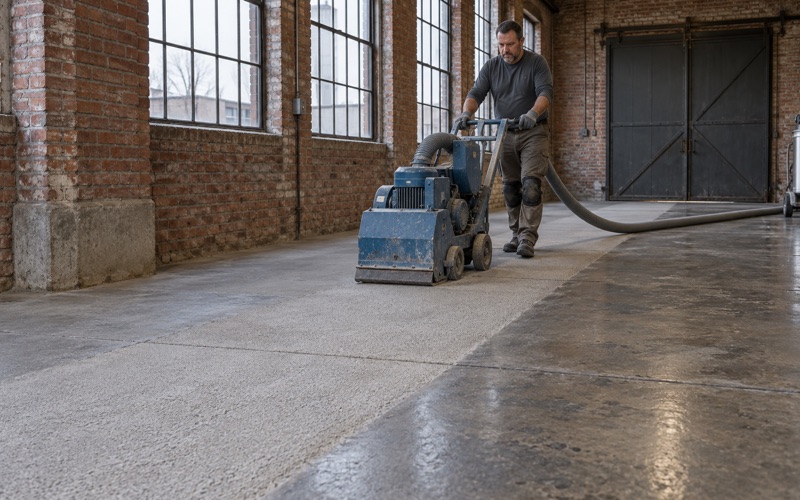
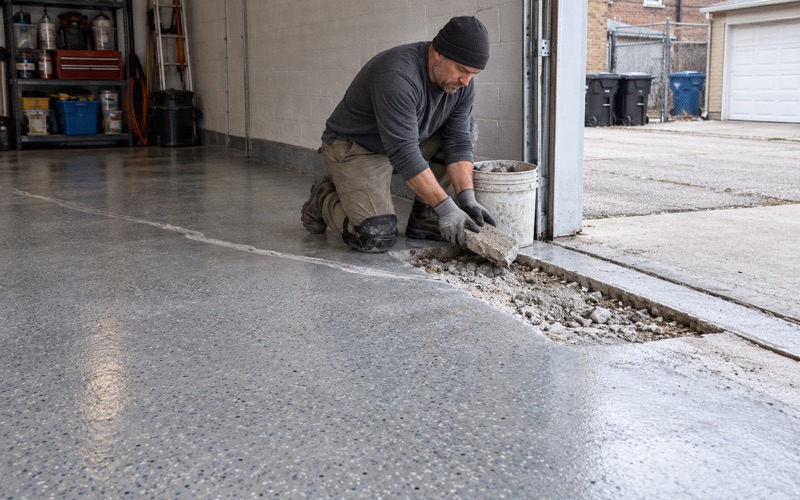
Every job starts the same way. We open the concrete with a diamond grinder or a shot blaster rather than an acid etch, and we map cracks, spalls and old coating before anyone talks about color. If a slab needs repair or replacement before it should be coated, we say so first, because no topcoat fixes a floor that is failing underneath it.
The written proposal then names the product line, the number of coats and the finished thickness, so the floor that goes down can be checked against the quote. That way there is no argument later about what was promised. Industrial and shop floors are phased around shifts, with overnight and weekend windows when a line cannot stop.
A Flashlamp Maker on Gateway Road
Specialty Lighting Made in Bensenville
Bensenville has a specialty lamp maker. Amglo’s xenon lamp division at 215 Gateway Road manufactures high-powered quartz flashlamps, and the company was established in 1935. That address sits inside the village, in Addison Township, DuPage County, and it is the reason this page is written around heat and glass rather than tires and road salt.
The Bensenville division builds the high-power lamps, while low-power commodity xenon lamps and related assemblies come from the company’s Juarez, Mexico facility. The markets it names include laser, medical, machine vision, aircraft, airport runway and warning-light work. Lamps for those uses are precise parts, and the rooms that make that kind of product need floors that do not shed dust or crumble at the edges.
A Village Built Around Industry
Bensenville borders the southwest corner of O’Hare International Airport, is home to more than 1,500 businesses and has one of the largest industrial parks in Illinois. Small manufacturers sit alongside much bigger operations, and a specialty glass shop may share a street with businesses whose floors face very different demands.
That mix is why we do not quote from a template. A lamp or glass shop has heat, grit and clean-assembly needs in one footprint, and the system that suits a parking floor could fall short in different ways in different rooms. We start with a walk-through that marks each zone on a plan before any product is named.
General Practice, Not Inside Knowledge
To be clear about where our knowledge stops: we have not been inside that plant, and nothing on this page describes its floors, equipment or process. What follows is general glassworking practice, the conditions a shop that shapes quartz with flame tends to share. Those conditions are what we plan a coating around when a glass, lamp or lighting shop in Bensenville calls us.
That honesty carries into the scope. Before the job is sold we explain what the coating warranty excludes, and moisture is the first exclusion we name. On an older industrial slab, moisture coming up through the concrete is a common reason a coating lets go, so we test for it before quoting a system.
Looking for epoxy-flooring closer to Palos Heights? See Epoxy-Flooring in Palos Heights.
Heat Near the Lathes and Torches
Quartz lamp making is glassworking. In general practice that means gas-fired lathes and hand torches, quartz tubing heated until it softens, and finished pieces set down to cool. The floor below that work does not see open flame most of the day, but it does see dropped hot glass, radiant heat near the machines and the cleaners used around the benches.
Heat Ratings Belong to Products
No floor coating shrugs off unlimited heat, and we will not sell one as if it does. Heat tolerance is a rating attached to a specific product, stated by its maker, and it varies widely between systems. A standard epoxy can soften and scorch where a hot piece lands, while some urethane cement and novolac-type systems carry higher service temperatures on their data sheets.
So we read the data sheet with you. Near a lathe or torch station we look at the product’s rated service temperature, its resistance to thermal shock and how it handles a hot object resting on it, then match the system to the zone. A heavier urethane cement near the heat and a smoother epoxy elsewhere is a common split.
Cure Times Follow the Slab
Heat also matters during installation. We set cure times by slab temperature and the dew point spread at the slab surface, not by the calendar, and process heat running nearby can shorten a resin’s working time on the floor. That is one reason we schedule a hot-work room for a window when the equipment is off.
Cold matters too. If the room is unheated over a holiday shutdown in January, the slab may sit below the product’s minimum, and we will tell you to wait rather than lay resin that cannot cure properly. Amine blush, a waxy film that forms on some epoxies in cool, damp air, is another reason we watch the numbers.
Shards and Grit: Abrasion a Garage Floor Never Sees
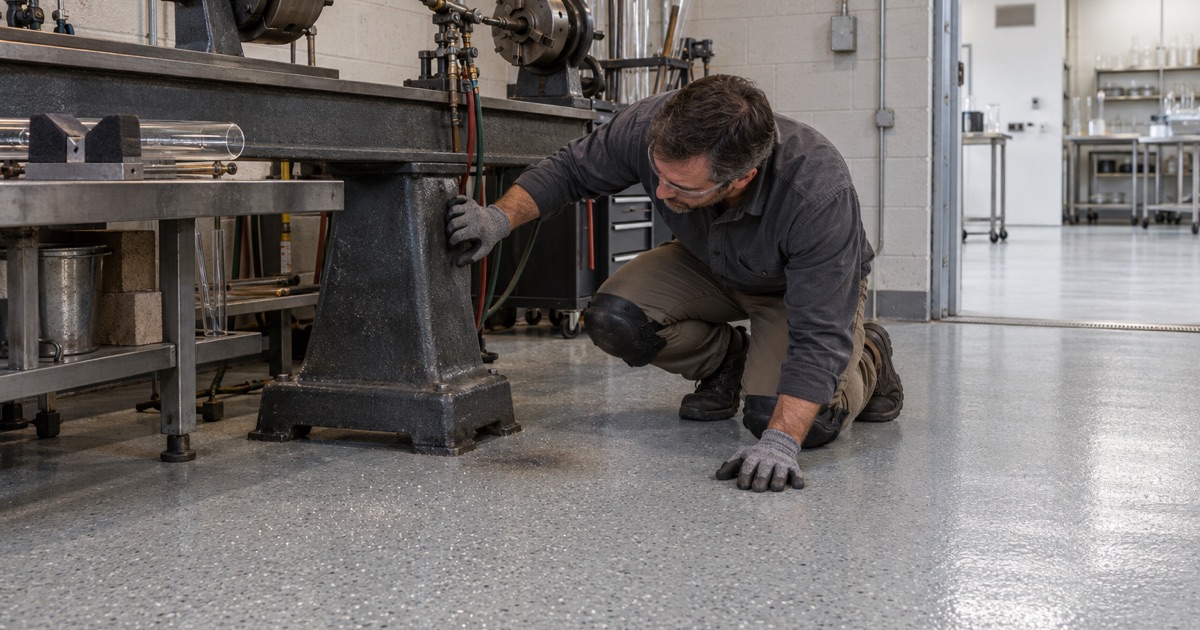
Glass shops make sharp debris. Offcuts, broken tubing and fine quartz fragments end up on the floor, and foot traffic and cart wheels grind them into whatever surface is there. Quartz is harder than most floor coatings, so a shard under a boot heel works like a piece of sandpaper, scratching a soft finish and dulling a glossy one over months.
Building Wear Into the System
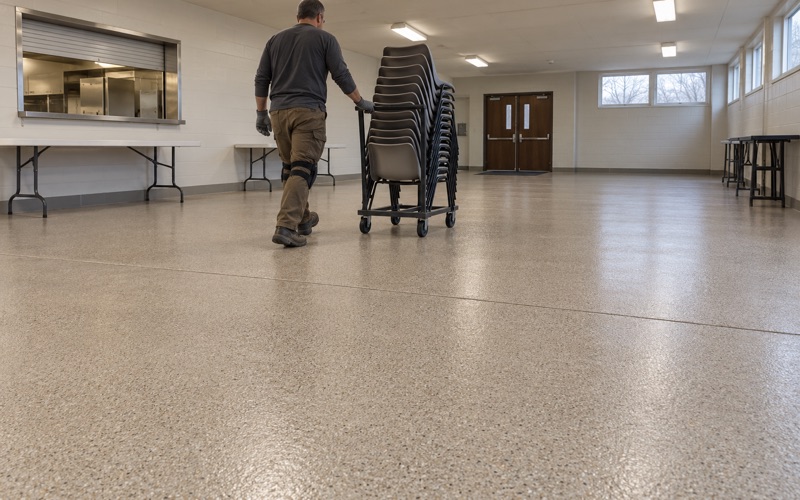
The answer is thickness and hardness in the right layers. A 100% solids epoxy base gives build, and a quartz aggregate broadcast locked in with a hard topcoat puts abrasion-resistant material at the surface where the grinding happens. Polyaspartic and polyurea topcoats hold gloss better under scratching than many standard epoxy finishes and are worth pricing for a glass room.
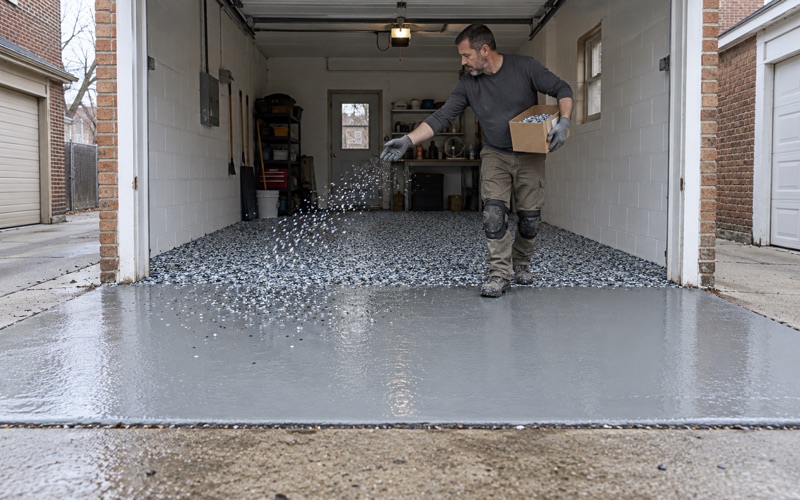
Vinyl flake broadcast, the decorative chip finish common in garages, is a weaker choice here because a thin clear coat over the chips gives grinding glass little to wear through. We would rather see a tighter quartz texture, which also adds grip for anyone carrying fragile parts. Texture level is a trade-off: more grip means more for a mop to work around.
Preparing a Slab That Has Seen Industry
Wear resistance starts below the coating. We profile the concrete by diamond grinding or shot blasting to the ICRI CSP range the product calls for, because a coating bonded to a weak, etched surface tends to chip under impact from dropped parts. Old industrial slabs often carry previous coatings, patches or oil, and each has to come off or be dealt with first.
Grinding dust is captured at the machine with a vacuum rather than rinsed toward a floor drain, which matters in a shop where fine particles are already a concern. The moisture test in the scope uses ASTM F2170 in-situ relative humidity probes or the ASTM F1869 calcium chloride method, so the primer choice rests on a reading rather than a guess.
Cleaning Up Glass Without Wrecking the Finish
Maintenance is part of the abrasion plan. Dry sweeping with a soft broom or using a vacuum lifts glass fragments before they are walked in, while dragging a dust mop across shards can scratch the topcoat the way a boot heel does. We hand over care notes written for the specific topcoat on the floor.
Even a well-built floor dulls in a glass room over time, and that is expected rather than a defect. A worn topcoat can usually be lightly abraded and recoated without grinding back to bare concrete, provided it is still bonded. We inspect for that bond before suggesting a recoat, because new resin over a failing layer only hides the problem for a while.
Clean Assembly Areas, Tougher Floors for Hot Work
A lamp shop is rarely one room. After the glass is formed, lamps are filled, sealed and assembled, and those steps reward a floor that wipes clean and holds no dust in its texture. One building can need two different floors, and we price them as separate zones instead of forcing one system across both.
Smooth, Cleanable Finishes
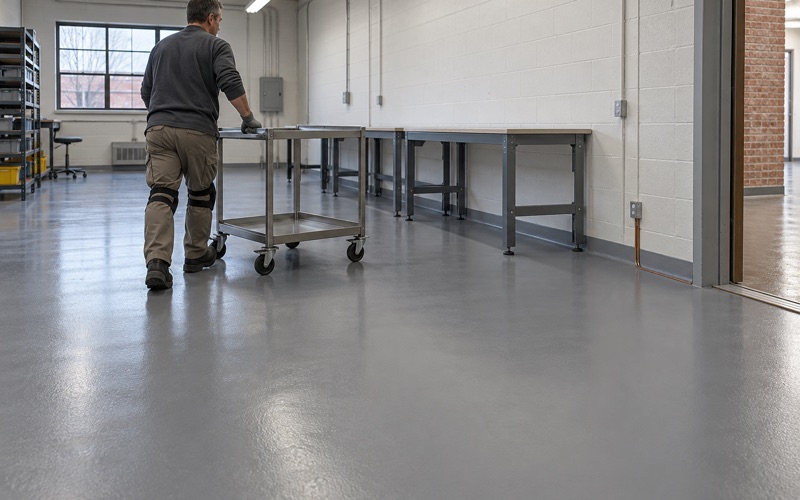
For assembly areas we lean toward a smooth, high-build epoxy with a tight polyaspartic or urethane topcoat and little or no broadcast texture. Coved transitions where the floor meets the wall remove the corner where dust collects. Where static is a concern for electronic components, a static-dissipative or ESD system can be specified to a stated resistance range.
An ESD floor is only as good as its testing, so the proposal names the product, the target range and how it will be measured once cured. Chemical resistance gets the same treatment: tell us what cleaners the room uses, and we check them against the topcoat’s resistance chart before anything is ordered.
Drawing the Line Between Zones
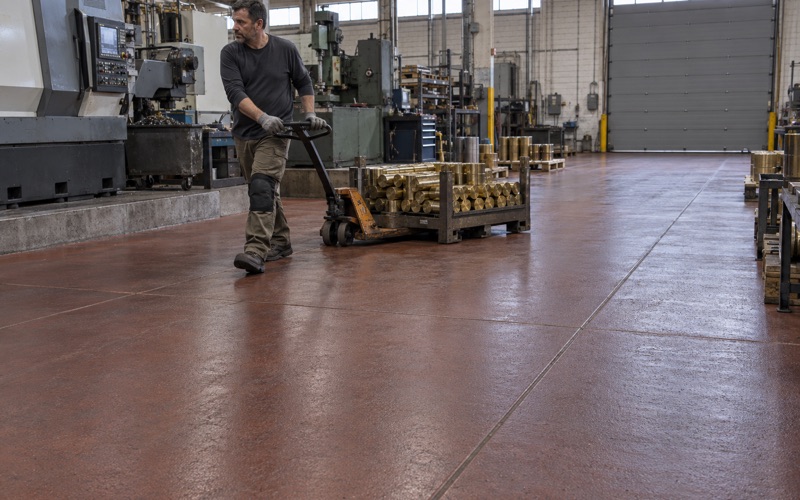
The transition between a hot-work floor and a clean floor is where carts cross and where two systems meet, so we plan it carefully. A saw-cut termination or a flush joint keeps the heavier textured system from lifting at the edge, and a walk-off zone helps keep quartz grit from traveling into the assembly side on shoes and wheels.
Splitting the floor this way also splits the schedule. We can coat the assembly area during one shutdown window and the hot-work area during another, so the shop never loses both at once, and each zone gets the cure time its own product requires before traffic returns. Forklift or cart wheel loads are checked against the system’s rating for each side.
Who Signs Off in Bensenville
Commercial work in the village runs through the Village of Bensenville Community Development office where a permit applies, and the Bensenville Fire Protection District No. 2 conducts annual inspections of non-residential businesses. We check the village’s contractor registration, bond and insurance rules before booking, and we can supply product data sheets if an inspector asks what went down on the floor.
Products are selected inside the Illinois VOC limits for floor and industrial coatings, which apply to the applicator, and that matters indoors, where the air stays inside the building during the cure. Call us with the room’s layout and the heat sources in it, and we will walk the slab, test it and put the zones in writing.
- 20+ Years on Concrete
- Moisture Tested Before Pricing
- Written Coat-by-Coat Proposals