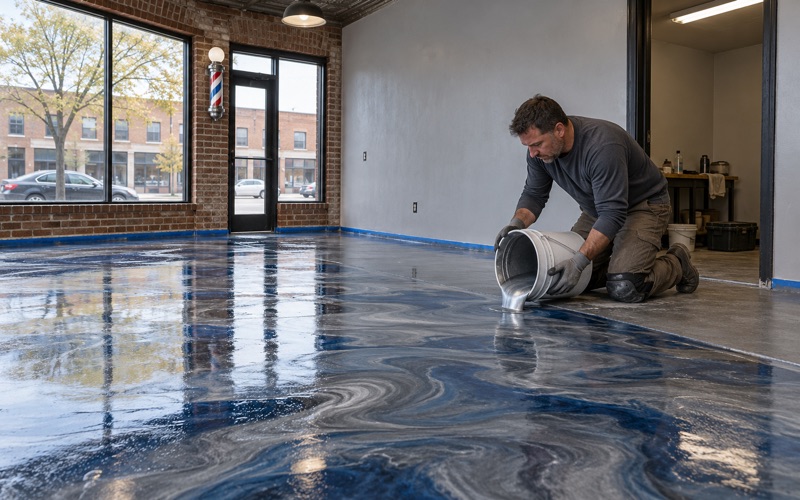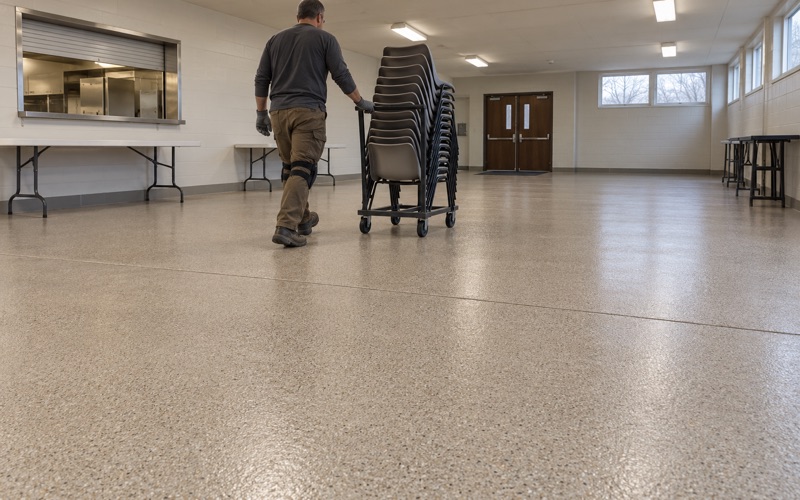
Cicero Epoxy Flooring brings more than 20 years of epoxy flooring in Bellwood and across Cook County to one plain starting question: what lands on this floor? A slab that only sees foot traffic and a mop wants a different system than one that takes dropped plates, rolling carts and lifting tests from open to close.
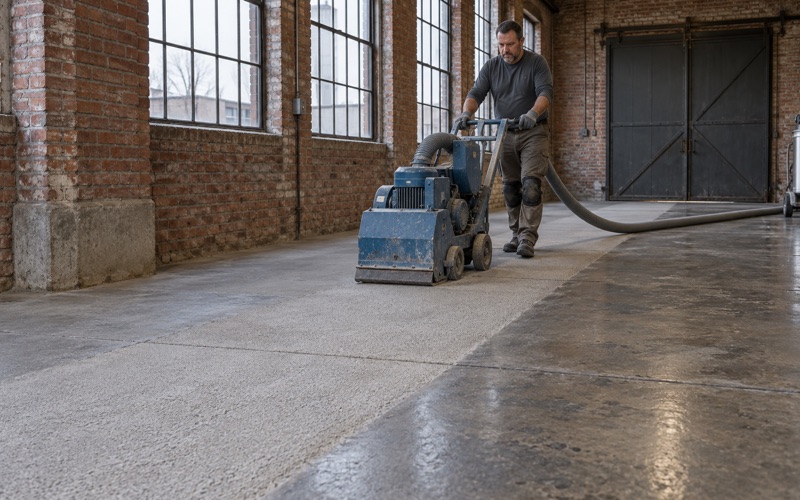
Every job starts the same way, with the slab opened by a diamond grinder or a shot blaster rather than an acid etch, and a moisture test written into the scope before the price is settled. Our proposal then names the product line, the coat count and the finished thickness, so you can hold the installed floor up against the paper.
This page is about one kind of floor that rarely gets its own conversation: the work-injury rehab gym and the clinical rooms beside it. The same thinking carries down into a home gym in a basement, which is where most Bellwood residents will meet it. Both get zoned by load, not by looks.
A Work-Injury Clinic on Harrison Street
What Concentra’s Listing Describes
Bellwood has an occupational-medicine clinic of exactly this type. Concentra, at 2615 West Harrison Street, is a walk-in center open Monday through Friday from 8:00 a.m. to 5:00 p.m., and its listing names workers’ compensation injury treatment, physical therapy, DOT physicals and regulated DOT drug screening. It describes multiple exam rooms and a generous physical therapy space.
We have not worked on that building and have not seen its floors, so nothing here describes them. We use it because it shows, in one building, the two floor types that most clinics of this kind put side by side: a therapy area built for movement and rooms built for exams and specimen collection.
Therapy for Work Injuries Means Real Loads
Physical therapy after a work injury is not a quiet stretching room. Patients rebuild the strength their job demands, which means lifting, carrying, pushing and pulling under supervision, often with free weights, kettlebells and weighted sleds. The floor under that work is closer to a training gym than to a medical office, and it should be specified that way.
A common mistake in clinical build-outs is one coating chosen for the whole suite because it looks clean in the exam rooms. A thin decorative system that performs well under a mop can chip and dent where a kettlebell is set down hard a few hundred times a week. The fix is planning the zones before anyone picks a color.
Paperwork Before Work Starts in Bellwood
Illinois issues no state license for floor coating work, so before any job in Bellwood is booked we check the Village of Bellwood’s own contractor registration, bond and insurance requirements. Permit questions on a commercial build-out go to the Village of Bellwood Building Department, which reports the 2006 International Building Code as its adopted edition.
Bellwood sits in Proviso Township, Cook County, but for a floor inside a Bellwood building the village is where the local requirements start. A specification copied from a neighboring town on a newer code edition does not transfer automatically, so we read the job carefully against what Bellwood has actually adopted rather than assuming it.
Looking for epoxy-flooring closer to River Grove? See River Grove Epoxy-Flooring.
Rehab Gym Floors Take Impact and Rolling Loads
A gym floor is specified by its worst day, not its average one. In a work-injury rehab setting that worst day is a mix of three loads, and each one asks something different of the slab and the finish above it. Treating them as one load is how a floor fails early.
Dropped Weights and Point Impact
A dropped dumbbell or kettlebell puts its whole weight on a corner or an edge a fraction of an inch wide. A resinous film bonded to concrete has nothing to cushion that blow, so repeated drops in the same spot will eventually crack the coating or spall the concrete beneath it, however good the system is.
That is why heavy-drop areas in any gym normally carry a resilient rubber mat, and we say so in the proposal rather than letting a coating be sold as the answer. What the coating does underneath is protect the slab, seal it against spills and make the area around the mats far easier to clean.
Treadmills, Carts and Wheeled Equipment
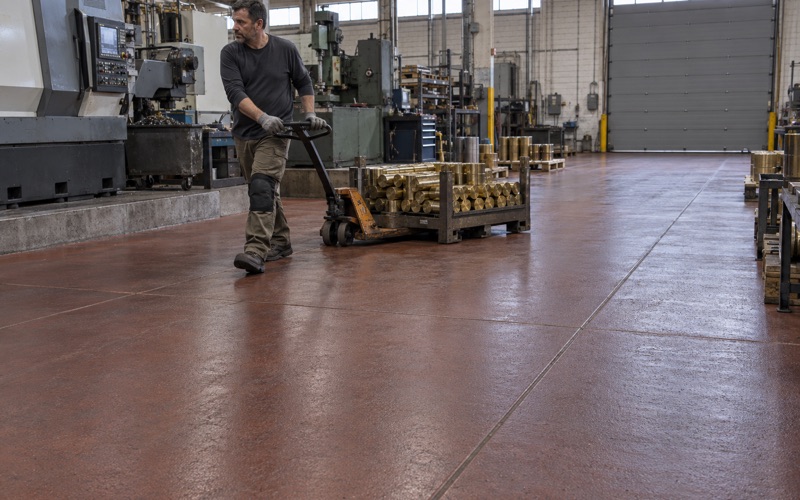
Rolling loads behave differently from drops. A treadmill sits on small feet that carry the machine and the runner, a wheeled cart or rack crosses the same path dozens of times a day, and a hard wheel grinding grit into the surface wears a lane into a soft finish long before the rest of the floor shows age.
For those paths we lean toward a 100% solids epoxy body coat at a real build, not a thin roll-on, finished with a polyaspartic or urethane topcoat chosen for abrasion. A quartz aggregate broadcast adds grip that holds up under traffic better than a decorative flake, and the finished thickness goes in writing so it can be checked.
Lift-and-Carry Testing and Sled Work
Functional testing for a return to work often asks a patient to lift a loaded box from the floor, carry it a set distance and set it back down. That repeats a moderate drop and a scuffing slide on one strip of floor, and sled pushes add a dragging load that scours whatever finish is under the runners.
A sled lane is usually best as dedicated turf or rubber laid over a coated slab, and a testing strip benefits from a mat or a heavier broadcast system. We mark and dimension those strips on the floor plan with the owner before grinding, because moving them later means cutting into or reworking a finished floor.
Mat, Coating or Both: Zoning a Therapy Floor
Where the Gym Ends and the Clinic Begins
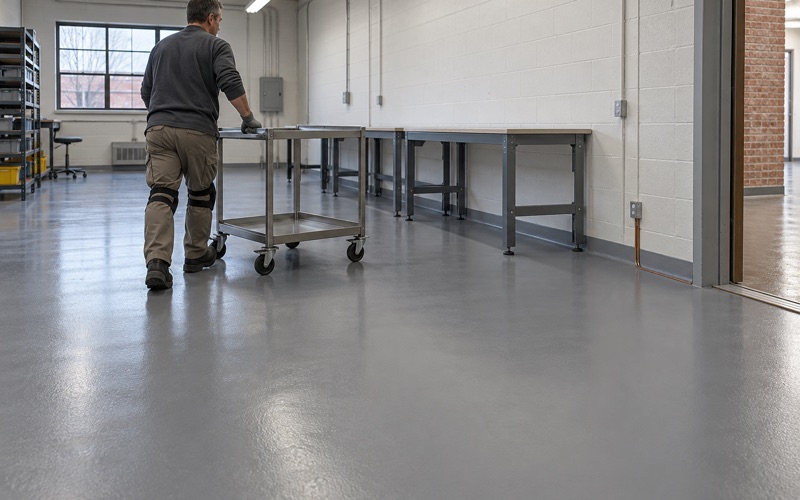
Zoning the gym apart from the exam rooms is the core of the job. The heavy-drop area gets a coated slab under resilient mats, the rolling and walking paths get a thicker broadcast system on its own, and the clinical rooms get a smooth, seamless finish built for constant cleaning. Each zone is priced and specified separately.
The transitions matter as much as the zones. Where a mat edge meets a coated floor, the joint should sit flush or be beveled so a cart wheel or a patient’s foot does not catch, and where two coating systems meet, the line is saw-cut or ground and terminated cleanly rather than feathered out to nothing.
Why the Slab Under the Mats Still Matters
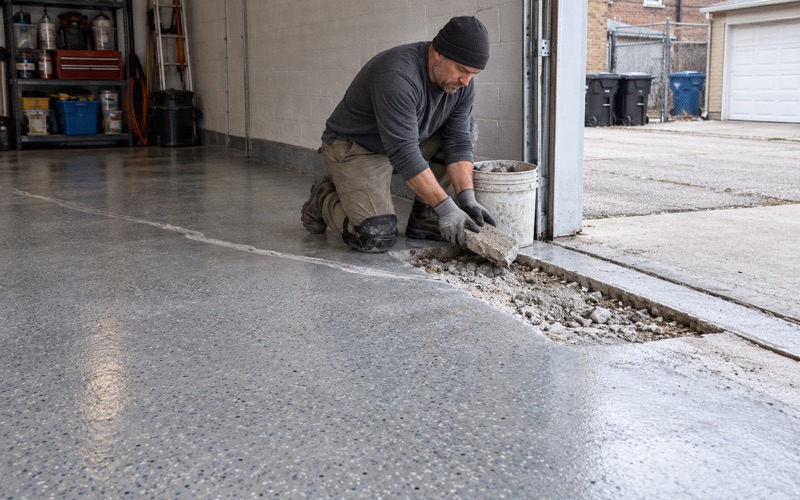
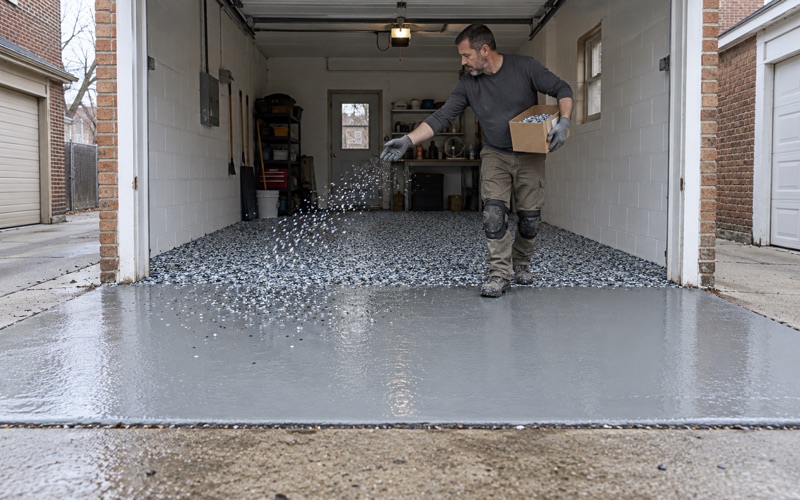
A mat hides the floor, which is why the slab under it gets the same preparation as everywhere else. We bring it to a measured ICRI concrete surface profile with diamond grinding or shot blasting, and we map cracks, spalls and old coatings first, so you hear about a slab that needs repair before anything is applied.
Moisture is the other hidden risk. Rubber over concrete traps vapor, and a coating on a damp slab can blister under a mat where nobody sees it until it fails, so an ASTM F2170 relative humidity probe or an ASTM F1869 calcium chloride test is part of the scope, not an extra. Moisture is also the first exclusion we name when we explain the warranty.
Scheduling Work Around a Clinic Week
A clinic that sees walk-in patients on weekdays cannot hand its floor over for a week. We phase commercial work around operating hours, using evenings and weekends where a zone can be closed off, and we set cure times by slab temperature and dew point rather than by the calendar. Fast-curing polyaspartic topcoats help when a room must reopen the next morning.
Dust control matters just as much in an occupied building. Grinding runs with the vacuum attached at the machine, so the dust is collected at the head instead of being swept or rinsed toward a drain, and the work zone is sealed off from rooms that stay open to patients. Products are selected inside the Illinois VOC limits for floor and industrial coatings, which apply to us as the applicator.
Exam Rooms, Collection Rooms and the Home Gym
Exam Rooms That Are Mopped All Day
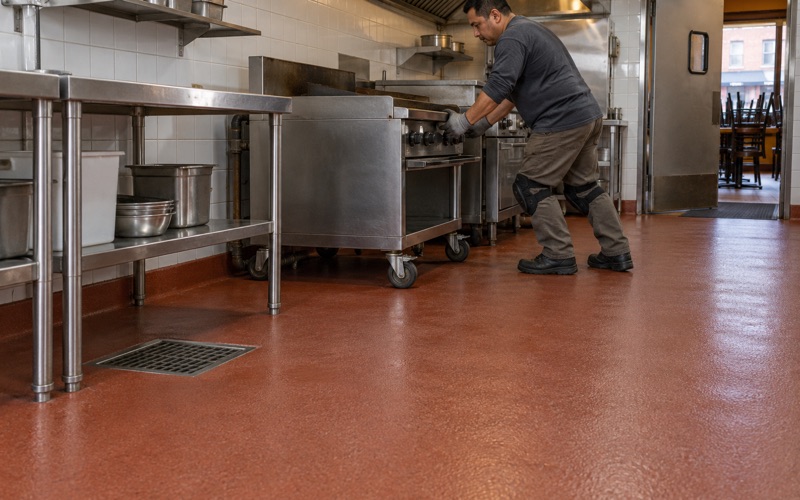
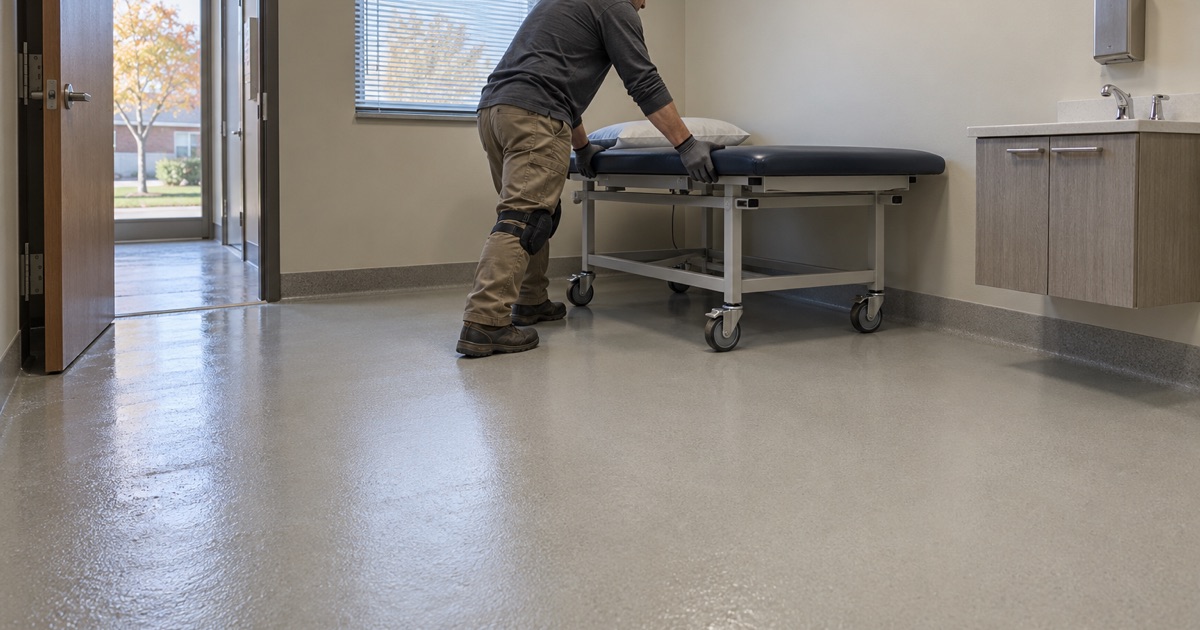
The exam rooms next to a therapy gym have the opposite problem. Nothing heavy lands there, but the floor is wet-mopped and wiped down repeatedly every day, so it is judged at the seams, the joints and the wall base, where water and cleaning solution find their way under a poorly terminated edge or into an open crack.
For these rooms we favor a smooth, seamless resinous floor carried a few inches up the wall as an integral cove base, with joints filled flush. A light texture in the topcoat gives some grip when the floor is wet without making it hard to mop clean. Slip resistance and cleanability pull against each other, so the texture is sampled before the room is coated.
Drug-Screen Collection Rooms
Clinics that run DOT physicals and regulated drug screening also keep collection rooms and restrooms, which are among the most heavily cleaned floors in any building. We specify them on cleanability and durability: seamless, coved at the wall and sealed tight around every toilet flange and pipe penetration, so water has no seam to follow into the slab.
The restroom side of a collection area sees spills and standing water around fixtures, not only the water from cleaning. Every crack and spall there is repaired before coating, because a floor mopped that often pushes water into any defect left open, and a failure there tends to start at the edges and the base.
The Same Logic for a Bellwood Basement Gym
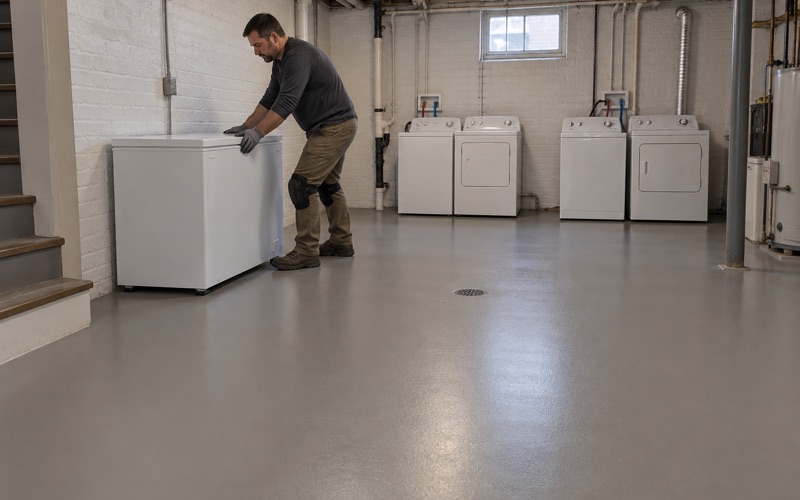
The same zoning works at home. Many Bellwood houses date from the 1950s, and a basement in one of them is a natural place for a rack, a bench and a treadmill. Put rubber stall mats where the bar and dumbbells come down, and coat the rest of the slab so the walkway, the treadmill pad and the laundry corner all clean easily.
Before we pick a system we check an older basement floor for paint, patching compound and old adhesive, and we say plainly that a coating will not stop water coming up a floor drain. Home jobs over the state threshold get a written contract and the Home Repair: Know Your Consumer Rights pamphlet before grinding starts.
- 20+ Years on Concrete
- Moisture Tested Before Pricing
- Written Coat-by-Coat Proposals