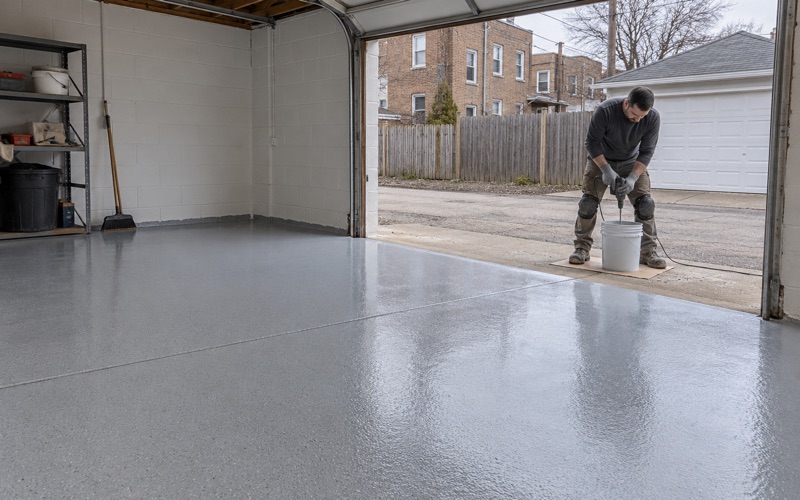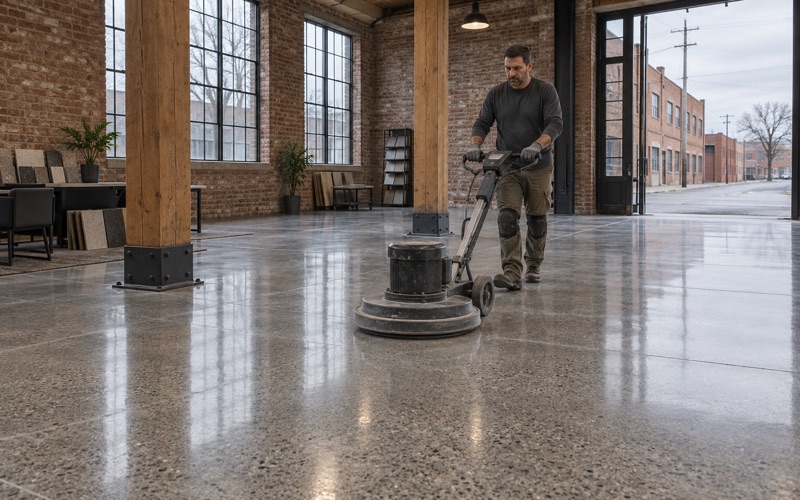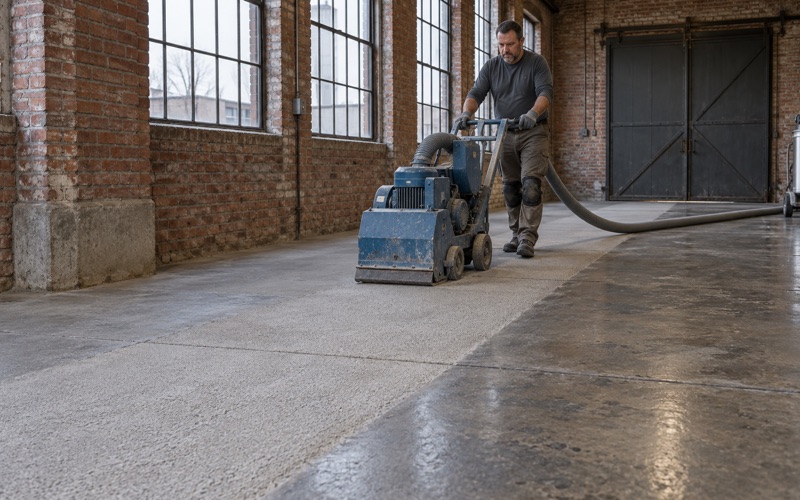
Cicero Epoxy Flooring installs epoxy flooring in Alsip for food plants, warehouses, shops and the garages and basements of homes built decades ago, drawing on more than 20 years in the trade. Every floor starts the same way: we open the slab with a diamond grinder or a shot blaster, because an acid etch leaves a coating nothing reliable to hold.
Before a price is final, a moisture test goes into the written scope, whether the slab sits under a production line or a family car. The proposal then names the product line, the number of coats and the finished thickness, so the floor that goes down can be checked against the paper that sold it.
Commercial work is phased around shifts, with overnight and weekend windows when a line cannot stop. On a food floor that matters more than anywhere else, because the plant’s quality staff decide when a room can come out of service and what has to happen before it goes back in. We plan the coating schedule around their rules, not ours.
A Bread and Pretzel Plant on 128th Place
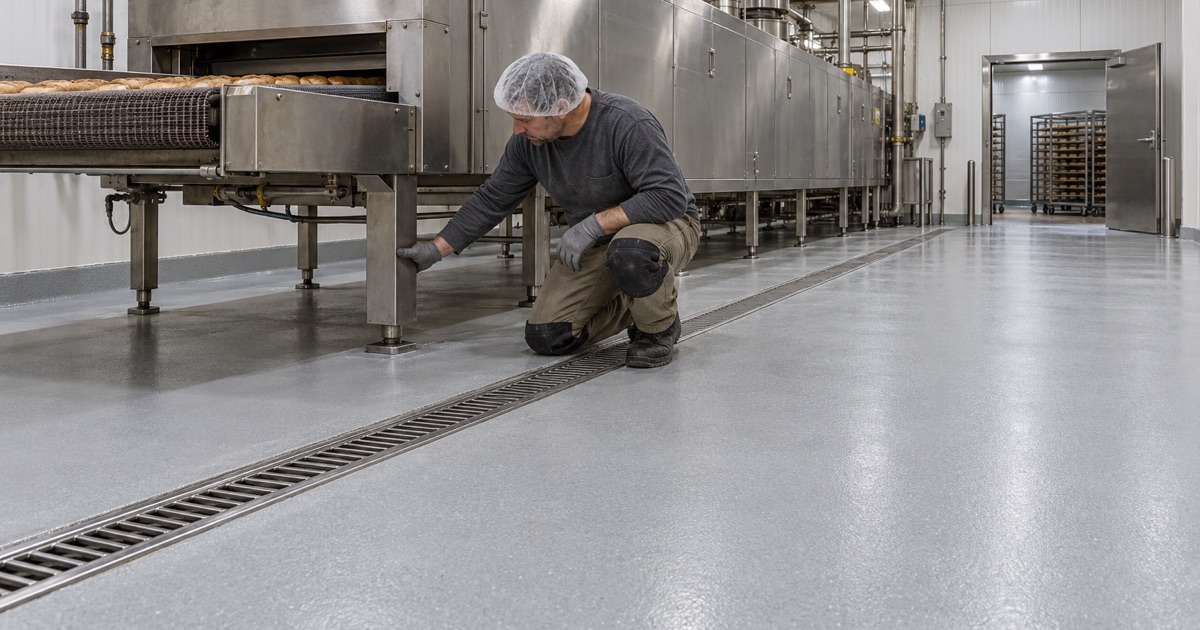
Alsip is a south suburban village in Cook County, counted at 19,063 people in the 2020 census, with I-294 and the Calumet Sag Channel both passing through it. It is described as about 60% residential and 40% commercial or industrial, and one plant on that industrial side shows better than any brochure what a food floor has to survive.
Labriola Baking at 3701 W. 128th Place
Labriola Baking, a bread and artisan soft pretzel maker that began in 1993 as a local delivery bakery, moved in 2010 into a 175,000-square-foot plant at 3701 W. 128th Place. J&J Snack Foods acquired the company. A 2013 trade article described six production lines and more than 100,000 pounds of dough a day. Its pretzel line also ran through a lye bath before baking.
We have no connection to that plant and have never worked inside it. We use it because the equipment list in that article is a clean map of the stresses a bakery floor meets, and because smaller food producers deal with the same physics on a different scale. Nothing here describes the floors it has today.
What the Audit Calendar Means for a Floor
The same article reported the plant as BRC certified, audited annually by AIB International and run under a HACCP plan. None of those programs names a floor product. What they do is hold a plant to sanitation expectations that a cracked, porous or peeling floor makes harder to meet.
For a plant running under that kind of calendar, floor work has to be planned like any other change to the building. We write the scope so the quality team can see each product, its cure time and its odor window before they approve a shutdown, and we schedule around their audit dates rather than into them.
Looking for epoxy-flooring closer to Bensenville? See Bensenville Epoxy-Flooring.
From a 390-Degree Oven to a Minus-150 Freezer
The article listed two thermal-oil tunnel ovens, thermal-oil deck ovens, at least eight rack ovens, a rotary carousel oven and a further tunnel oven. Pretzel rolls baked at about 390 degrees for 15 to 17 minutes. Downstream, two nitrogen blast tunnel freezers took product to minus 150 degrees in ten minutes. That is a spread of more than 500 degrees under one roof.
Heat Near the Ovens
The floor in front of an oven is not baked at 390 degrees, but it takes radiant heat for hours, hot pans set down in a hurry, and spills of hot oil, sugar and fat. Standard epoxy softens as its temperature climbs, and a soft floor scuffs, stains and holds soil in the marks.
Around ovens we usually point owners toward urethane cement, which tolerates heat and thermal cycling far better than a thin film, and which can be installed in thicknesses that ride out hot spills. Where a decorative or lighter-duty finish is wanted farther from the heat, 100% solids epoxy still has a place, and the proposal says which goes where.
Cold at the Blast Freezer
A blast freezer pulls the slab cold, and every door cycle drags warm, damp air across it. Frost and condensation form at the threshold, and a coating that performed well on day one can turn brittle and begin to disbond where the cold and warm zones meet.
That transition line is where we spend the most planning. Freezer slabs often need a system rated for low service temperatures, a wider expansion detail at the door, and a cure plan that accounts for how long a room takes to come back to temperature. A freezer that cannot be shut down at all is a different conversation, and we say so early.
Hot Wash-Down, Steam and a Round-the-Clock Schedule
Bakeries clean with hot water, and often with a lot of it. When near-boiling rinse water hits a slab that was chilled by a freezer or a cold dock, the coating and the concrete expand at different rates. That mismatch is thermal shock, and it is a common reason a thin coating cracks and lifts in a food plant.
Why Hot Wash-Down Cracks the Wrong Floor
A thin epoxy film bonded to concrete behaves like a skin stretched over a moving surface. Each hot rinse makes it fight the slab beneath it, and after enough cycles the bond lets go at the weakest point, often along a saw cut or an old crack. Water then gets under the film and the damage spreads.
Urethane cement systems have a thermal expansion closer to concrete, which is why they are a common choice in wash-down rooms. We still map every crack, spall and patch of old coating first, because no system holds over a slab that is failing underneath. When a section needs repair or replacement before it is coated, the proposal says that plainly.
Proofing Rooms and Floor Slope
The article described walk-in proofing boxes, and proofing rooms are warm and humid by design. Condensation runs down walls and gathers at the floor line, flour mixes with that moisture into a paste, and dough scraps end up underfoot. A floor there needs a texture that grips under wet flour yet still releases soil under a scrub.
We set the broadcast of quartz aggregate to the room, finer where crews scrub and coarser where they stand in wet product. Coved floor-to-wall junctures, which the FDA Food Code describes in 6-201.13, keep paste out of the corner where a mop cannot reach. Slope to drains is checked before coating, since a coating follows the slab and will not fix ponding.
Scheduling Floor Work in a 24-Hour Bakery
A bakery that runs around the clock, as the 128th Place plant was described, has no quiet night for a contractor to borrow. Floor work in a plant like that happens in planned shutdowns, one zone at a time, with the rest of the plant still producing on the other side of a temporary wall.
We break a plant into zones that match its own sanitation boundaries, so a coated room can be cleaned and released without dragging dust into a live one. Grinding dust is vacuumed at the machine, never rinsed toward a drain. Each window is booked with the plant’s own staff, who decide when product can move again.
Fast-return systems help here. Polyaspartic and polyurea topcoats and some urethane cement products can take foot traffic within hours, which shortens a shutdown. Odor matters too in a building full of open food, so product choice and ventilation are agreed with quality staff in advance. Every product we use sits inside the Illinois VOC limits for floor and industrial coatings, limits that apply to whoever puts the coating down.
Garages, Basements and Village Rules in Alsip
Most of Alsip’s housing went up between the 1950s and the 1990s, with 2,211 units built in the 1970s alone, and only 15 units have been added since 2010. That makes a residential floor here usually a retrofit over a slab roughly 25 to 65 years old.
Garages in Alsip’s 1970s Houses
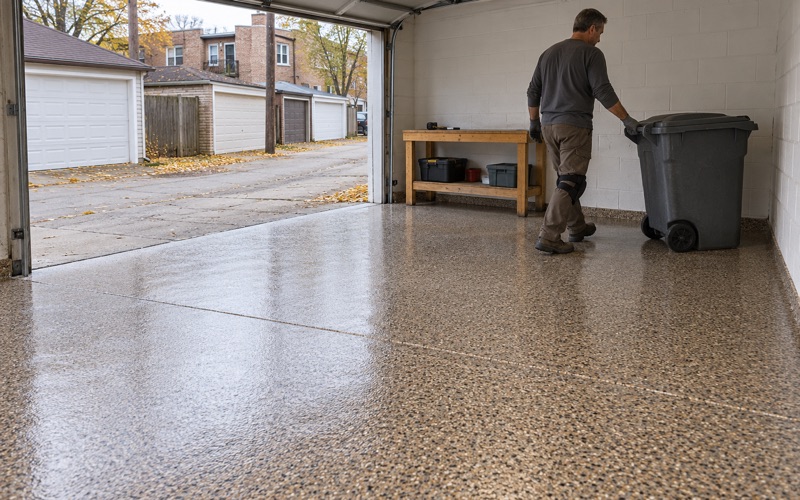
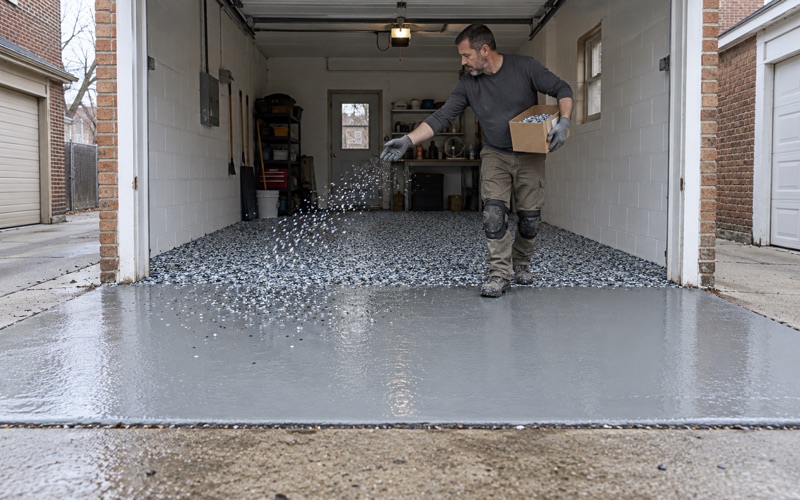
An older garage slab often carries oil stains, earlier sealers and years of rock salt and brine dragged in on tires. We grind through all of it to sound concrete, test for moisture, and choose a system that resists hot tire pickup and the deicers that arrive every winter. A vinyl flake broadcast under a polyaspartic topcoat is a common result.
Cure times follow slab temperature and the dew point spread at the surface, not a date on the calendar. An unheated garage in January is told to wait for warmer conditions, because a coating laid over a cold, damp slab can blush, stay soft or lose its bond.
Basements and Older Slabs
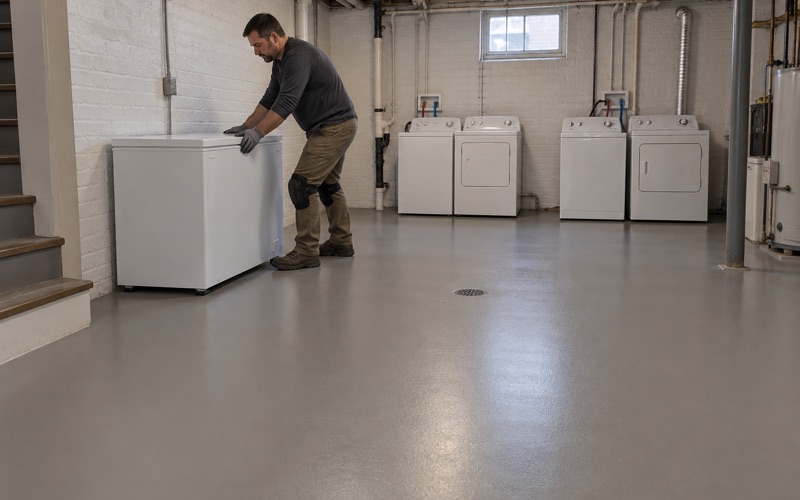
Basement floors in older houses often hide paint, patching compound or old tile adhesive, and each one changes which system will bond. We check for all three before choosing a product. Moisture is measured with ASTM F2170 in-situ relative humidity probes or an ASTM F1869 calcium chloride test, and the result decides whether a moisture-mitigation primer goes down first.
We also explain warranty exclusions before a job is sold, and moisture is the first one we name. A coating will not stop water backing up through a floor drain, so we point owners to the drain and backflow question first, and we never sell a floor coating as radon reduction, which in Illinois is licensed mitigation work.
Who Signs Off in Alsip
Illinois licenses no general, flooring or coatings contractor, so local rules carry the weight. The Village of Alsip Building Department works from a building code adopted in 2007 on an IBC basis. We check the village’s own contractor registration, bond and insurance requirements before a job is booked. Home jobs above the state threshold also get a written contract and the Home Repair: Know Your Consumer Rights pamphlet before grinding starts.
Food manufacturing plants are generally regulated at the state and federal level, not by the village. For a smaller food-service floor, the picture is less settled: the village lists its own Health Department, while its hazard-mitigation annex places public health under the Cook County Board of Health. We ask the village which body reviews the room before work begins.
- 20+ Years on Concrete
- Moisture Tested Before Pricing
- Written Coat-by-Coat Proposals